

When a rheumatologist prescribes Humira instead of a biosimilar, or an oncologist insists on Ocrevus despite lower-cost alternatives, it’s not just about patient preference-it’s a system built on complexity, scarcity, and financial incentives. Specialty drugs aren’t your typical pills. They’re high-cost, high-complexity treatments for rare or chronic conditions like multiple sclerosis, rheumatoid arthritis, and cancer. And even though they make up less than 7% of all prescriptions, they account for more than 71% of total prescription drug spending in the U.S.
What Makes a Drug ‘Specialty’?
A specialty drug isn’t defined by how it works, but by how it’s handled. The Centers for Medicare & Medicaid Services (CMS) sets the baseline: any drug costing more than $670 per month qualifies. But in reality, many cost far more-over $100,000 a year per patient. These aren’t oral tablets you pick up at your corner pharmacy. Most require injections, infusions, or special storage. Some need refrigeration. Others need trained nurses to administer them. And almost all require ongoing monitoring for side effects.
Take Jakafi for myelofibrosis or Ofev for pulmonary fibrosis. These aren’t drugs you can swap out like you would with ibuprofen and generic naproxen. There’s often only one or two options that work for a specific genetic profile or disease subtype. When a patient has a rare mutation, the difference between a brand and a biosimilar isn’t just cost-it’s survival.
Why Specialists Stick With Brand Names
It’s not that specialists don’t know about generics or biosimilars. They do. But here’s what they see in practice:
- Limited alternatives: For many rare diseases, there are no approved generics. Even biosimilars-drugs designed to mimic biologics-are not always considered interchangeable. A 2024 study in the Journal of Managed Care & Specialty Pharmacy found that 63% of rheumatologists believed biosimilars weren’t clinically equivalent for their most complex patients.
- Unpredictable outcomes: Switching from a brand-name drug to a biosimilar can lead to unpredictable immune responses. In multiple sclerosis, a single flare-up can mean months of disability. Specialists aren’t willing to gamble with a patient’s quality of life.
- Prior authorization nightmares: Even when a generic is available, insurers often block it. One oncologist in Texas told a Medscape survey respondent: ‘I spent 90 minutes on the phone last week just to get approval for a drug my patient has been on for five years. The insurer wanted me to prove why the biosimilar wouldn’t work-when the patient’s insurance didn’t cover it in the first place.’
- Real-world data gaps: Biosimilars are approved based on clinical trials, but those trials rarely include patients with multiple comorbidities or rare disease subtypes. Real-world evidence is still catching up. Specialists trust what’s worked for their patients for years.
The Financial Engine Behind the Preference
There’s another layer no one talks about openly: money. The pharmacy benefit managers (PBMs)-Caremark, Express Scripts, OptumRx-control the distribution of specialty drugs. Between 2017 and 2022, these three companies made over $7.3 billion in revenue by marking up the price of specialty drugs far beyond what they paid to manufacturers.
Here’s how it works: A PBM might pay $5,000 for a vial of a specialty drug, then charge the insurer $15,000. The difference? That’s their profit. And they make even more on generics. The Federal Trade Commission’s 2025 report found that PBMs marked up specialty generic drugs by thousands of percent-sometimes charging $12,000 for a drug that cost $800 to acquire.
Doctors don’t get kickbacks for prescribing brand names anymore-at least not openly. But the system still rewards them indirectly. When a specialist chooses a drug that’s covered under a PBM’s preferred network, the patient’s copay is lower. If they choose a non-preferred drug, the patient might pay $1,000 out of pocket. So the specialist picks the brand-not because they want to, but because the patient can’t afford the alternative.

What Patients Are Really Saying
On Reddit’s r/healthinsurance, users describe a system that feels rigged. One user, u/ChronicWarrior42, wrote: ‘I pay $1,200 a month for Ocrevus. My insurance covers 80%, but my deductible is $7,000. My specialist says there’s no other drug that works for my mutation. So I pay. Or I don’t take it.’
Medicare patients aren’t better off. A 2024 post on the Medicare Rights Center forum said: ‘My Humira copay jumped from $50 to $850 when my plan changed. My rheumatologist said biosimilars aren’t right for me. But I can’t afford $10,000 a year out of pocket.’
These aren’t outliers. They’re the norm. Less than 2% of Americans use specialty drugs. But they account for over half of all pharmacy spending. That’s a $38,000 annual cost per patient-75 times higher than non-specialty drugs.
The Prescriber’s Dilemma
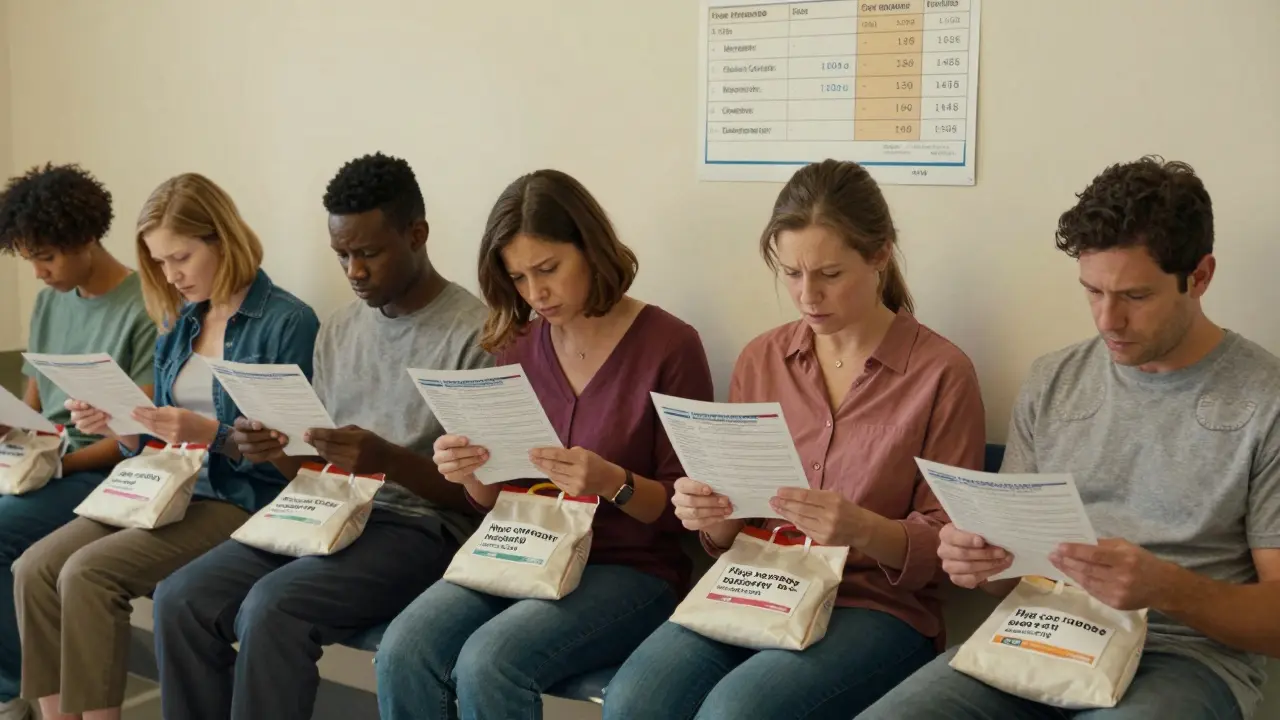
Specialists aren’t profit-driven. Most are deeply frustrated. A 2023 Medscape survey of 1,200 specialists found that 68% spent more than 10 hours a week on prior authorizations-78% of that time was on specialty drugs. Oncologists averaged 13 hours. Rheumatologists, 12.
They’re caught between two impossible choices: prescribe the drug that works, or the one the insurer will cover. Many end up writing lengthy appeals, attaching lab results, and even calling insurance case managers personally. Some give up and just write the brand name-knowing the patient will eventually get it, after weeks of delay.
And when they do switch a patient to a biosimilar? Some report worse outcomes. One hematologist in Ohio shared: ‘I switched two patients to a biosimilar last year. One had a severe reaction. The other’s disease came back within three months. I won’t do it again unless the data says it’s safe.’
Is There a Way Forward?
Change is coming-but slowly. The Inflation Reduction Act of 2022 lets Medicare negotiate prices for some high-cost drugs. Starting in 2026, drugs like Jakafi and Xtandi could be affected. That might bring down prices. But it won’t fix the underlying problem: too few alternatives.
More transparency is also on the table. The Centers for Medicare & Medicaid Services proposed new rules in March 2025 requiring PBMs to disclose their true acquisition costs. If enacted, it could cut billions in hidden markups.
But until there are more proven alternatives-and until insurers stop making patients pay the price for administrative chaos-specialists will keep prescribing what works. Not because they love brand names. But because they’ve seen what happens when they don’t.
What Patients Can Do
- Ask your specialist: ‘Is there a biosimilar or generic that’s been proven safe for my condition?’
- Request a copy of your insurer’s formulary. Know which drugs are preferred.
- Check patient assistance programs. NORD helped 45,000 people in 2023 get specialty drugs for free or at low cost.
- Document everything. If your drug is denied, keep records of your doctor’s notes, lab results, and denial letters.
There’s no easy fix. But awareness is the first step. The system is broken-not because doctors are greedy, but because the rules were written for a different time. And until those rules change, specialists will keep doing what they’ve always done: choosing the drug that saves lives, even if it costs a fortune.




Comments
Prachi Chauhan
10/Jan/2026It's not about greed. It's about survival. I've seen patients go from walking to bedridden because a biosimilar 'worked' in a trial but not in their body. The system pretends science is clean and simple. It's not. Biology is messy. And we're gambling with lives when we swap drugs like trading cards.
Specialists aren't rich because of this. They're exhausted. They spend hours fighting insurers while patients cry in their offices. The real villain isn't the doctor-it's the middlemen who profit from confusion.
Katherine Carlock
10/Jan/2026I’m a nurse in oncology and I see this every day. One lady had to sell her car to afford her meds. Her doctor cried with her when he couldn’t help. We’re not talking about luxury here. We’re talking about someone’s ability to see their kid graduate.
And yeah, PBMs are the real monsters. They’re not even in the same country as the patient. They’re in a boardroom calculating how much extra they can charge before someone notices. 🤦♀️
Sona Chandra
10/Jan/2026THIS IS WHY AMERICA IS BROKEN. DOCTORS AREN’T THE PROBLEM. THE SYSTEM IS A CORRUPT, PROFIT-DRIVEN MONSTER THAT TREATS HUMAN LIVES LIKE STOCK OPTIONS. WHY DO YOU THINK PEOPLE DIE WAITING FOR PRIOR AUTHORIZATIONS? BECAUSE SOMEONE’S BONUS DEPENDS ON THEM NOT GETTING THE DRUG!
STOP BLAMING THE SPECIALISTS. BLAME THE $7.3 BILLION PBMs. BLAME THE LAWYERS WHO WROTE THE RULES. BLAME THE POLITICIANS WHO TAKE THEIR MONEY. THIS IS NOT MEDICINE. THIS IS A SCAM.
Jennifer Phelps
10/Jan/2026I don't understand why biosimilars aren't trusted more if they're approved by the FDA I mean if they're the same why do people have reactions is it the fillers or the storage or just fear or is the data really that bad I've read some studies but they're so small and I don't know if they include people like my uncle who has three other diseases and takes ten pills a day and I just wish someone would explain it without jargon because I'm tired of hearing 'clinical equivalence' and 'immune response' and I just want to know if it's safe or not
beth cordell
10/Jan/2026My cousin in Texas is on Humira and she cried when her copay jumped to $900. She’s 32. She has a dog named Sparky. She’s not rich. She’s not lazy. She just has a broken immune system.
And now I’m crying too 😭
Also, can we talk about how PBMs are like the vampire squid of healthcare? They suck the blood out of everyone and then pretend they’re helping? 🐙💸
Lauren Warner
10/Jan/2026Let’s be clear: the 63% of rheumatologists who say biosimilars aren’t equivalent are either lying or dangerously uninformed. The data is there. The trials are robust. The problem isn’t science-it’s inertia. And fear. And profit. You want to know why patients suffer? Because too many doctors are afraid to change, and too many insurers are incentivized to make them wait.
Stop romanticizing the specialist. They’re part of the system. They just don’t want to admit it.
Craig Wright
10/Jan/2026It is regrettable that the American healthcare system has devolved into such a state of commercialized chaos. In the United Kingdom, we have the NHS, where clinical guidelines are determined by evidence and not by the financial machinations of private entities. The notion that a patient's survival should hinge on the profit margins of a pharmacy benefit manager is not only unethical-it is an affront to the very principles of medicine.
It is no wonder that global health observers view the U.S. system as fundamentally broken.
Lelia Battle
10/Jan/2026I’ve worked in rural clinics for 20 years. I’ve seen what happens when a patient can’t get their drug. Not just the physical decline-the shame. The silence. The way they stop coming back because they don’t want to be reminded they’re too poor to stay alive.
Specialists aren’t heroes. They’re soldiers in a war they didn’t sign up for. The real question isn’t why they prescribe brand names-it’s why we let this system exist at all.
We need to fix the architecture, not blame the architects.
Jessica Bnouzalim
10/Jan/2026Okay but let’s be real-what if we just made ALL specialty drugs free for patients who need them? Like, no copays, no prior auth, no drama. Just give them the drug that works. We spend billions on wars and tax breaks for billionaires. Why not spend it on keeping people alive? I’m not saying it’s easy. But it’s possible. And honestly? It’s cheaper than the ER visits, the disability payments, the lost wages, the funeral costs. We’re paying anyway. We’re just paying the wrong people.
Let’s flip the script. Let’s put patients first. Not profits. Not paperwork. People.
And if you’re still mad about biosimilars? Then fund the real-world studies. Don’t just sit there and say ‘it’s risky.’ Show us the data. Or shut up and help us fix it.