

Personalized Drug Response Calculator
How Your Body Handles Medications
This tool demonstrates how genetics and drug combinations influence side effect risks using real-world pharmacogenomic data from the article.
Note: This is for educational purposes only. It does not replace medical advice.
Results
Select medication and genetic markers to see your risk profile
Every year, millions of people take medications to feel better - but many end up feeling worse. A headache pill gives you nausea. An antibiotic causes a rash. A blood pressure drug makes you dizzy. It’s not random. It’s not bad luck. It’s biology. Medications don’t just target the problem; they interact with your whole body, often in ways scientists are still learning to predict.
What Exactly Are Side Effects?
Side effects, officially called adverse drug reactions (ADRs), are any unwanted effects that happen because of a medicine. The FDA defines them as effects that are ‘possibly related’ to the drug. That’s important - not all side effects are guaranteed, but many are predictable. About 75 to 80% of them happen because we understand how the drug works - and how it doesn’t stay where it’s supposed to. Take NSAIDs like ibuprofen or aspirin. They reduce pain and inflammation by blocking an enzyme called COX-2. But they also block COX-1, which protects your stomach lining. That’s why up to 30% of regular users develop stomach irritation, ulcers, or even bleeding. The drug didn’t ‘fail.’ It just did its job in the wrong place.How Your Body Handles Drugs: Pharmacokinetics
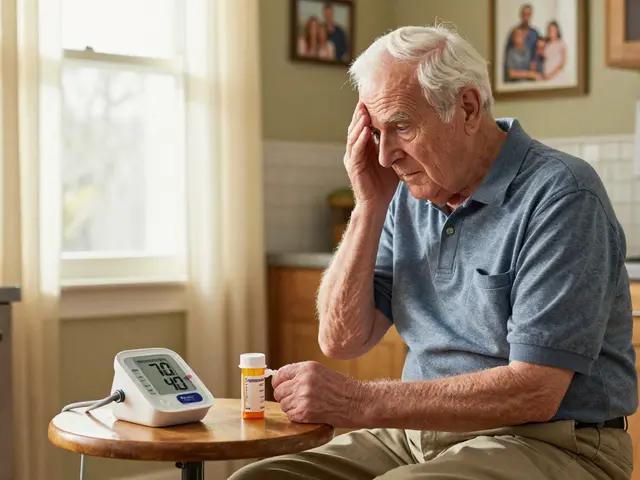
Before a drug can work, your body has to absorb it, move it around, break it down, and get rid of it. This whole process is called pharmacokinetics. And your genes play a huge role. For example, the enzyme CYP2D6 breaks down about 25% of common medications, including codeine. Some people have a version of this gene that makes the enzyme work super fast - they turn codeine into morphine too quickly and risk dangerous breathing problems. Others have a slow version - they barely get any pain relief. About 5 to 10% of Caucasians are slow metabolizers. That’s not rare. That’s normal variation. Even what you eat matters. Grapefruit juice blocks another enzyme, CYP3A4, which normally breaks down drugs like felodipine (a blood pressure medicine). When you drink grapefruit juice with it, your blood levels of the drug can spike by 260%. That’s not a myth - it’s a documented risk that can cause your blood pressure to drop too low, leading to fainting or worse.Drugs That Don’t Know Where to Stop: Off-Target Effects
Many drugs are designed to hit one specific target - like a lock and key. But sometimes, the key fits other locks too. Haloperidol, used to treat schizophrenia, blocks dopamine receptors in the brain to reduce hallucinations. But dopamine receptors are also in the basal ganglia, a part of the brain that controls movement. So, 30 to 50% of people taking haloperidol develop tremors, stiffness, or uncontrollable movements within days. It’s not a mistake. It’s a side effect built into the drug’s chemistry. Even more surprising: some drugs don’t even need to bind to a specific protein to cause trouble. Research from Weill Cornell Medicine in 2021 showed that certain drugs interact with the cell membrane itself - changing its thickness, flexibility, or charge. That can mess up dozens of proteins stuck in the membrane, like a rock thrown into a pond causing ripples everywhere. Drugs that do this - like antibiotics or antifungals - are especially likely to cause unexpected side effects because they don’t just target one thing. They disrupt entire systems.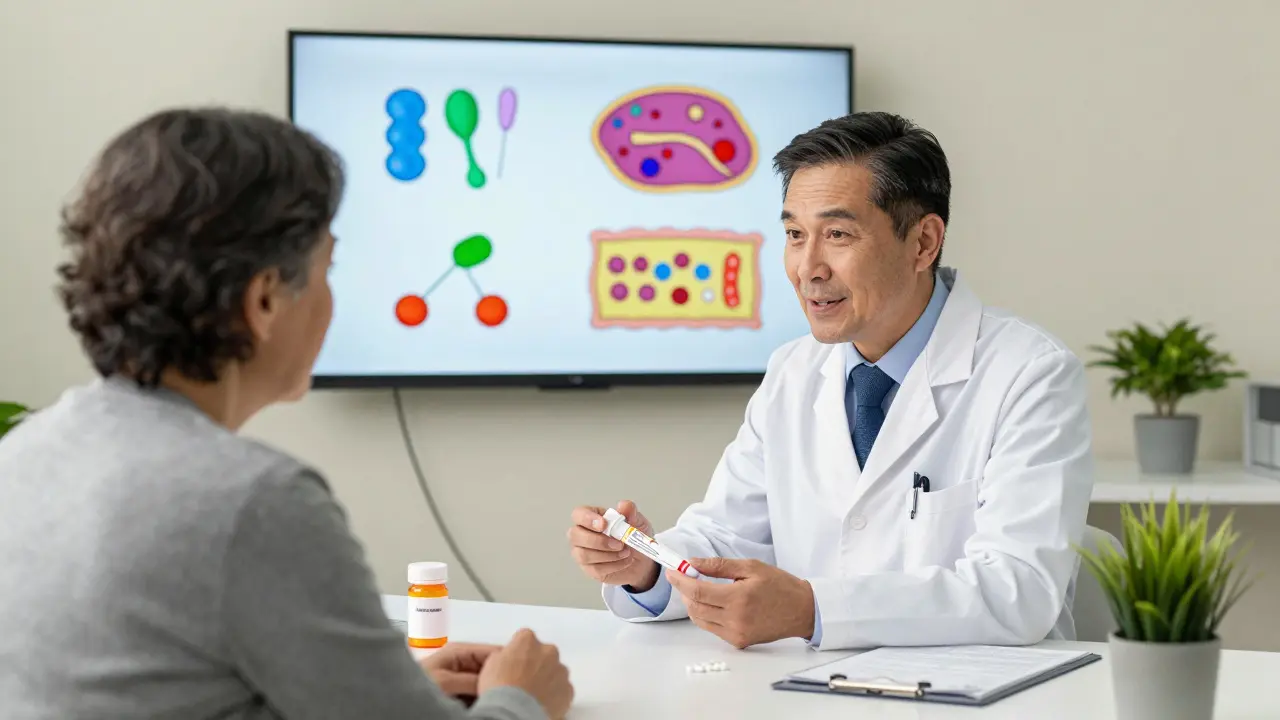
When Your Immune System Gets Involved
Not all side effects are predictable. About 20 to 25% are unpredictable, and some are immune-driven. These are the ones that scare people: rashes, swelling, anaphylaxis, or life-threatening skin reactions. Penicillin can cause anaphylaxis in 1 to 5 out of every 10,000 courses. It’s rare, but deadly. That’s a Type I reaction - your immune system sees the drug as an invader and goes into overdrive. Other reactions show up weeks later. Type III reactions involve immune complexes building up in tissues, causing fever, joint pain, or kidney damage. Type IV reactions, mediated by T-cells, cause severe skin conditions like Stevens-Johnson Syndrome. This happens in just 1 to 6 cases per million people a year - but it’s almost always linked to specific drugs: allopurinol, sulfonamides, or seizure meds like carbamazepine. And then there’s the HLA-B*57:01 gene. If you have it, your risk of a dangerous reaction to the HIV drug abacavir goes up 50 to 100 times. Before testing, about 5 to 8% of carriers had severe reactions. Now, doctors test for this gene before prescribing. The reaction rate has dropped to under 0.5%. That’s science saving lives.Drug Interactions: The Hidden Danger
Taking more than one medication? You’re playing Russian roulette with your body. Rifampicin, an antibiotic used for tuberculosis, speeds up the breakdown of digoxin - a heart medication. That can drop digoxin levels by 30 to 50%, making it useless. On the flip side, NSAIDs like ibuprofen can reduce kidney blood flow, slowing down how fast methotrexate (used for arthritis and cancer) leaves your body. That can cause bone marrow failure - a medical emergency. Older adults are especially at risk. About 6 to 7% of hospital admissions in people over 65 are caused by drug interactions. And the risk doesn’t go up linearly - it explodes when someone takes five or more drugs at once. That’s why polypharmacy is one of the biggest problems in modern medicine.


Comments
Chandreson Chandreas
31/Dec/2025Honestly? This is why I don't trust pills anymore. 🤷♂️ I take turmeric and yoga now. My body knows what it's doing better than some chemist in a lab. 🌿🧘♂️
Darren Pearson
31/Dec/2025The assertion that side effects are merely 'biological consequences' is an egregious oversimplification. One must consider the epistemological limitations of pharmacokinetic modeling in the context of polygenic expression and inter-individual variability. The FDA's definition is archaic.
Stewart Smith
31/Dec/2025I used to hate that my blood pressure med made me dizzy. Then I realized it was just my body saying 'hey, slow down.' Now I take it with my morning coffee and just... breathe. Turns out, the side effect was a message.
Retha Dungga
31/Dec/2025Grapefruit juice and meds are like dating someone who says they love you but also steals your snacks 😅
Jenny Salmingo
31/Dec/2025My grandma takes five pills a day. She says one makes her sleepy, one makes her hungry, one makes her tingly. I just smile and say 'good, that means they’re working.' She laughs and says she’s just trying to stay alive. I love her.
Aaron Bales
31/Dec/2025Testing for HLA-B*57:01 before abacavir? That’s not innovation. That’s basic medicine. If you’re not screening for known genetic risks, you’re not a doctor-you’re a gambler.
Lawver Stanton
31/Dec/2025I’ve been on 17 different meds in the last 5 years. One gave me hives so bad I looked like a boiled lobster. Another made me cry during cartoons. One turned my tongue blue. I don’t know if I’m sick or if my body just hates me. I once Googled 'why do I feel like a science experiment?' and the top result was this exact article. I cried again. But also... kind of validated? I guess.
Brady K.
31/Dec/2025You call that 'predicting side effects'? That’s just damage control. Real science isn’t waiting for people to turn into human glitch reports. We need AI-driven de novo drug design that avoids off-target binding before the molecule even leaves the simulator. Stop patching broken systems. Build new ones. The future isn’t ‘personalized medicine’-it’s *predictive pharmacology*. And if you’re still using CYP2D6 phenotyping like it’s 2012, you’re part of the problem.