

You’ve been eating clean, hitting the gym, tracking every calorie-and yet, the scale won’t budge. You’re not lazy. You’re not failing. Your body is doing exactly what it’s wired to do: defend your old weight.
Why Your Weight Loss Stalls (It’s Not Your Fault)
Most people think a weight loss plateau means they’re eating too much or not working hard enough. But science says otherwise. When you lose weight, your body doesn’t just slow down-it actively fights to get back to where it was. This isn’t a glitch. It’s a survival mechanism.
Decades of research, starting with the famous Minnesota Starvation Experiment in the 1940s, show that when people lose significant weight, their bodies drop energy expenditure far beyond what’s expected from losing fat and muscle. In some cases, metabolism slows by up to 40%. That means if you used to burn 2,200 calories a day at your old weight, you might now be burning only 1,800-even if you haven’t changed your activity level.
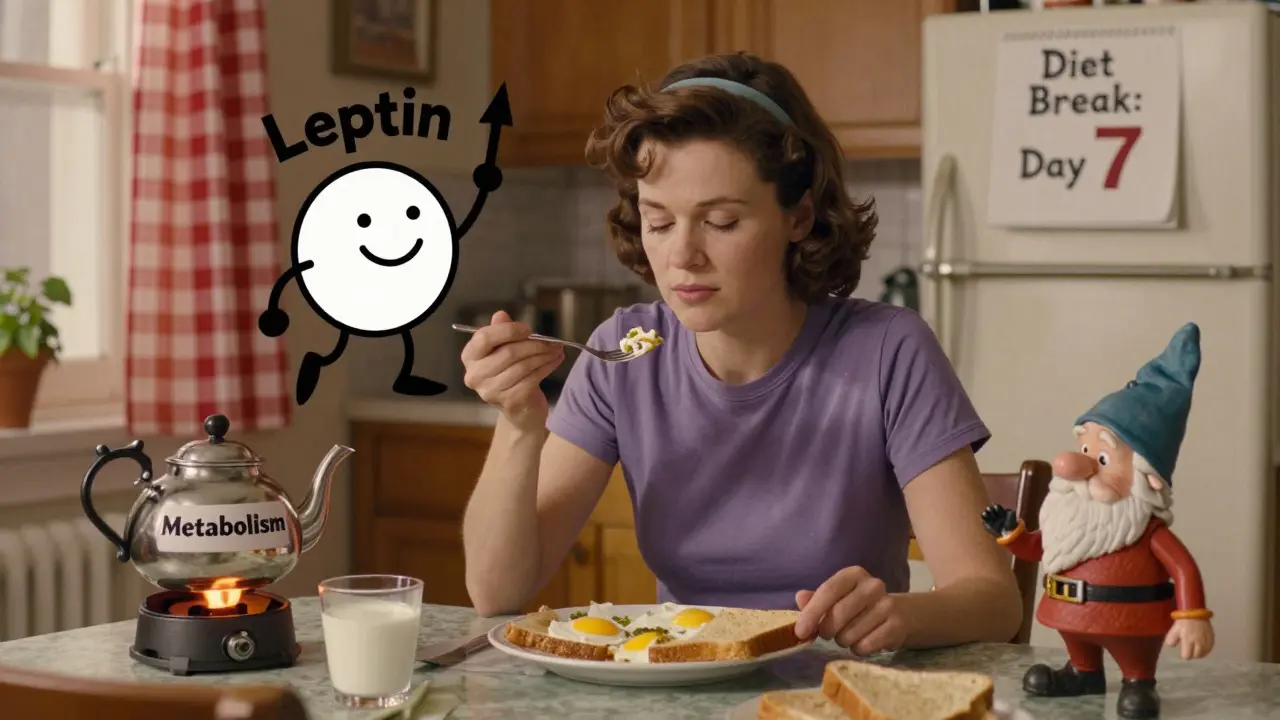
This drop isn’t just from losing mass. It’s called adaptive thermogenesis. Your body lowers your resting metabolic rate (RMR), reduces thyroid hormone, cuts leptin (the hormone that tells you you’re full), and even makes you hungrier. It’s like your body hits the brakes hard to prevent starvation.
And here’s the kicker: this doesn’t go away after a few weeks. Studies show these metabolic changes persist for over a year-even after you’ve stabilized at your new weight. So if you’ve been stuck for 8 weeks, it’s not because you slipped up. It’s because your biology is working overtime to protect you.
What Happens Inside Your Body During a Plateau
Your metabolism doesn’t just slow down randomly. Specific systems kick in:
- Leptin drops-by as much as 70% after major weight loss. That means your brain thinks you’re starving, even if you’re eating enough. Hunger spikes. Cravings intensify.
- Thyroid hormone decreases-slowing down your entire energy-burning engine.
- Cortisol rises-a stress hormone that can promote fat storage, especially around the belly.
- Brown fat activity drops-this type of fat burns calories to make heat. Women have more of it than men, and it shuts down faster during dieting, which may explain why women often hit plateaus harder.
- Proton leak and UCP-1 decline-these are cellular mechanisms that generate heat. When they slow, you burn fewer calories just staying alive.
These changes aren’t optional. They’re automatic. And they’re why two people on the same diet can lose very different amounts of weight-even if they start at the same weight and follow the plan identically.
Why Crash Diets Make Plateaus Worse
Many people try to break through a plateau by cutting calories even more. That’s like slamming the gas pedal harder when your car is stuck in mud-it just digs you deeper.
Research from the University of Alabama at Birmingham shows that rapid weight loss from very low-calorie diets (like 800 calories a day) triggers much stronger metabolic adaptation than gradual loss. In one study, people who lost 16% of their body weight fast had a metabolic drop 2.4 times greater than those who lost weight slowly.
And here’s what most people don’t realize: the first 5-10 pounds you lose on a new diet? Mostly water. Glycogen (stored carbs) holds water. When you cut carbs, you flush it out. That’s why the scale plummets at first. But once that water’s gone, your body shifts into defense mode-and real fat loss slows way down.
That’s why a 1,200-calorie diet that worked at 200 pounds might not work at 170. Your body isn’t broken. It’s just recalibrating.
How to Break Through: Science-Backed Strategies
Breaking a plateau isn’t about willpower. It’s about working with your biology, not against it. Here’s what actually works:
1. Take a Diet Break
Instead of cutting more, eat at maintenance for 1-2 weeks. This means consuming the number of calories your body needs to stay at your current weight. Do this every 8-12 weeks of dieting.
Studies show diet breaks reduce metabolic adaptation by up to 50%. Your leptin levels rise. Your thyroid resets. Your hunger drops. You come back to dieting with more energy and less cravings.
One woman on Reddit lost 30 pounds, then hit a 12-week plateau on 1,200 calories. After a 10-day diet break at 1,800 calories, she lost another 15 pounds in the next 6 weeks-not because she ate less, but because her metabolism recovered.
2. Lift Weights
Cardio burns calories while you’re doing it. Strength training builds muscle-and muscle burns calories all day, every day.
People who lift weights 3-4 times a week during weight loss lose less muscle and maintain a higher resting metabolic rate. One study found they had 8-10% smaller drops in RMR compared to those who only did cardio.
You don’t need to be a bodybuilder. Squats, push-ups, rows, and deadlifts-three times a week-is enough to protect your metabolism.
3. Eat More Protein
Protein isn’t just for building muscle. It’s your best friend during weight loss.
Studies show that consuming 1.6-2.2 grams of protein per kilogram of body weight (about 0.7-1 gram per pound) during a calorie deficit leads to 3.2 kg more fat loss and 1.3 kg less muscle loss than lower protein intakes.
That means if you weigh 70 kg (154 lbs), aim for 112-154 grams of protein daily. Eggs, chicken, fish, tofu, Greek yogurt, and whey protein are easy sources.
4. Try Reverse Dieting
Reverse dieting means slowly adding calories after a long diet to raise your metabolism without gaining fat. Start by adding 50-100 calories per week-mostly from carbs and fats-and monitor how your body responds.
This isn’t about gaining weight. It’s about teaching your body you’re not in starvation mode. Many people find that after reverse dieting, they can eat more and still lose weight.
What Doesn’t Work (And Why)
There’s a lot of noise out there. Supplements that “boost metabolism.” Detox teas. 7-day cleanses. None of these fix metabolic adaptation.
Here’s the truth: no pill, powder, or potion can undo the biological changes your body makes after weight loss. If a product claims to “reset your metabolism,” it’s selling hope, not science.
Also, don’t fall for the myth that you need to eat less to lose more. That’s like trying to fix a leaky roof by making the rain heavier.

How New Programs Are Adapting
Big names in weight loss are finally catching up. WW (Weight Watchers) now uses personalized calorie targets based on metabolic needs, not just weight and height. Noom’s app includes “metabolic reset” features built from NIH research.
Even pharmaceuticals are stepping in. Drugs like semaglutide (Wegovy) help by reducing the hunger spike caused by low leptin. In clinical trials, users lost nearly 15% of their body weight-not because the drug burned fat, but because it helped them stick to eating less by calming their hunger signals.
Bariatric surgery still works best for severe obesity, reducing metabolic adaptation by about 60% compared to dieting alone. But it’s invasive and risky. The real breakthrough? Learning how to manage adaptation without surgery.
The Future of Weight Loss
By 2025, experts predict 85% of science-based weight loss programs will include strategies to address metabolic adaptation. Research is already exploring cold exposure to activate brown fat, and drugs that target UCP-1 to increase heat production.
But the biggest shift isn’t technological-it’s psychological. We’re moving away from blaming people for “failing” their diets and toward understanding that weight loss isn’t linear. It’s not a straight line down. It’s a zigzag with plateaus, detours, and rest stops.
As Dr. David Ludwig from Harvard says, “The next frontier in weight management isn’t about eating less. It’s about working with your body’s natural defenses.”
What to Do Right Now
If you’re stuck:
- Stop cutting calories. You’re not broken-you’re adapted.
- Calculate your maintenance calories (use an online TDEE calculator).
- Eat at maintenance for 10-14 days. No restriction. Just eat enough to hold your weight.
- Start lifting weights 3x a week if you aren’t already.
- Get your protein up to 1.6-2.2g per kg of body weight.
- After the break, restart your deficit-but this time, plan your next diet break before you hit the next plateau.
This isn’t a quick fix. It’s a smarter long-term strategy. The goal isn’t just to lose weight. It’s to keep it off. And that means respecting your biology, not fighting it.
Write a comment
Latest Posts





Comments
Aayush Khandelwal
29/Dec/2025Man, this post is a godsend. Adaptive thermogenesis isn’t some buzzword-it’s your body’s ancient survival algorithm kicking in like a paranoid AI. Leptin crash? Thyroid slowdown? Brown fat going offline? That’s not laziness, that’s evolution. I’ve been on and off diets since college, and the moment I stopped treating my body like a broken laptop to be ‘fixed’ with more juice, everything changed. Now I reverse diet like it’s yoga for my metabolism. Slow. Mindful. No panic.
Henry Ward
29/Dec/2025Stop pretending this isn’t just another excuse for people who can’t control themselves. If your metabolism is ‘slow,’ then why do people in India and Africa lose weight on rice and lentils without counting calories? You’re not special. You’re just weak. Eat less. Move more. End of story.
srishti Jain
29/Dec/2025lol u think protein fixes everything? u eat 150g protein and still fat. lol.
Hayley Ash
29/Dec/2025Oh wow so now we’re blaming evolution for my muffin top? Cute. I’m pretty sure my body doesn’t have a PhD in endocrinology. If I can’t lose weight on 1200 calories, maybe I’m just a fat person who likes food. Maybe the real problem is that I’m not trying hard enough. Or maybe this whole ‘metabolism’ thing is just a fancy way to avoid accountability.
Sandeep Mishra
29/Dec/2025Hey Henry, I hear you. But let’s not forget: biology isn’t an enemy. It’s a partner. The fact that your body fights to hold onto weight? That’s not a flaw-it’s proof you’ve survived. And that’s powerful. I used to rage against my own metabolism. Now I treat it like a stubborn old dog: patient, consistency, and respect. Diet breaks? Yes. Protein? Hell yes. But also-rest. Sleep. Joy. You can’t out-train your stress. And no, that’s not ‘woo.’ That’s cortisol science.
Also, if you’re not lifting weights, you’re losing muscle. And muscle is your metabolic engine. Not a luxury. A necessity. You don’t need to be big. Just strong enough to keep your body running like it’s meant to.
Colin L
29/Dec/2025Interesting, but I think you’re underestimating the role of gut microbiota in metabolic adaptation. Recent studies from the University of Copenhagen show that after weight loss, the microbial diversity in the gut shifts toward energy-harvesting strains, effectively increasing caloric extraction from food-even if intake remains constant. This isn’t just leptin or thyroid-it’s an entire ecosystem recalibrating. And guess what? Antibiotics, processed foods, and artificial sweeteners exacerbate this. So maybe the problem isn’t just ‘eating too little’-it’s what you’re eating that’s poisoning your internal ecosystem. Also, cold exposure isn’t just for brown fat activation-it’s a systemic hormetic stressor that upregulates UCP-1 independently of leptin. Have you considered cryotherapy? Or even just cold showers? I’ve seen 20% increases in resting energy expenditure in just 4 weeks. No magic. Just physics.
kelly tracy
29/Dec/2025I’ve been doing this for 7 years. I’ve lost 80 pounds. I’ve gained it back. I’ve lost it again. I’ve tried everything. The only thing that worked? Stopping. Not dieting. Not counting. Not tracking. Just eating when I was hungry. Stopping when I was full. No rules. No guilt. No ‘metabolism reset.’ Just listening. And now I’m not just thin-I’m peaceful. You don’t fix a broken metabolism. You stop fighting it. And you learn to love your body even when it’s not perfect. That’s the real breakthrough.
Shae Chapman
29/Dec/2025THIS. THIS. THIS. 🙌 I hit a plateau for 14 months. I cried. I yelled. I threw my scale out the window (literally). Then I took a 2-week break. Ate pizza. Ate pasta. Ate ice cream. And guess what? I didn’t gain 10 pounds. I gained 1. And then I lost 5 in the next 3 weeks. My energy? Skyrocketed. My cravings? Gone. My therapist said I was ‘reparenting’ myself. I said I was finally letting my body breathe. 🤍 Thank you for writing this. I’m not broken. I’m biologically intelligent. And I’m proud of that.
Cheyenne Sims
29/Dec/2025While the article contains several scientifically valid points regarding adaptive thermogenesis, it lacks precise citation of peer-reviewed sources. The reference to the Minnesota Starvation Experiment is appropriate, but the claim that ‘metabolism slows by up to 40%’ is misleading without specifying baseline metrics, duration of weight loss, and participant demographics. Furthermore, the recommendation to consume 1.6–2.2 g/kg of protein assumes ideal renal function and ignores contraindications for individuals with chronic kidney disease. As a medical professional, I urge readers to consult a registered dietitian before implementing any macronutrient protocol.
Joseph Corry
29/Dec/2025It’s fascinating how this post weaponizes biology to absolve personal responsibility. You frame metabolic adaptation as some noble, almost spiritual struggle-when in reality, it’s just the predictable outcome of a calorie deficit. The real ‘toxic’ narrative here is the idea that people need ‘permission’ to eat more, that they’re victims of their own hormones. If you’re not losing weight, you’re still in a calorie surplus. The science is clear. The rest is narrative theater. And yes, I’m aware of leptin. I’m also aware that most people who cite it have never measured their own energy expenditure. Spoiler: You’re eating more than you think.