

When your pharmacist hands you a pill that looks nothing like the one you’ve been taking, it’s normal to pause. The color is different. The shape is odd. The name on the tablet doesn’t match what your doctor wrote. You might wonder: is this really the same thing?
The short answer is yes - if it’s an FDA-approved generic. But knowing that doesn’t always ease the worry. Switching from a brand-name drug to its generic version is common, affordable, and safe for most people. But it’s not always simple. What you should expect - and what you should watch for - matters more than you might think.
Generics Are Not Cheaper Copies - They’re Identical in Effect
Generic drugs aren’t knockoffs. They’re not lower quality. They’re not diluted. Under U.S. law, a generic must contain the exact same active ingredient, in the same strength, and work the same way in your body as the brand-name version. The FDA requires this. Every single generic approved since 1985 has gone through strict testing to prove it delivers the same amount of medicine into your bloodstream at the same rate as the original.
This isn’t just theory. A 2019 study in JAMA Internal Medicine looked at over 2,000 clinical trials and found that generics performed identically to brand-name drugs in 88% of cases. For most medications - like blood pressure pills, cholesterol drugs, or antibiotics - you won’t notice a difference. Your body doesn’t know the difference. The active ingredient is the same. The way it works is the same.
The real difference? Price. Brand-name drugs can cost $600 or more per prescription. Generics? Around $128 on average. That’s an 80% to 85% drop. For someone taking medication every day, that’s hundreds - sometimes thousands - of dollars saved each year. Medicare beneficiaries who switched to generics saved an average of $1,268 annually. People with chronic conditions like diabetes or high cholesterol often see their adherence improve simply because they can now afford to take their medicine regularly.
What Will Look Different - And Why
Even though the medicine inside is identical, the pill you hold will likely look different. That’s not a mistake. It’s the law.
Trademark rules require generic manufacturers to make their pills look different from the brand version. That means different colors, shapes, sizes, or even markings. A brand-name pill might be a small blue oval. The generic could be a large white round tablet. It’s confusing - and that’s the problem.
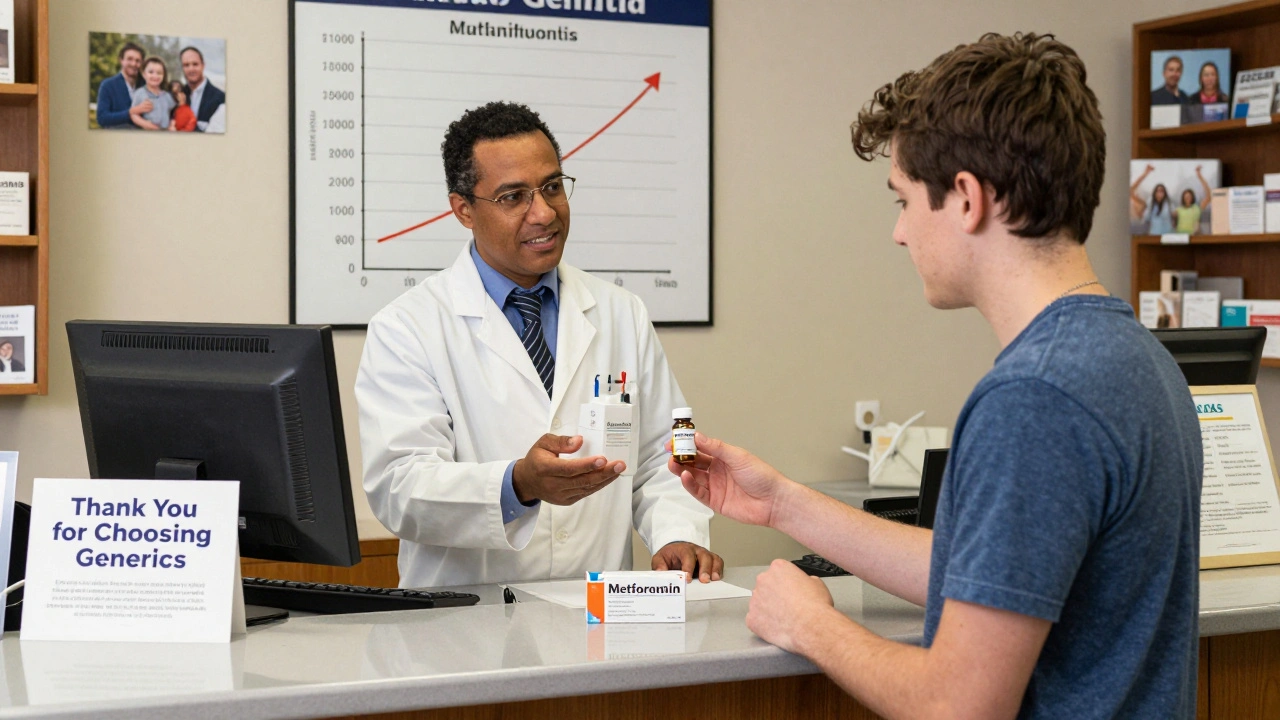
One patient in her 80s accidentally took double her dose because she didn’t recognize the new pill. She thought the old one was gone and the new one was an extra. That’s why pharmacists are required to explain the switch. In 42 states, they must offer a 5- to 7-minute counseling session when switching to a generic. They’ll point out the differences and remind you: It’s the same medicine. Just looks different.
Another thing that changes: inactive ingredients. These are the fillers, dyes, and binders that hold the pill together. They don’t affect how the drug works. But they can cause reactions in rare cases. If you’re allergic to red dye, certain generic versions of antidepressants or blood pressure meds might trigger a rash. If you’re sensitive to lactose, some generics might contain it - while the brand version doesn’t. Always check the Patient Package Insert that comes with your prescription. It lists every inactive ingredient. If you’re unsure, ask your pharmacist.
When You Should Be Cautious
Most people switch without issue. But there are exceptions. Some drugs have what’s called a narrow therapeutic index - meaning even tiny changes in blood levels can cause big problems. These include:
- Levothyroxine (for thyroid)
- Warfarin (blood thinner)
- Phenytoin and carbamazepine (for seizures)
For these, consistency matters more. A 2021 study by the American Epilepsy Society found that 12.7% of patients switching between different generic versions of seizure meds had breakthrough seizures - compared to just 4.3% who stayed on the same formulation. That doesn’t mean generics don’t work. It means switching back and forth between different generic manufacturers can be risky. If you’re on one of these drugs, stick with the same generic manufacturer if possible. Ask your pharmacist to fill your prescription with the same brand of generic each time.
Some complex delivery systems also struggle with generics. Inhalers, patches, and eye drops are harder to copy exactly. In 2020, the FDA warned that some generic versions of Advair Diskus didn’t disperse the powder the same way as the brand. That meant patients got less medicine with each puff. These aren’t common, but they exist. If you’re using an inhaler, patch, or nasal spray and notice it’s not working like before, talk to your doctor. Don’t assume it’s all in your head.
What to Do When You Switch
Switching doesn’t mean you’re done. You need to monitor how you feel. Here’s what to do:
- Keep a simple log. For the first two weeks after switching, write down how you feel. Any new side effects? Any change in how well your condition is controlled?
- Track key numbers. If you have diabetes, check your fasting blood sugar. If you’re on warfarin, monitor your INR. If you’re on an antidepressant, use a simple mood tracker like the PHQ-9. Small changes matter.
- Don’t ignore weird symptoms. If you get a rash, feel dizzy, or notice your condition worsening, call your doctor or pharmacist. It might be the generic. Or it might be something else. Either way, don’t wait.
- Ask for the same manufacturer. Especially for thyroid, seizure, or blood thinner meds. Ask your pharmacist: “Can you fill this with the same generic brand as last time?”
Most people have no issues. But if you’ve had a bad experience before, you’re not alone. On Reddit’s pharmacy forum, 16.7% of users reported problems after switching - mostly side effects or feeling the drug didn’t work as well. But 83.3% said it was identical. The difference often comes down to consistency. Sticking with one generic version is safer than switching between different ones.
Why Doctors and Pharmacies Push Generics
It’s not about saving money for the pharmacy. It’s about saving lives.
Kaiser Permanente found that diabetic patients on generic metformin had a 78% adherence rate - compared to just 63% for those on the brand-name version, Glucophage. Why? Because the generic cost $15 instead of $350. People didn’t skip doses because they couldn’t afford them. That’s not a small thing. Skipping insulin or blood pressure meds leads to hospitalizations, strokes, heart attacks.
Doctors know this. A 2022 survey found 78% of physicians automatically prescribe generics when available. Medicare and Medicaid encourage it. The Inflation Reduction Act of 2022 requires Medicare to cover all FDA-approved generics without prior authorization starting in 2024. That means fewer hoops, faster access, lower cost.
The system is built to get you the medicine you need - at a price you can afford. Generics are the backbone of that system.

What’s Changing in 2025 and Beyond
The FDA is pushing harder to make more generics available - especially for expensive drugs. In January 2024, the first biosimilars for Humira (adalimumab) hit the U.S. market. These aren’t traditional generics - they’re complex biologic drugs - but they cut costs by 15% to 30%. More are coming.
By 2025, new FDA rules will require clearer labeling of inactive ingredients on generic packaging. Right now, only 37% of generic labels clearly list potential allergens. That’s changing. You’ll soon see “contains soy,” “contains lactose,” or “contains FD&C Red No. 40” right on the bottle.
The goal? More transparency. Fewer surprises. More people able to take their medicine safely - and affordably.
Final Thoughts: Trust the Science, Stay Aware
Switching from brand to generic isn’t a gamble. It’s backed by decades of data, strict regulation, and real-world results. For the vast majority of people, it’s a simple, safe, and smart move.
But smart doesn’t mean passive. Know what you’re taking. Check the label. Ask questions. Track your response. If something feels off, speak up. Your body tells you when something’s wrong. Don’t ignore it just because the pill looks different.
Generics save lives - not just by cutting costs, but by making consistent, daily treatment possible. You’re not settling for less. You’re choosing a better way to stay healthy.
Are generic drugs as effective as brand-name drugs?
Yes, for the vast majority of medications. The FDA requires generics to have the same active ingredient, strength, dosage form, and route of administration as the brand-name drug. They must also prove they work the same way in the body through strict bioequivalence testing. Studies show generics perform identically to brands in 88% of cases. The only differences are in inactive ingredients and appearance - not effectiveness.
Why do generic pills look different from brand-name ones?
Trademark laws require generic manufacturers to make their pills look different from the brand version. This prevents confusion and avoids infringing on the brand’s design. So while the medicine inside is identical, the color, shape, size, or markings may change. This is normal and doesn’t affect how the drug works.
Can switching to a generic cause side effects?
Rarely. Side effects from generics usually come from differences in inactive ingredients - like dyes, fillers, or preservatives - not the active drug. If you have allergies (e.g., to lactose, red dye, or gluten), check the label. Some people report feeling different after switching, but this often happens when they’re switched between different generic manufacturers. For drugs with a narrow therapeutic index - like levothyroxine or warfarin - sticking with the same generic brand helps avoid issues.
Which medications should I be careful switching?
Be cautious with drugs that have a narrow therapeutic index - small changes in blood levels can cause serious effects. These include levothyroxine (thyroid), warfarin (blood thinner), phenytoin, and carbamazepine (anti-seizure). Also, avoid switching generics for complex delivery systems like inhalers, patches, or nasal sprays unless your doctor confirms the generic is equivalent. Always talk to your pharmacist before switching these.
How can I make sure I get the same generic every time?
Ask your pharmacist to fill your prescription with the same generic manufacturer each time. Generic drugs are made by different companies, and even though they’re all approved, slight variations can occur. If you’re on a drug like levothyroxine or an anti-seizure medication, consistency matters. Write down the name on the bottle (e.g., “Teva” or “Sandoz”) and ask for that brand next time. Most pharmacies can accommodate this request.
Is it safe to switch back to the brand name if I don’t feel well?
Yes - but talk to your doctor first. If you notice new side effects, worsening symptoms, or reduced effectiveness after switching to a generic, don’t stop taking your medication. Call your doctor or pharmacist. They can help determine if the issue is the generic or something else. If needed, they can write a prescription for the brand-name drug with a “Dispense as Written” note. But remember: many people feel better on generics simply because they can now afford to take them regularly.





Comments
Grant Hurley
1/Dec/2025Just switched my blood pressure med to generic last month and honestly? Zero difference. My BP’s stable, no dizziness, no weird side effects. Saved like $200 a year. Pharmacist showed me the label and said ‘same juice, different bottle’ - and she was right.
Dennis Jesuyon Balogun
1/Dec/2025The bioequivalence paradigm is fundamentally flawed when applied to narrow therapeutic index (NTI) pharmacotherapeutics. The FDA’s 80-125% AUC/Cmax confidence interval threshold is statistically permissive - it permits pharmacokinetic variance that, in clinical practice, manifests as subtherapeutic or toxic exposure, particularly in polypharmacy populations with hepatic CYP450 polymorphisms. The JAMA study you cite? It conflates population-level equivalence with individualized therapeutic fidelity. In real-world settings - especially among elderly, renally impaired, or geriatric patients - the inactive excipients (e.g., lactose monohydrate, colloidal silicon dioxide) induce variable dissolution kinetics that compromise bioavailability. This isn’t ‘brand fear’ - it’s pharmacovigilance.
Furthermore, the regulatory gap in biosimilar interchangeability protocols for complex delivery systems (e.g., inhalers, transdermal patches) remains unaddressed. The 2020 Advair Diskus discrepancy wasn’t an outlier - it was systemic. Until the FDA mandates batch-to-batch pharmacodynamic monitoring for generics, we’re playing Russian roulette with chronic disease control.
Sean McCarthy
1/Dec/2025People keep saying ‘it’s the same medicine’ but what about when you switch from Teva to Sandoz and suddenly your seizures come back? That’s not placebo. That’s real. My cousin went from one generic to another and ended up in the ER. You can’t just treat all generics like they’re interchangeable. Some companies make better pills than others. Ask for the same one every time.
Shashank Vira
1/Dec/2025How quaint. In the West, we still believe in the myth of pharmaceutical egalitarianism - as if the FDA’s bureaucratic stamp is some divine seal of therapeutic equivalence. The truth? Generics are the pharmaceutical equivalent of fast fashion: cheap, disposable, and designed to fail quietly. The active ingredient may be identical - but the manufacturing standards? The purity of excipients? The quality control? You think a factory in Bangalore or Shanghai operates under the same sterile rigor as a Swiss or German lab? The data is skewed. The patients who report ‘no difference’ are the lucky ones. The rest? They’re quietly deteriorating - and no one’s tracking them.
Courtney Co
1/Dec/2025I switched to generic levothyroxine and felt like a zombie for two weeks. Like, total emotional numbness. I cried for no reason. I couldn’t focus. I thought I was going crazy. My doctor said ‘it’s all in your head.’ But I know my body. I went back to the brand and boom - I was myself again. Why do they push these generics so hard? Is it really about saving money - or just cutting corners? I’m tired of being treated like a statistic.
Matt Dean
1/Dec/2025Anyone who says generics don’t work is just lazy. You want the brand? Pay for it. The system works. You get the same active ingredient, same FDA approval, same results. If you feel weird, maybe it’s not the pill - it’s you. Stop blaming the medicine and start taking responsibility. Millions take generics every day without issue. Your body isn’t special. Get over it.
Jaswinder Singh
1/Dec/2025Bro I switched to generic metformin and my sugar went wild. I thought I was doing good but my A1c jumped from 6.2 to 7.8 in 3 months. I went back to brand and it’s back to normal. Don’t listen to these people who say ‘it’s the same.’ It’s not. The fillers mess with absorption. Ask your doc to write ‘dispense as written’ - it’s your right.
Linda Migdal
1/Dec/2025Generics are a national security issue. When you let foreign manufacturers produce life-saving drugs without full oversight, you’re outsourcing American health to countries with zero accountability. The FDA’s inspection rate for overseas plants is less than 2%. That’s not regulation - that’s negligence. If you’re on a generic, you’re playing Russian roulette with your life. And if you’re okay with that? You’re not just careless - you’re complicit.
Nnaemeka Kingsley
1/Dec/2025My grandma took her generic pills every day and never missed a beat. She didn’t care what color they were - she cared that she could afford them. If you can’t afford your meds, you don’t take them. And that’s when people end up in the hospital. Generics save lives. Simple as that.