

Why accurate cancer staging depends on the right imaging tool
Getting cancer staged right isn’t just important-it can mean the difference between life and death. A tumor that looks small on a scan might be spreading silently through lymph nodes or nerves, while another that appears aggressive could be harmless scar tissue. That’s why doctors don’t rely on one scan alone. They choose between PET-CT, MRI, and increasingly, PET-MRI based on the cancer type, location, and what they’re trying to find. The goal isn’t to pick the "best" machine-it’s to pick the right tool for the job.
PET-CT: The workhorse of cancer staging
PET-CT became the standard in oncology after its FDA approval in 2001. It works by combining two images: one showing where cancer cells are metabolically active (PET), and another showing the body’s anatomy (CT). The tracer used, usually 18F-FDG, glows where glucose-hungry cancer cells are busy dividing. This makes PET-CT excellent for spotting tumors in the lungs, lymph nodes, liver, and bones-places where cancer often spreads.
For non-small cell lung cancer, PET-CT changes treatment plans in nearly 30% of cases compared to CT alone. It’s fast-most scans take under 20 minutes-and widely available. Most hospitals have it. But it has limits. It can’t always tell the difference between cancer and inflammation. And because it uses radiation from the CT scan, the total dose ranges from 10 to 25 mSv-roughly equivalent to 3 to 5 years of natural background radiation.
MRI: Seeing soft tissue in detail
MRI doesn’t use radiation. Instead, it uses powerful magnets and radio waves to create incredibly detailed pictures of soft tissues. That’s why it’s the go-to for brain tumors, spinal cord cancers, prostate cancer, and liver lesions. A 3T MRI machine can show tumor boundaries down to 0.5 mm, far sharper than PET-CT’s 4-5 mm resolution for metabolic activity.
In prostate cancer, multiparametric MRI detects tumors with 75% accuracy, outperforming early PSMA PET-CT scans in some studies. For breast cancer patients undergoing chemotherapy, MRI tracks tumor shrinkage better than PET-CT in the first few cycles. And for patients who need repeated scans over years-like young adults with sarcoma or pediatric cancers-MRI avoids the cumulative radiation risk that comes with repeated CT scans.
But MRI is slow. A full pelvic scan can take up to an hour. It’s noisy. And people with pacemakers, metal implants, or severe claustrophobia often can’t use it. Not every hospital has a 3T machine, and interpreting the images requires specialized training.

PET-MRI: The high-end hybrid that’s changing the game
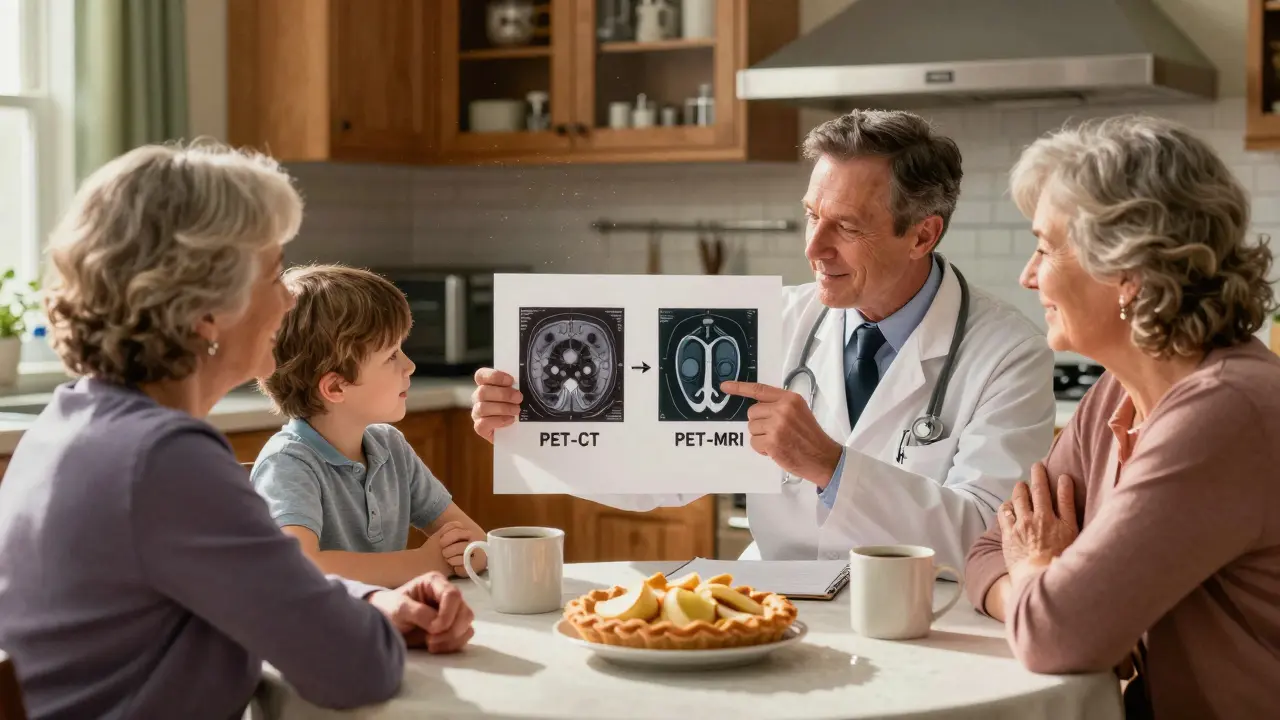
PET-MRI, first cleared by the FDA in 2011, merges the metabolic power of PET with the soft-tissue clarity of MRI in a single scan. The result? A picture that shows not just where cancer is, but exactly how it’s interacting with surrounding nerves, blood vessels, and organs.
For brain tumors, PET-MRI is unmatched. It can tell apart tumor recurrence from radiation damage-a problem that confounds even experienced radiologists using MRI alone. Studies show PET-MRI improves accuracy from 70-80% to 85-90% in this critical distinction. In liver metastases, it changes treatment decisions in nearly half of patients compared to standard imaging.
It also cuts radiation exposure by about half compared to PET-CT since it replaces the CT component with MRI. That’s a big deal for children, pregnant women, and patients needing lifelong monitoring. But PET-MRI isn’t perfect. The machines are expensive-$3 million to $4.2 million-and require special shielded rooms. The scans take 45 to 60 minutes, and motion from breathing or patient movement can blur the images. Attenuation correction-correcting for how tissues absorb the PET signal-is trickier without CT data, and errors here can lead to false readings.
Which scan for which cancer?
There’s no one-size-fits-all. The choice depends on the cancer’s biology and where it’s hiding.
- Prostate cancer: PSMA PET-CT is great for finding distant spread, but multiparametric MRI is better for locating the primary tumor inside the gland.
- Breast cancer: MRI tracks response to chemo early on; PET-CT is better for detecting spread to bones or lungs.
- Lymphoma: PET-CT is still the gold standard for staging and checking if treatment worked.
- Brain tumors: PET-MRI is becoming the new standard-it’s the only way to reliably tell if a growing area is cancer returning or just healing tissue.
- Pancreatic cancer: PET-MRI changed management in 49% of cases in one 2023 study, outperforming both PET-CT and standalone MRI.
- Pediatric cancers: MRI or PET-MRI are preferred to reduce lifetime radiation exposure.
Cost, access, and real-world challenges
PET-CT costs about $1,600-$2,300 per scan in the U.S. PET-MRI? $2,500-$3,500. That’s a 50% jump. Insurance doesn’t always cover PET-MRI unless there’s a clear clinical need-like a brain tumor with ambiguous findings or a child needing repeated scans.
Only 1 in 4 cancer centers in the U.S. have PET-MRI. Most are in academic hospitals with research programs. Radiologists need extra training-3 to 6 months beyond what’s needed for PET-CT. Technologists report needing 40+ additional hours of instruction to operate PET-MRI safely and effectively.
And even when the machine is there, workflow gets messy. Scans take longer. Patients move. Artifacts appear. One radiologist on a medical forum said, "I’ve had to rescan 3 patients this week because their breathing messed up the liver images." Still, 82% of centers that use PET-MRI say they wouldn’t give it up. The diagnostic payoff is too high for specific cases.
The future: AI, new tracers, and smarter choices
Things are changing fast. In January 2024, Siemens launched the BioMatrix 600 PET-MRI with a 6-minute whole-body scan time-cutting scan duration nearly in half. New radiotracers like 68Ga-PSMA-11 are making prostate cancer detection far more precise. And AI is stepping in to help. At the 2023 RSNA meeting, researchers showed algorithms that could predict how a tumor would respond to treatment just from a single PET-MRI scan, using patterns invisible to the human eye.
The American Society of Clinical Oncology now recommends tailoring imaging to tumor subtypes. For example, triple-negative breast cancer responds better to MRI monitoring, while hormone-receptor-positive types may benefit more from PET-CT.
By 2035, experts predict PET-MRI will make up 25-30% of oncologic imaging in top academic centers. But PET-CT won’t disappear. It’s too practical, too fast, too widely available. The future isn’t about replacing one tool with another. It’s about using the right one at the right time-with AI helping doctors decide which scan to order, and why.
What patients should know
If you’re facing cancer staging, ask your doctor: "Which scan are you recommending, and why?" Don’t assume the most expensive or newest option is always best. Ask if there’s a chance you’ll need multiple scans over time-then consider radiation exposure. If you have metal implants, claustrophobia, or kidney problems, let your team know upfront. These factors matter more than you think.
And remember: imaging is just one piece. Biopsies, blood tests, and genetics all play a role. But without the right scan, even the best treatment plan can miss the mark.
Is PET-CT or MRI better for cancer staging?
Neither is universally better-it depends on the cancer type. PET-CT excels at finding spread to lungs, bones, and lymph nodes, especially in lung cancer and lymphoma. MRI is superior for soft tissue detail, making it the top choice for brain, prostate, liver, and spinal tumors. For many cases, doctors use both, but the first scan is chosen based on where the cancer is likely to spread and what needs to be seen most clearly.
Does PET-MRI replace PET-CT?
Not yet. PET-MRI offers better soft tissue contrast and less radiation, but it’s slower, more expensive, and less available. PET-CT remains the standard for most cancers because it’s fast, widely accessible, and proven. PET-MRI is reserved for specific cases where its advantages matter most-like brain tumors, pediatric cancers, or when a patient needs repeated scans over years.
How accurate is PET-CT for detecting cancer spread?
PET-CT is about 85-90% accurate for detecting distant metastases in cancers like lung, colorectal, and lymphoma. It’s particularly strong for spotting small lymph node involvement and bone lesions. However, it can miss tumors in organs like the liver or brain where background activity is high, or confuse inflammation with cancer. That’s why it’s often paired with MRI for more complex cases.
Is MRI safe for repeated cancer scans?
Yes. MRI uses no ionizing radiation, making it the safest option for patients who need multiple scans over time-such as children, young adults, or those with hereditary cancer syndromes. The main risks are related to metal implants or severe claustrophobia, not radiation exposure. For long-term monitoring, MRI is often preferred over CT or PET-CT.
Why is PET-MRI so expensive?
PET-MRI machines cost $3-$4.2 million, compared to $1.8-$2.5 million for PET-CT. They require specialized shielded rooms, advanced software for image fusion, and highly trained staff. The technology is complex-merging two powerful systems into one machine isn’t simple. Plus, fewer are made each year, so economies of scale don’t apply yet. The higher cost is justified in specific cases, but not for routine screening.
Can PET-MRI detect cancer earlier than other scans?
In some cases, yes. For tumors in the brain, liver, or pelvis, PET-MRI can detect small changes in metabolism and tissue structure before they’re visible on PET-CT or MRI alone. It’s especially useful for spotting early recurrence after treatment. But for many common cancers like lung or colon, PET-CT still detects spread just as early. The advantage of PET-MRI is in precision, not speed of detection.
What’s the biggest limitation of PET-MRI?
The biggest issue is technical: attenuation correction. Without a CT scan to map how tissues absorb radiation, PET-MRI must estimate it using MRI data, which can lead to errors-especially near the lungs or sinuses. This can cause false hot spots or mask real tumors. It’s a known challenge, and newer software is improving it, but it still requires expert oversight and physics support to fix.
Should I get a PET-MRI if my doctor recommends it?
If your doctor recommends PET-MRI, it’s likely because they believe it will give critical information that PET-CT or MRI alone can’t. Ask why they think it’s necessary. Is it for a brain tumor? Liver lesion? Pediatric case? If the answer is yes to one of these, then yes-it’s probably worth it. If it’s for a routine lung cancer check, PET-CT may be just as good and more practical.
Write a comment
Latest Posts





Comments
Mike Rose
29/Jan/2026lol why do we even need all this fancy stuff? CT works fine for most stuff, just sayin'.
Sidhanth SY
29/Jan/2026Honestly, I’ve seen PET-MRI change the game for my cousin’s liver mets. Yeah it’s pricey, but when you’re staring at a blurry spot on a CT and the doc says ‘maybe cancer, maybe scar’-you want that clarity.
April Allen
29/Jan/2026The attenuation correction artifact in PET-MRI remains the Achilles’ heel of hybrid imaging. Without robust Dixon-based or atlas-driven correction algorithms, quantitative SUV values in the pulmonary apex and paranasal sinuses can be systematically biased by up to 22%, leading to false-positive interpretations that may trigger unnecessary biopsies.
Shawn Peck
29/Jan/2026You people are overcomplicating the hell out of this. PET-CT is THE tool. Everything else is just expensive theater. If your tumor isn’t glowing on FDG, it ain’t cancer. Period.
Sheila Garfield
29/Jan/2026I think it’s wild how much we’ve come from just X-rays to this. I remember my dad getting a CT in 2005 and being terrified of the radiation. Now we’ve got machines that can see cancer’s heartbeat without burning you up. Kinda beautiful, really.
Claire Wiltshire
29/Jan/2026It’s important to remember that imaging is only one piece of the puzzle. A 3T MRI might show a suspicious lesion, but without a biopsy, you’re still guessing. And if the patient has renal impairment, contrast use adds another layer of risk. Always weigh the full clinical picture.
Russ Kelemen
29/Jan/2026There’s something poetic about how medicine is learning to hold two truths at once: that speed and accessibility save lives, and that precision can redefine them. PET-CT gets you there fast. PET-MRI helps you understand why you got there. Both matter. Neither is the enemy.
Niamh Trihy
29/Jan/2026I’ve worked in two Irish hospitals-one with PET-CT, one with PET-MRI. The difference in diagnostic confidence for prostate cancer recurrence? Night and day. The wait time? Yeah, longer. But when you’re deciding whether to restart chemo or just monitor, that clarity? Worth every minute.
Beth Beltway
29/Jan/2026Let’s be real: PET-MRI is just a luxury for academic centers that want to look cutting-edge. Most patients don’t need it. And if your hospital is pushing it without clear guidelines, you’re just billing more and confusing your staff. Stop the hype.
Adarsh Uttral
29/Jan/2026i had a friend who got a pet-mri for a brain tumor and they saved his life. the doc said the old ct missed the recurrence because it looked like scar tissue. pet-mri saw the glow. no joke. worth the wait.