

G6PD Risk Assessment Tool
Assess Your Risk
This tool helps you understand your risk of hemolytic anemia when taking nitrofurantoin. Enter your information below to receive your personalized risk assessment.
Every year, millions of people take nitrofurantoin to treat a simple urinary tract infection. It works fast, it’s cheap, and for most people, it’s safe. But for a hidden group of patients-those with G6PD deficiency-this common antibiotic can trigger a life-threatening reaction: acute hemolytic anemia. And many doctors still don’t check for it.
What Is G6PD Deficiency?
G6PD deficiency is a genetic condition where your red blood cells lack enough of an enzyme called glucose-6-phosphate dehydrogenase. This enzyme acts like a shield, protecting your red blood cells from oxidative damage. Without it, certain drugs, foods, or infections can cause those cells to break apart too fast-leading to hemolytic anemia.
It’s not rare. Around 400 million people worldwide have it, according to the World Health Organization. In some populations, it’s common: 10-14% of Black African and African American people, 4-7% of those with Mediterranean or Middle Eastern ancestry, and 2-5% in Southeast Asia. Many people never know they have it until they take a drug like nitrofurantoin-and then it’s too late.
Why Nitrofurantoin Is Dangerous for G6PD-Deficient People
Nitrofurantoin isn’t just any antibiotic. It’s an oxidizing agent. In the acidic environment of the urinary tract, it becomes active and kills bacteria. But in people with G6PD deficiency, that same oxidative power attacks red blood cells. The cells can’t make enough glutathione-a natural antioxidant-to protect themselves. Hemoglobin inside the cells starts to clump, forming Heinz bodies. The spleen then destroys these damaged cells, causing a rapid drop in hemoglobin.
It doesn’t take long. Symptoms usually show up within 24 to 72 hours after taking the first dose. You might feel feverish, tired, or dizzy. Your urine turns dark-like tea or cola. Your skin gets pale or yellow. Your heart races. These aren’t just side effects-they’re signs your red blood cells are being destroyed.
A 2022 review in the Journal of Clinical Antimicrobial Chemotherapy found 42 confirmed cases of nitrofurantoin-induced hemolytic anemia in G6PD-deficient patients. Ten of those cases ended in death. Another study tracked 8 cases in pregnant women and 3 in newborns, showing the risk extends to vulnerable groups who may not even be aware they’re exposed.
Who’s at Risk-and Who’s Not Getting Screened
Doctors don’t routinely test for G6PD deficiency before prescribing nitrofurantoin. A 2022 survey of 350 primary care physicians found only 32% ever checked for it. That’s despite clear guidelines from the American Society of Hematology and the Clinical Pharmacogenetics Implementation Consortium (CPIC), which say: avoid nitrofurantoin in G6PD-deficient patients.
Why the gap? For one, many patients don’t know their own ancestry or family history. In the U.S., newborn screening for G6PD deficiency is not universal-it’s only required in some states. In the UK, it’s not done at all unless there’s a family history or jaundice in a newborn. So unless someone has had a prior reaction to a drug like sulfa or primaquine, or comes from a high-risk population, they’re flying blind.
And here’s the catch: nitrofurantoin is still a top choice for UTIs. It’s effective against resistant E. coli strains, with resistance rates around 10-15%, compared to 20-25% for trimethoprim-sulfamethoxazole. It’s also cheaper than newer options. But cost savings mean nothing if a patient ends up in the hospital with a hemolytic crisis.
The Real Cost of Skipping the Test
A G6PD test costs between $35 and $50. Medicare reimburses that amount. A hospital admission for drug-induced hemolytic anemia? That averages $8,500 to $12,000. And that’s just the direct cost. Missed work, lost time, anxiety, and the risk of needing a blood transfusion or dialysis add up fast.
One case report from 2023 described a patient whose hemoglobin dropped from 14 g/dL to 7.2 g/dL in just four days after starting nitrofurantoin. His LDH and bilirubin spiked. His haptoglobin vanished. He was hospitalized with fever, confusion, and low blood pressure. He recovered fully after stopping the drug and getting IV fluids-but he didn’t need a transfusion. That’s luck. Not all cases end that way.
What Should You Do Instead?
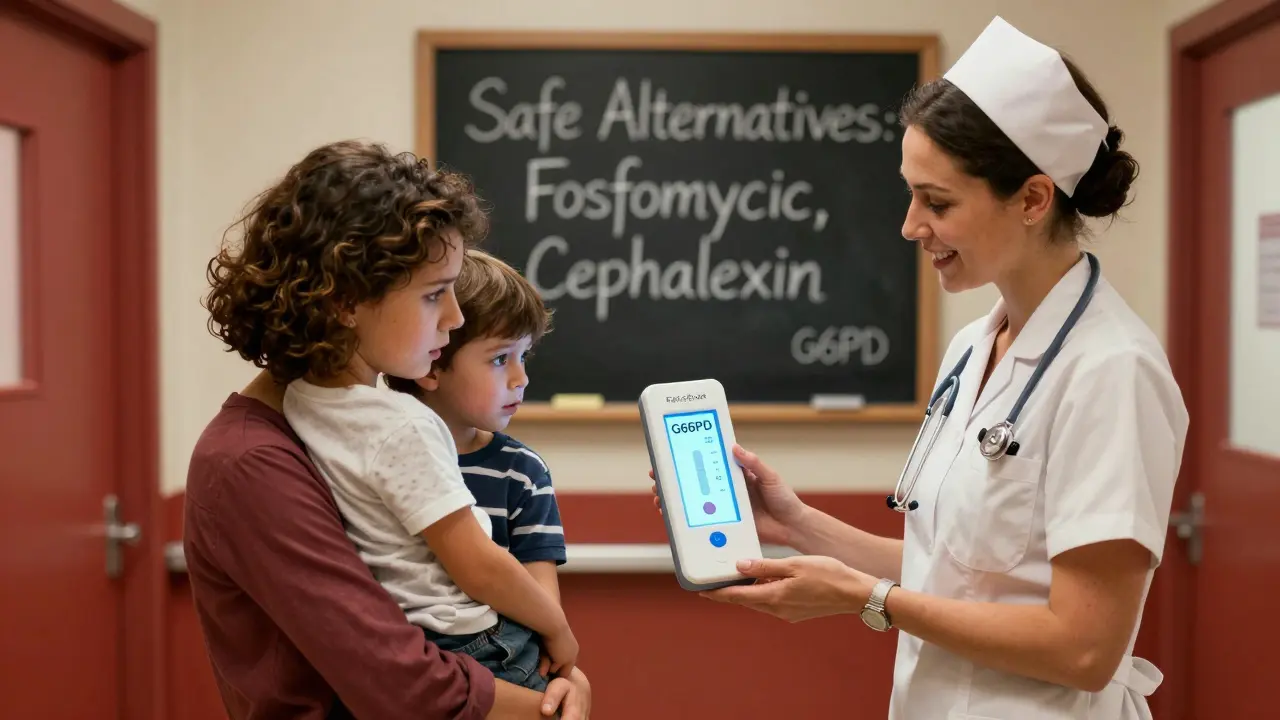
If you’re at risk for G6PD deficiency-your family comes from Africa, the Mediterranean, the Middle East, or Southeast Asia-ask your doctor for a simple blood test before taking nitrofurantoin. It’s a finger prick, results in under an hour with newer point-of-care tests.
If you have G6PD deficiency, there are safe alternatives:
- Fosfomycin (Monurol): A single-dose oral antibiotic with no known hemolytic risk. Now recommended by the CPIC as first-line for G6PD-deficient patients.
- Cephalexin: A first-generation cephalosporin. Low risk of hemolysis, though not always effective against resistant E. coli.
- Pivmecillinam: Used widely in Europe, low resistance, no G6PD interaction.
- Trimethoprim-sulfamethoxazole: Only if you’re not allergic and your infection isn’t resistant. Sulfonamides can also trigger hemolysis in G6PD deficiency, so use with caution.
For pregnant women with UTIs and unknown G6PD status, fosfomycin is the safest bet. Nitrofurantoin is sometimes used in pregnancy-but not if G6PD deficiency is suspected. The risk to the fetus from maternal hemolysis is real.

What’s Changing-and What’s Not
The good news? Awareness is growing. The global G6PD testing market is expected to hit $310 million by 2027. Point-of-care tests are becoming faster and cheaper. Electronic health records in some U.S. hospitals now flash alerts if a patient’s ethnicity suggests G6PD deficiency and a nitrofurantoin prescription is being written.
The bad news? Regulations haven’t kept up. The FDA’s nitrofurantoin label warns of hemolytic anemia in G6PD-deficient patients-but doesn’t require testing. The European Medicines Agency updated its warning in 2021. But in many places, the default is still: prescribe nitrofurantoin, hope for the best.
There’s an ongoing NIH trial (NCT04567891) testing whether routine G6PD screening before nitrofurantoin use saves money and lives. Preliminary results are due in mid-2024. If they show a strong return on investment, this could become standard practice.
Bottom Line: Don’t Guess. Test.
Nitrofurantoin is a good drug-for the right person. But for someone with G6PD deficiency, it’s a ticking time bomb. You can’t tell who’s at risk by looking. You can’t rely on symptoms before it’s too late. And you can’t afford to wait until the hemoglobin crashes to act.
If you’re from a high-risk background, have had unexplained anemia before, or have a family member with G6PD deficiency, ask your doctor for a test before you fill that prescription. If you’re a provider, don’t assume your patient’s history is complete. A simple blood test can prevent a hospital stay, a transfusion, or worse.
There’s no excuse anymore. The test exists. The guidelines are clear. The cost of skipping it is too high.
Can nitrofurantoin cause hemolytic anemia even if I’ve taken it before without problems?
Yes. G6PD deficiency is genetic, so if you have it, you’ve always had it. You might have taken nitrofurantoin before without symptoms because your body handled the oxidative stress that time. But each exposure can be more severe, especially if you’re sick, dehydrated, or taking other oxidizing drugs. There’s no safe "trial run." Once you’re diagnosed with G6PD deficiency, avoid nitrofurantoin completely.
Is G6PD testing covered by insurance?
In the U.S., Medicare and most private insurers cover G6PD testing when ordered for clinical reasons, like before prescribing nitrofurantoin. The test typically costs $35-$50 out-of-pocket, but if you have insurance, your copay may be lower or zero. In the UK, testing is available through the NHS if there’s a clinical suspicion, but it’s not routinely offered for UTI prescriptions. Always check with your provider or lab.
Are there any symptoms I should watch for if I accidentally take nitrofurantoin?
Yes. If you have G6PD deficiency and take nitrofurantoin, watch for dark urine (cola- or tea-colored), sudden fatigue, yellowing of the skin or eyes (jaundice), rapid heartbeat, dizziness, or fever. These can appear within 1-3 days. Stop the drug immediately and seek medical care. Early intervention-stopping the drug and staying hydrated-can prevent serious complications. Don’t wait for symptoms to worsen.
Can my children inherit G6PD deficiency if I have it?
Yes. G6PD deficiency is X-linked, meaning it’s passed through the X chromosome. If you’re male and have it, all your daughters will be carriers (they inherit your X chromosome), but none of your sons will (they get your Y). If you’re female and have it, each son has a 50% chance of inheriting it, and each daughter has a 50% chance of being a carrier. If you’re planning a pregnancy and have G6PD deficiency, talk to a genetic counselor about risks to future children.
What other drugs should I avoid if I have G6PD deficiency?
Besides nitrofurantoin, avoid sulfa drugs (like sulfamethoxazole), primaquine, dapsone, methylene blue, and some antimalarials. Also avoid naphthalene (mothballs), fava beans, and certain herbal supplements like angelica and tea tree oil. Always check with your pharmacist or doctor before taking any new medication, even over-the-counter ones. Keep a list of unsafe drugs and carry it with you.



Comments
Wesley Pereira
5/Jan/2026nitrofurantoin is literally a landmine for G6PD folks and docs still treat it like it’s Advil? 😑 I’ve seen three patients crash in the ER from this. One was a 68yo Black veteran who’d taken it twice before ‘no prob’-until the third time his Hgb dropped to 5.8. He needed a transfusion. He didn’t know he had G6PD. Neither did his PCP. We’re not talking rare edge cases here. This is systemic negligence.
Isaac Jules
5/Jan/2026LOL so now we’re gonna test everyone for G6PD before giving them a UTI antibiotic? Next you’ll want a DNA scan before prescribing ibuprofen. Grow up. If you’re from a ‘high-risk’ group, you should know your own damn history. Stop making healthcare a lottery.
Amy Le
5/Jan/2026U.S. doctors are lazy. In India, we test for G6PD before ANY antimalarial or antibiotic. Period. We’ve known this since the 1950s. But here? We’d rather spend $10k treating a hemolytic crisis than $50 to prevent it. Classic American healthcare logic: pay now or pay later-preferably later, with interest.
Ryan Barr
5/Jan/2026Test. Don’t guess.
Dana Termini
5/Jan/2026This is one of those things that should be obvious, but isn’t. I’m a nurse and I’ve seen patients get scared when they hear ‘hemolytic anemia’-like it’s a death sentence. But if you catch it early, stop the drug, hydrate, and monitor? Most people bounce back. It’s not about fear. It’s about awareness. And we’re failing at that.
Pavan Vora
5/Jan/2026Wow... this is so important... I am from India, and here, G6PD is checked before any antibiotic is given... especially in newborns... but in US, it's like... people just... assume? I mean, why? It's just a finger prick... I don't understand... it's not like it's expensive or hard... why do we wait until someone is almost dead?
Tom Swinton
5/Jan/2026Let me tell you something-I had a cousin who took nitrofurantoin for a UTI and ended up in the ICU. He’s 32, African American, never been told he had G6PD deficiency. He thought he was fine because he’d taken sulfa drugs before. But this time? His body couldn’t handle it. He was pale, jaundiced, couldn’t breathe. His wife found him passed out on the bathroom floor. They rushed him. He got a transfusion. He’s okay now, but he’s terrified of every pill. And guess what? His doctor didn’t even ask about family history. Just wrote the script. This isn’t just medical negligence-it’s a betrayal of trust. We need mandatory screening. Not optional. Not ‘if you think you’re at risk.’ If you’re Black, Mediterranean, or Southeast Asian, you should be flagged. Period. No more ‘hope for the best.’ We’re better than this.
Molly McLane
5/Jan/2026For anyone reading this: if you’ve ever had unexplained fatigue, dark urine, or jaundice after taking antibiotics-especially sulfa or nitrofurantoin-get tested. It’s not a big deal. It’s a finger prick. And if you’re a parent? Ask about newborn screening. In some states, they do it. In others? They don’t. That’s not a coincidence. That’s systemic bias. We can fix this. But only if we stop pretending it’s not happening.
Beth Templeton
5/Jan/2026Test. Done. Next.
Cam Jane
5/Jan/2026I’m a pharmacist and I see this every week. Someone walks in with a nitrofurantoin script, I check their profile-ethnicity, meds, allergies-and if there’s even a hint of risk, I call the doctor. Nine times out of ten, they’re like, ‘Oh, I didn’t know.’ So I say, ‘I’ll hold the script. Let’s get a G6PD test first.’ Sometimes they’re mad. Sometimes they’re grateful. But I’d rather lose a sale than lose a patient. Fosfomycin works just as well. It’s pricier? Yeah. But so is a hospital bed. And a blood transfusion. And a lawsuit. This isn’t rocket science. It’s basic harm reduction. Why are we still debating this?
Stuart Shield
5/Jan/2026Christ on a bike. I’m British and I’ve never even heard of this being tested for before a UTI script. We’re so bloody slow on the uptake. We’ve got NHS doctors prescribing this like it’s tea and crumpets. Meanwhile, in Nigeria or Pakistan, they’ve got G6PD flags on every prescription system. We’re still using paper charts and hoping for the best. It’s not just negligence-it’s cultural arrogance. We think our way is ‘modern’ when we’re literally leaving people to die because we’re too lazy to click a checkbox.
Indra Triawan
5/Jan/2026But... what if you don't know your ancestry? What if you're adopted? What if your family never talked about health? Isn't it unfair to blame the patient for not knowing something they were never told? And isn't it easier to just test everyone? Why make it so complicated?
Susan Arlene
5/Jan/2026so like... if you’re from a group that’s known to have this, you’re basically just supposed to know? like, it’s your responsibility to have a family history? but what if you’re mixed? or adopted? or your parents didn’t talk about it? i mean… it’s not like we all got a manual. i just want to take a pill for my UTI without being a lab experiment. why can’t the system just… check? it’s 2024.