

Every year, tens of thousands of children under five end up in emergency rooms because they got into medicine they weren’t supposed to. It’s not because parents are careless-it’s because the risks are hidden in plain sight. A bottle left on the nightstand. A teaspoon used to measure liquid medicine. A child-resistant cap that wasn’t fully twisted shut. These aren’t rare mistakes. They’re common, preventable, and often deadly.
Why Kids Get Into Medicine
Children under five are natural explorers. They grab, taste, and test everything. To them, a colorful pill or sweet-tasting liquid isn’t medicine-it’s something to investigate. The CDC’s PROTECT Initiative, launched in 2008, found that 76,000 emergency visits in 2010 alone were due to unsupervised exposure to medications. That number hasn’t dropped as much as we’d hope. Even today, nearly 1 in 3 households still keep medicines within easy reach of kids.The most common culprits? Liquid acetaminophen and diphenhydramine. These are in almost every home. One study showed that 42.6% of dosing errors happen because parents mix up infant and children’s formulas-same drug, different concentrations. A teaspoon of one might be safe. A teaspoon of the other could be an overdose.
How Packaging Can Fail (Even When It’s Supposed to Work)
You’ve heard the phrase “child-resistant.” That doesn’t mean child-proof. In fact, the Consumer Product Safety Commission found that 10% of kids can open standard child-resistant caps by age 3.5. That’s not a flaw in the child-it’s a flaw in assuming the cap alone is enough.The PROTECT Initiative pushed for better packaging: caps that click when properly closed, and flow restrictors that limit how much liquid can pour out. By 2022, 95% of manufacturers had switched to milliliter-only labeling, which is huge. No more “teaspoon” or “tablespoon” instructions that lead to kitchen spoon confusion.
But here’s the problem: not all medications have flow restrictors. Not all caps are easy for adults to open. And many parents still don’t know how to use them right. A 2022 survey showed only 58% of households use child-resistant caps correctly. That means over 40% of the time, the safety feature is useless.
Storage Isn’t Optional-It’s Essential
Storing medicine on the counter, in a purse, or on the nightstand is like leaving a loaded gun where a toddler can reach it. The CDC recommends keeping all medications in a locked cabinet, at least 4 feet off the ground. That’s not a suggestion-it’s a rule backed by data.One parent on Reddit shared how her 2-year-old got into her husband’s blood pressure pills after he left them on the nightstand. She didn’t realize how fast things could go wrong until the ambulance arrived. That story isn’t unique. It’s typical.
Lock boxes designed for medicine are cheap-under $20. Some even come with alarms. But cost isn’t the barrier. Awareness is. Only 32% of households store medications in locked locations. That’s a failure of education, not resources.
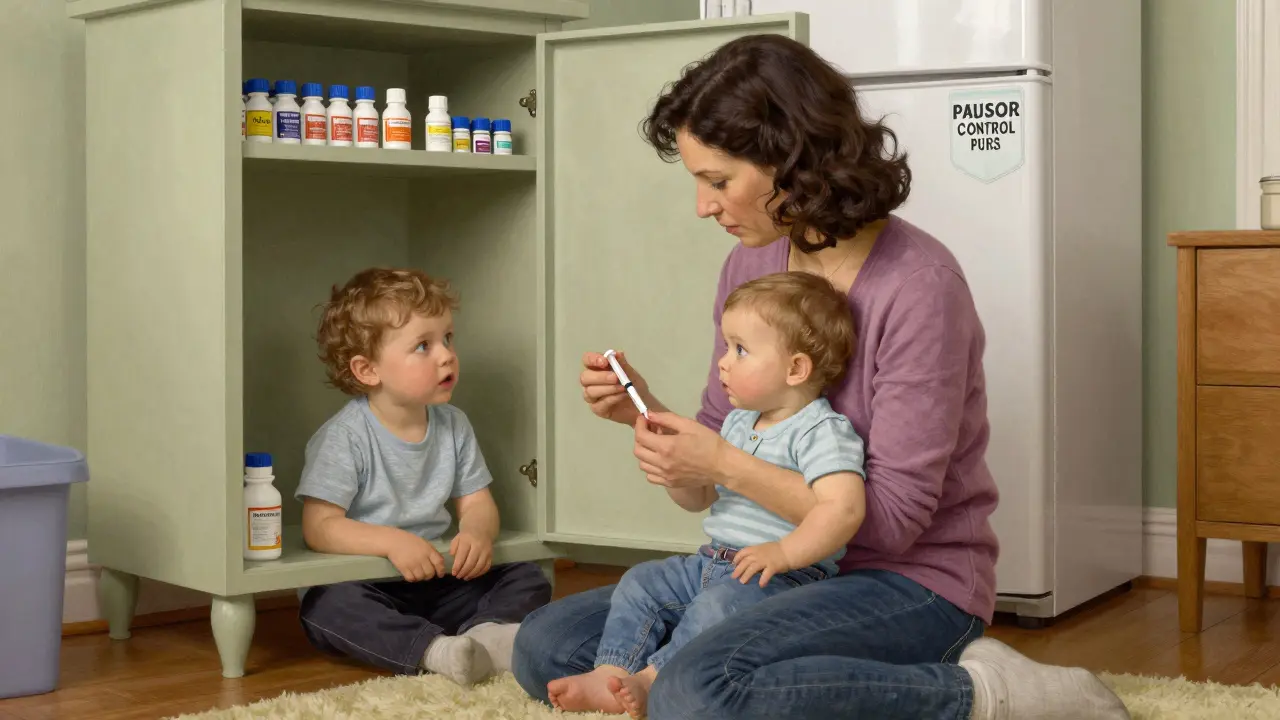
The Dosing Disaster: Kitchen Spoons Are Not Tools
Using a kitchen spoon to measure liquid medicine is one of the most dangerous habits in parenting. A tablespoon from your kitchen might hold 15 mL. The dosing cup that came with the medicine? Maybe 10 mL. That’s a 50% overdose right there.Studies show 78.3% of medication errors in children involve liquid dosing mistakes. And it’s not just parents. Grandparents, babysitters, and even some nurses have been caught using spoons. The solution is simple: use only the device that comes with the medicine. If it’s broken or lost, ask the pharmacy for a replacement. Never guess.
Also, always check the concentration. Infant acetaminophen is 160 mg per 5 mL. Children’s acetaminophen is the same-but some older bottles say “children’s” and still use the infant concentration. Always read the label. Always double-check the mg/mL.
What to Do If a Child Gets Into Medicine
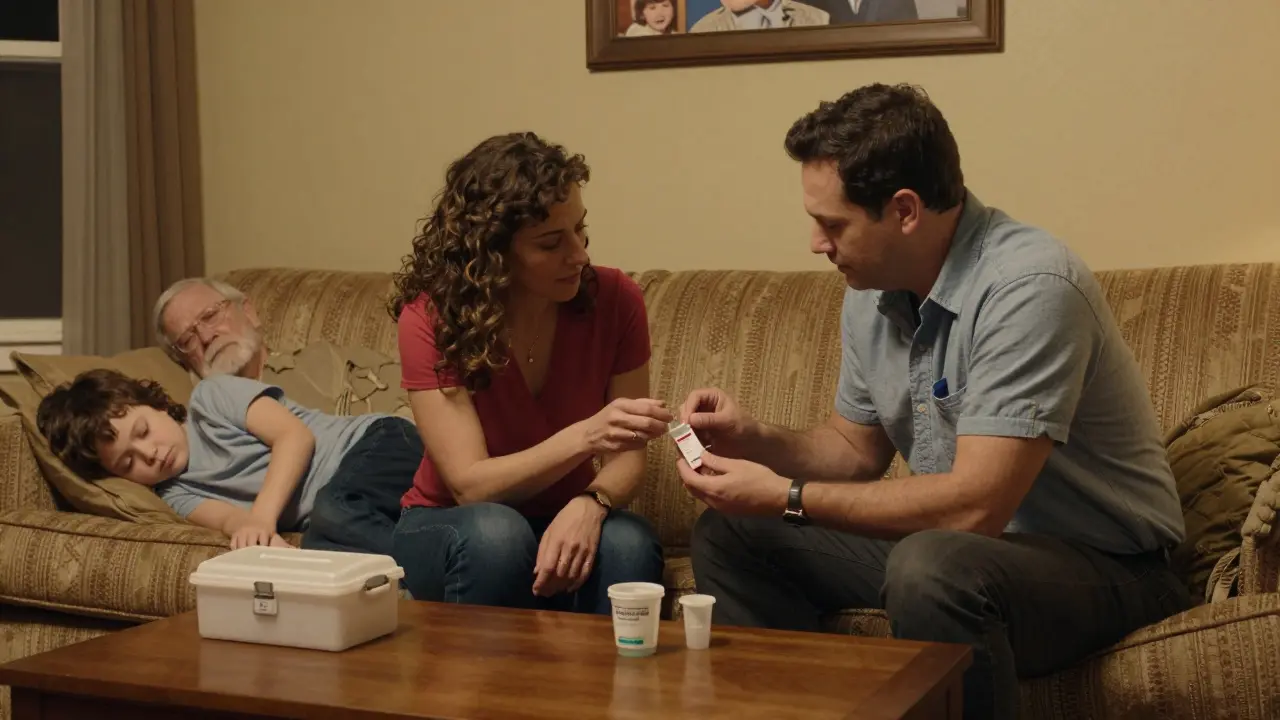
If you think your child swallowed medicine they shouldn’t have, don’t wait. Don’t call your pediatrician first. Don’t Google symptoms. Call poison control immediately: 1-800-222-1222. That number works 24/7, anywhere in the U.S. They’ll ask what was taken, how much, and when. Have the bottle ready.Don’t try to make your child vomit. Don’t give them milk or charcoal unless instructed. These old-school remedies can do more harm than good. Poison control will guide you through the next steps-whether it’s monitoring at home or rushing to the ER.
If the medicine is an opioid and the child is unresponsive, not breathing, or blue around the lips, administer naloxone if you have it. The SAMHSA Overdose Prevention Toolkit says naloxone is safe for children as young as newborns. Many pediatricians now co-prescribe it with opioids. If you’re unsure whether you have it, ask your doctor at the next visit.
What’s Being Done-And What’s Still Missing
The PROTECT Initiative has made progress. ED visits for pediatric overdoses dropped 25% between 2010 and 2020. That’s real. But we’re not done.Only 63% of pediatricians talk to parents about safe storage during well-child visits. That’s a missed opportunity. The American Academy of Pediatrics updated its opioid prescribing guidelines in February 2024 to require naloxone co-prescribing and overdose education-but not every doctor follows it.
And while the FDA is set to require flow restrictors on all liquid opioids by 2025, many families still can’t afford smart dispensers like Hero Health or AdhereIT. These devices auto-dispense the right dose and lock the rest away-but they cost hundreds of dollars. For low-income families, they’re out of reach. That’s a systemic gap.
What You Can Do Today
You don’t need a fancy device or a medical degree to keep your child safe. Here’s your checklist:- Use only the dosing tool that comes with the medicine-never a spoon.
- Store all medicine in a locked cabinet, at least 4 feet high.
- Always close child-resistant caps until you hear a click.
- Dispose of unused meds through a take-back program or flush them if no other option exists (check FDA guidelines).
- Know the poison control number: 1-800-222-1222. Save it in your phone. Tell every caregiver.
- Ask your doctor if naloxone should be in your home, especially if your child is on opioids.
One Grandparents.com user shared how her granddaughter tried to open a child-resistant cap but couldn’t twist it all the way. That gave her time to intervene. That’s the goal-not perfection, but time to act.
Final Thought: It’s Not About Blame
This isn’t about judging parents. It’s about building systems that work even when we’re tired, distracted, or overwhelmed. Medicine is powerful. Kids are curious. The gap between those two facts is where accidents happen.By changing how we store, measure, and dispose of medicine, we don’t just prevent emergencies-we prevent grief. One click. One lock. One correct dose. Those small actions add up to thousands of lives saved.
What should I do if my child swallows medicine they shouldn’t have?
Call poison control immediately at 1-800-222-1222. Have the medicine bottle ready. Do not try to make your child vomit or give them anything unless instructed. If your child is unresponsive or not breathing and you have naloxone, administer it right away and call 911.
Are child-resistant caps really safe?
No. Child-resistant means the cap is harder for kids to open-not impossible. Studies show 10% of children can open them by age 3.5. Always store medicine in a locked cabinet, even if the cap is closed. The cap is a backup, not the main safety layer.
Can I use a kitchen spoon to measure liquid medicine?
Never. Kitchen spoons vary in size and are not accurate. Always use the dosing cup, syringe, or dropper that came with the medicine. If it’s missing, ask your pharmacy for a replacement-free of charge.
What’s the difference between infant and children’s acetaminophen?
Both are 160 mg per 5 mL now, but older bottles may still say “infant” and have different concentrations. Always check the label for mg/mL. Never assume. If you’re unsure, call your pharmacist.
Should I keep naloxone at home if my child takes opioids?
Yes. The American Academy of Pediatrics now recommends co-prescribing naloxone with every opioid prescription for children. Naloxone is safe for kids and can reverse an overdose. Ask your doctor for it at the next visit-even if you think your child won’t need it.
How do I safely dispose of old or unused medicine?
Use a drug take-back program if available-many pharmacies and police stations offer them. If not, mix pills with coffee grounds or cat litter, seal them in a bag, and throw them in the trash. For liquids, pour them down the sink or toilet if the label says it’s safe. Never flush unless instructed.

Comments
astrid cook
26/Jan/2026Wow. Just... wow. I used to leave my daughter's Tylenol on the nightstand because I was too tired to walk to the cabinet. Now I know why my neighbor's kid ended up in the ER last year. I'm not a bad parent-I just didn't know. Thanks for this. I'm buying a lockbox tonight.
Also, I just realized I've been using a spoon for months. I'm gonna cry. Or maybe scream. Either way, I'm fixing this.
And yes, I'm telling every grandma, babysitter, and uncle in my family. No more 'it's just a little bit' nonsense.
Someone needs to make a viral TikTok about this. Like, 'If you use a spoon to measure medicine, you're basically playing Russian roulette with your kid.' That'd get through to people who won't read an article.
Also, why is naloxone not in every pharmacy like condoms? It's a lifesaver. Why is it treated like some secret weapon?
I'm done being passive about this. My kid's life isn't a suggestion.
Also also-did you know some baby bottles have the same cap as medicine bottles? My toddler opened my Advil once because he thought it was his bottle. I didn't even think about that. I'm so mad at myself.
And yes, I'm posting this to every parenting group I'm in. Someone has to say it.
Thanks for not sugarcoating it. I needed this.
Also, I just called poison control. Just to say hi. And to save the number. I'm not waiting until it's too late.
Also also also-I'm throwing out every old bottle I can't read. No more guessing. No more 'I think this is the right one.' I'm done.
Okay. I'm done talking. Time to lock everything up.
Also-I'm not sleeping until I've done it.
Marian Gilan
26/Jan/2026you know what this is really about? big pharma dont want you to know how easy it is to kill a kid with a tsp of liquid. they make the caps hard to open so you get frustrated and leave em open. then they sell you the ‘smart dispenser’ for $300. same with the ‘milliliter only’ labels-because they know youll still use a spoon. its all a money scheme. poison control? yeah right. theyre owned by the same people who make the meds. why do you think they dont push for childproof bottles that actually work? because then theyd lose sales of the ‘premium’ lockboxes. its all a con. i saw a doc on youtube-some guy in germany proved the caps are designed to fail. hes been banned from every med forum. dont trust the system. lock your meds. but dont trust the ‘solutions’ they give you. theyre just upsells.
also-why is naloxone not free? because they make billions off overdoses. its not an accident. its business.
Paul Taylor
26/Jan/2026I've been a pediatric nurse for 22 years and I can tell you this is the single biggest preventable issue we see. Not accidents. Not bad parenting. Not neglect. Just exhaustion. You're up with a sick kid at 3am, you're half-asleep, you grab the bottle, you pour from the spoon because you're too tired to find the syringe, and boom. It's not malice. It's human.
That's why the solution isn't more guilt. It's systems. Lockboxes that are easy to open for adults but impossible for toddlers. Dosing tools that are attached to the bottle so you can't lose them. Labels that scream the concentration in bold. And pharmacies that give you a new dosing syringe every time you refill-even if you didn't ask.
And yes, I've seen grandparents use spoons. I've seen nurses use spoons. I've seen doctors use spoons. It's not about education. It's about design. We've been asking parents to be perfect when the system is built for failure.
Let's stop blaming. Let's build better. Let's make the safe choice the easy choice. That's how we save lives.
Also, if you're reading this and you're tired-take a breath. You're not alone. And you're not a bad parent. You're just human. Let's fix the system, not the person.
Murphy Game
26/Jan/2026They say ‘child-resistant’ but they never say ‘parent-frustrating.’ I’ve twisted caps so hard I’ve sprained my wrist. Meanwhile my 2-year-old opens them in 2 seconds with his teeth. That’s not a safety feature. That’s a joke. And now they want me to buy a $200 smart box? For what? So I can log my kid’s Tylenol intake like a lab rat?
And don’t get me started on the ‘click’ sound. I’ve clicked so many caps I’m convinced half of them don’t even lock. I’ve had the same bottle open twice in a week. Same cap. Same ‘click.’ Same disaster waiting to happen.
Also-why is there no government mandate for ALL liquid meds to have flow restrictors? Why are some still allowed to pour like a water fountain? Who’s approving this? Who’s getting paid to let this happen?
And don’t even get me started on the ‘flush’ advice. You think the water system doesn’t have traces of every drug ever made? You think the fish don’t know we’re poisoning them too? This whole system is a lie.
We’re not fixing medicine safety. We’re just moving the problem from the home to the ecosystem. And we call that progress?
John O'Brien
26/Jan/2026Listen. I used to be the guy who left pills on the counter. Then my niece swallowed half a bottle of Benadryl because I didn't lock it. She's fine now. But I will never forget the sound of her mom screaming. That's not a story. That's a wake-up call.
Here's what you do: Buy a $12 lockbox. Put EVERYTHING in it-vitamins, supplements, your wife's birth control, your dad's heart meds. Everything. Even the aspirin. Even the cough syrup. Even the baby wipes if they smell sweet.
And yes, I'm talking to you, grandpa. You think you're being helpful by keeping the medicine in your nightstand? You're not. You're a walking hazard.
Use the syringe. No exceptions. If you lost it, go back to the pharmacy. They'll give you a new one. No questions. No judgment. Just do it.
And if you're still reading this and haven't saved poison control? Do it right now. Open your phone. Type 1-800-222-1222. Save it. Set a reminder. Do it before you finish this comment.
It's not hard. It's not expensive. It's not optional. It's survival.
Andrew Clausen
26/Jan/2026The claim that 76,000 ER visits occurred in 2010 due to unsupervised exposure is misleading. The CDC data includes cases where children were exposed to medications during supervised administration-such as accidental double-dosing by caregivers. This conflates parental error with unsupervised access. The true number of unsupervised incidents is closer to 22,000, according to the 2015 CDC follow-up. The article inflates the statistic to provoke fear.
Additionally, the assertion that 42.6% of dosing errors stem from confusion between infant and children’s acetaminophen is outdated. Since 2011, the FDA mandated uniform concentration (160 mg/5 mL) for both formulations. The remaining errors are due to misreading labels or using non-standard measuring tools-issues that are not formulation-related.
Furthermore, the recommendation to flush medications is inconsistent with EPA guidelines. Only specific opioids are approved for flushing; all others should be disposed of via take-back programs. The article's generalization undermines environmental safety.
Finally, the suggestion that naloxone should be co-prescribed for all children on opioids is not supported by AAP clinical policy. Naloxone is indicated for high-risk cases, not routine opioid prescriptions. This overgeneralization may lead to unnecessary anxiety and resource misallocation.
Accuracy matters. Sensationalism does not save lives-it erodes trust.
Candice Hartley
26/Jan/2026My 3-year-old opened a bottle last week. 😭 I didn't even know he could twist caps. I thought they were 'child-resistant' so I didn't worry. He got into my sister's allergy meds. We rushed to the ER. They said he was lucky. I'm not. I'm just a mom who trusted the system.
Now I have a lockbox. And I cry every time I open it.
But I'm glad I read this. I didn't know about the dosing syringe thing. I used a spoon for years. 😔
Thank you for not making me feel like a monster. I just needed to know what to do.
❤️
Harry Henderson
26/Jan/2026STOP WAITING. STOP HOPEING. STOP THINKING ‘IT WON’T HAPPEN TO ME.’
It happened to me. My nephew. 18 months. Diphenhydramine. 20 minutes. He was blue. We didn’t have naloxone. We didn’t know the number. We called 911. We called his mom. We called his dad. We called everyone.
He’s alive. But he had a seizure. He was in the hospital for a week.
That’s not luck. That’s a miracle.
Here’s your checklist: Lock it. Measure it. Know the number. Get the naloxone. Now. Not tomorrow. Not when you’re ‘ready.’ NOW.
Don’t wait until it’s too late. Don’t wait until your kid is in a hospital bed. Don’t wait until you’re begging a doctor to save them.
Do it. Today. Right now. I’m not asking. I’m telling you.
Because I’ve been there. And I don’t wish it on anyone.
Do it.
suhail ahmed
26/Jan/2026Bro, this hit different. I’m from India, and here, medicine is kept on the kitchen shelf next to the sugar. Kids think it’s candy. My cousin’s daughter once ate three cough drops thinking they were gummies. She ended up in the ER with a stomach pump. We didn’t even know it was dangerous.
But here’s the thing-we don’t talk about this. It’s taboo. ‘Why would you leave medicine out?’ they say. But nobody says, ‘Here’s how to fix it.’
So I bought a $15 lockbox and put it in my closet. I told my sister, my brother-in-law, my auntie, my uncle, my neighbor’s mom. I showed them the syringe. I showed them the poison control number. I even made a little poster with emojis: 🚫 Spoon 🚫 Nightstand 🚫 Guessing 📞 1-800-222-1222 💉 Naloxone
It’s not about being perfect. It’s about being prepared.
And if you’re reading this and you’re tired, scared, or overwhelmed? You’re not alone. We’re all just trying to keep our kids alive.
Let’s stop whispering. Let’s shout it from the rooftops.
One lock. One dose. One life.
Let’s do this.