

Kidney Protection Hydration Calculator
Personalized Hydration Plan Calculator
This tool helps determine the most appropriate hydration protocol for patients undergoing imaging procedures that use contrast dye, based on kidney function and health conditions.
Your Health Information
When you’re scheduled for a CT scan, angiogram, or other imaging test that uses contrast dye, your doctor might tell you to drink more water. But it’s not just about staying thirsty-it’s about protecting your kidneys from damage caused by nephrotoxic medications. For many people, especially those with existing kidney issues, this simple step can mean the difference between walking out of the hospital the same day and spending days in the hospital with acute kidney injury.
Why Hydration Matters More Than You Think
Contrast dye used in imaging tests isn’t harmless. It’s a known nephrotoxin-a substance that can harm kidney cells. About 1 in 10 patients with chronic kidney disease or diabetes will develop contrast-induced acute kidney injury (CI-AKI) after receiving this dye. CI-AKI shows up as a sudden spike in creatinine levels within 48 to 72 hours after the procedure. It’s not always dramatic-sometimes it’s just a small change in blood tests-but it can lead to longer hospital stays, dialysis, or even permanent kidney damage. The good news? Hydration is one of the most effective, low-cost ways to prevent it. Studies show that giving the right fluids at the right time can cut CI-AKI risk by more than half. And it’s not just about chugging a gallon of water. Timing, type, and amount matter. A 2020 analysis of over 21,000 patients found that standard IV saline reduced CI-AKI by 26%. But the most advanced methods? They slashed it by nearly 70%.What Does a Real Hydration Plan Look Like?
There’s no one-size-fits-all plan. It depends on your kidney function, heart health, and the type of procedure you’re having. Here’s what the evidence says about the most common approaches:- Standard IV saline: 0.9% sodium chloride given at 3-4 mL per kg of body weight per hour, starting 4 hours before the procedure and continuing for 4 hours after. This is the baseline for most hospitals.
- Long protocol IV saline: Slower drip at 1 mL per kg per hour, starting 12 hours before and lasting 12 hours after. Used for higher-risk patients, but adds nearly 5 hours to your hospital stay.
- Sodium bicarbonate IV: A slightly alkaline solution given at 3 mL per kg per hour for 1 hour before, then 1 mL per kg per hour for 6 hours after. Shown to reduce CI-AKI by 26%, similar to saline but with a slight edge in some studies.
- Oral hydration: 500 mL of water 2 hours before, then 250 mL every hour during the procedure. For patients with eGFR above 29 mL/min/1.73m², this works just as well as IV fluids-with no needles involved.
- RenalGuard system: A closed-loop device that tracks your urine output and automatically adjusts IV fluids to keep you producing 150-200 mL per hour. Used in high-risk patients and shown to reduce CI-AKI by 68%.
For most people with normal kidney function, drinking water is enough. But if your eGFR is below 60, especially below 30, you’re in the high-risk group-and you need more than just advice to drink more.
Who Needs Advanced Hydration? Who Doesn’t?
Not everyone needs an IV. A 2018 study in eClinicalMedicine found that patients with eGFR above 29 mL/min/1.73m² had almost no difference in kidney injury rates whether they got IV fluids or nothing at all. That’s a game-changer. It means thousands of low-risk patients are getting unnecessary IVs, needles, and hospital time. But for those with chronic kidney disease (CKD stage 3 or worse), diabetes, heart failure, or age over 75? The data is clear: skip hydration at your peril. In high-risk patients, CI-AKI rates drop from over 20% without hydration to under 8% with RenalGuard. That’s not just a stat-it’s avoiding dialysis, avoiding ICU stays, avoiding long-term kidney decline. The VA/DOD Clinical Practice Guideline from April 2025 spells it out: for patients with eGFR between 30 and 59, use isotonic fluids at 1-1.5 mL/kg/hour for 3-12 hours before and after contrast. For eGFR under 30? Don’t rush into contrast at all. Consider an MRI or ultrasound first. If contrast is unavoidable, use the most aggressive hydration possible-and monitor closely.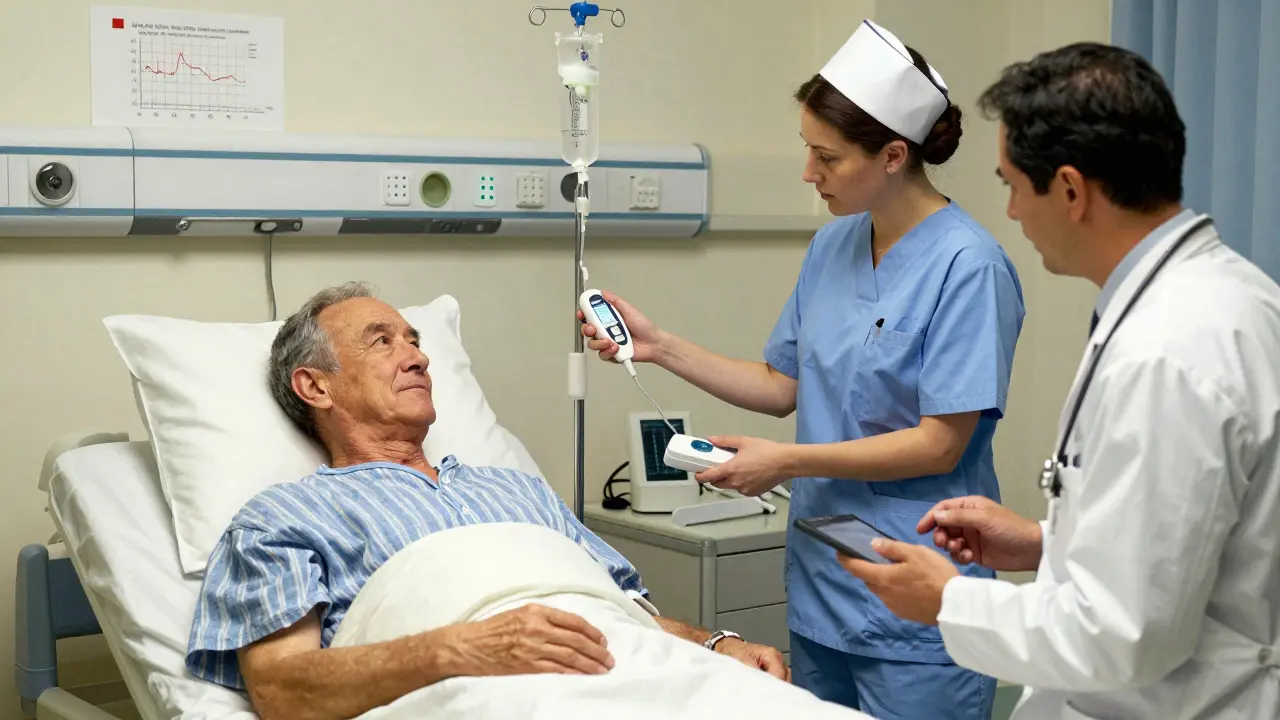
Advanced Systems: Are They Worth the Cost?
The RenalGuard system sounds like sci-fi: it monitors your urine in real time and pumps in fluid exactly as needed. It’s expensive-adding about $1,200 per procedure. But here’s the catch: each case of CI-AKI costs hospitals around $7,500 in extra days, dialysis, and complications. So preventing one case pays for the system-and then some. Hospitals with high procedure volumes (over 1,000 a year) are adopting these systems faster. About 15% of major cardiac cath labs in the U.S. now use RenalGuard. The American Heart Association predicts AI-driven fluid systems will be standard in five years. Why? Because they’re smarter than humans. They don’t miss a drop. They don’t overhydrate a heart failure patient. They adjust on the fly. But here’s the reality: most community hospitals still use standard IV saline. It’s cheaper, simpler, and works well enough for most. You don’t need RenalGuard unless you’re high-risk and your hospital has it. Ask your doctor: “Do I need IV fluids? Is there a better option for my kidney function?”What About Heart Failure Patients?
This is where things get tricky. Hydration helps kidneys-but too much fluid can drown a weak heart. Patients with reduced ejection fraction (below 35%) are at risk of pulmonary edema if given too much IV fluid. Even 500 mL extra can trigger a hospital readmission. That’s why hemodynamic-guided hydration exists. It doesn’t just count milliliters-it monitors central venous pressure, blood pressure, and heart rate to tailor fluid delivery. It’s the gold standard for patients with both kidney disease and heart failure. If you have both, your hydration plan must be a tightrope walk. Too little, and your kidneys get damaged. Too much, and your lungs fill with fluid. The key? Communication. Tell your care team about every heart condition, every diuretic you take, every time you’ve been hospitalized for swelling. They need that info to balance your fluids safely.What You Can Do Right Now
If you’re scheduled for a scan with contrast:- Check your latest eGFR. If it’s below 60, talk to your doctor about hydration before your appointment.
- Ask: “Will I get IV fluids, or is oral hydration enough?”
- If you’re told to drink water, don’t wait until the day before. Start 24 hours ahead. Keep sipping.
- Don’t skip your pre-procedure blood work. Your creatinine level determines your risk.
- If you have heart failure, ask if your fluid plan includes monitoring for overload.
The National Kidney Foundation says it plainly: “Drinking extra water with certain medicines or after a test that uses dye may help prevent kidney damage.” But they also warn: “Your needs are personal.” Don’t assume your neighbor’s plan works for you.





Comments
Meina Taiwo
19/Dec/2025For patients with eGFR under 30, oral hydration alone isn't enough-IV is non-negotiable. I've seen too many cases where lazy protocols led to avoidable AKI. Stick to the guidelines, not the convenience.
Sandy Crux
19/Dec/2025Oh, of course… the medical-industrial complex has *finally* discovered that water is good for kidneys. Next they’ll tell us oxygen prevents asphyxiation. And let’s not forget the RenalGuard™-a $1,200 placebo with a fancy name and a patent lawyer’s signature.
Sarah Williams
19/Dec/2025Hydration isn’t optional-it’s preventative medicine. If your doc doesn’t mention it, ask. Your kidneys won’t remind you.
Theo Newbold
19/Dec/2025Contrast-induced AKI is a well-documented phenomenon, but the meta-analyses cited here suffer from selection bias. Most studies exclude patients with severe comorbidities, skewing outcomes. Also, the RenalGuard data is largely from tertiary centers-hardly generalizable to community hospitals.
Jay lawch
19/Dec/2025They want you to drink water, but they don’t tell you the dye is designed to trigger kidney stress so they can sell you more treatments later. The pharmaceutical lobby owns every guideline. The VA/DOD? They’re just puppets. Look at the numbers-CI-AKI spikes right after new contrast agents are approved. Coincidence? Or profit-driven pathology? You decide.
They say ‘drink water’-but they don’t say why the dye is even necessary. Why not use ultrasound? It’s cheaper, safer, and doesn’t require a corporate sponsorship. The system doesn’t want you healthy-it wants you returning.
My uncle got dialysis after a ‘routine’ CT. He was told to ‘drink more.’ He did. Nothing changed. The hospital never apologized. They just billed him $42,000.
They’ll tell you it’s science. But science is what they pay for. Ask yourself: who profits when your kidneys fail?
Dan Adkins
19/Dec/2025While the hydration protocols presented are statistically sound, one must consider the broader epistemological framework of nephrotoxicity prevention. The reduction in CI-AKI incidence is not merely a function of fluid volume, but of systemic renal perfusion dynamics modulated by osmotic gradients and tubular flow rates. The RenalGuard system, while technologically impressive, represents a reductionist approach to a multidimensional physiological challenge.
Furthermore, the assumption that oral hydration is equivalent to IV in patients with eGFR >29 assumes homogeneity of renal tubular function-an assumption invalidated by interindividual variability in aquaporin expression and sodium-potassium ATPase activity. Thus, blanket recommendations risk under-treatment in phenotypically high-risk subpopulations.
The economic argument for RenalGuard is compelling, yet it fails to account for the latent costs of iatrogenic fluid overload in elderly patients with subclinical cardiac dysfunction-a population often excluded from randomized trials. Thus, while the data is persuasive, clinical application requires nuanced interpretation.
Erika Putri Aldana
19/Dec/2025why do they even use this dye?? it's literally poison. why not just use a different test?? i'm tired of being told to drink water like i'm a dog who forgot to pee. they just want to make money. i got a scan last year and they gave me iv fluids even though i'm healthy. total scam.
Grace Rehman
19/Dec/2025So we've reduced a complex physiological response to a hydration checklist and called it medicine
How quaint
It's like telling someone with a broken leg to 'just walk it off' and then charging them for the crutches
Hydration isn't the solution-it's the bare minimum
The real problem is we're still using 1980s contrast agents in a 2025 world of imaging tech
And we call that progress
Jerry Peterson
19/Dec/2025My dad had a CT last month with eGFR at 34. They did the 12-hour IV protocol. He was fine. But I noticed the nurse was stressed-she had to manage three other patients on the same schedule. This stuff works, but it's not scalable. We need better systems, not just more nurses.
Southern NH Pagan Pride
19/Dec/2025they say iv fluids help but what if the saline is laced with something?? i read a thread once where a guy said the bags had microchips to track kidney response. dont trust the hospitals. they know what theyre doing. they just dont care. why do you think they dont use mri for everyone? its cheaper. its safer. its all about control.
Jackie Be
19/Dec/2025DRINK WATER PEOPLE ITS NOT THAT HARD!!! my grandma did it with just a water bottle and lived to 98!! stop overcomplicating everything!!! your kidneys are tougher than you think!!!
Orlando Marquez Jr
19/Dec/2025The clinical guidelines presented are methodologically rigorous and reflect a consensus grounded in contemporary evidence-based nephrology. The distinction between low-risk and high-risk cohorts is not merely statistical but physiologically significant. To generalize hydration protocols across all patient populations risks therapeutic misalignment, particularly in those with concurrent cardiovascular pathology. The RenalGuard system, while resource-intensive, exemplifies precision medicine at the intersection of hemodynamic monitoring and renal physiology. Its adoption should be contextualized within institutional capacity and patient risk stratification-not cost alone.
Furthermore, the dismissal of N-acetylcysteine is warranted by recent meta-analyses, yet the omission of urinary biomarkers such as NGAL and KIM-1 as adjunctive indicators of early tubular injury represents a missed opportunity for dynamic risk assessment. Future iterations of these protocols should integrate real-time biomarker feedback loops to personalize fluid delivery beyond static volume-based algorithms.
The ethical imperative here is not merely clinical efficacy, but equitable access. To reserve advanced hydration systems for tertiary centers while community hospitals rely on saline infusions is to institutionalize disparities in care. Policy must evolve to fund these technologies as preventive, not luxury, interventions.
Peggy Adams
19/Dec/2025Wait so you’re telling me the hospital doesn’t want me to die? How novel. Next they’ll tell me the sun rises in the east and that my insurance won’t cover my kidney transplant if I don’t drink 8 glasses of water. I’m shaking.
Adrian Thompson
19/Dec/2025They say ‘drink water’ but they don’t tell you the contrast dye is patented by a company that also owns the IV fluid suppliers. And the RenalGuard? Made by a subsidiary of the same conglomerate that sells the contrast agents. It’s a closed loop. You think this is medicine? It’s a revenue engine. Your kidneys are just a profit center.
Why do you think they stopped funding research into non-iodinated contrast? Because it didn’t have a patent. Because it didn’t make money. Water is free. That’s why they’ll never stop pushing IVs.
Grace Rehman
19/Dec/2025So we’ve turned prevention into a protocol checklist
And called it innovation
Meanwhile the real breakthrough would be ditching the nephrotoxin entirely
But that would require the system to stop treating bodies like billable events
And that… is not profitable