

Most people assume that if two pills have the same active ingredient, they work the same way. That’s true for the drug’s intended effect-but not always for how your body reacts to it. The real problem? The stuff besides the active ingredient. These are called inactive ingredients, or excipients. They’re the fillers, binders, dyes, and preservatives that make pills hold their shape, taste better, or last longer. And for some people, they’re a silent trigger for allergic reactions, digestive crashes, or even life-threatening symptoms.
Here’s the hard truth: 90% of all oral medications in the U.S. contain at least one ingredient that can cause a reaction in sensitive individuals. A major 2019 study from Brigham and Women’s Hospital and MIT analyzed over 42,000 medications and found that 92.8% of them included at least one of 38 known problematic excipients. That’s not rare. That’s routine.
What Are Inactive Ingredients, and Why Do They Matter?
Inactive ingredients aren’t meant to treat anything. They’re there to make the medicine work as a product. Lactose helps tablets bind together. Food dyes like Red #40 or Yellow #5 make them easier to tell apart. Corn starch fills space. Gelatin holds capsules together. But for someone with a milk allergy, gluten intolerance, or sulfite sensitivity, these aren’t harmless fillers-they’re triggers.
Take lactose. It’s in over 20% of prescription drugs and about 6% of over-the-counter ones. That means if you’re lactose intolerant, you could be consuming dairy every time you take a pill for high blood pressure, asthma, or depression. And you might never know-because most labels don’t say "contains milk". They say "lactose monohydrate". If you don’t know what that is, you’re flying blind.
Same goes for gluten. It’s not just in bread. It’s in some generic versions of medications like metformin, levothyroxine, and even birth control pills. A 2022 study from the Celiac Disease Foundation found that 78% of gluten-free certification programs now include medications-but only for less than 15% of commonly prescribed drugs. So if you have celiac disease, you’re essentially guessing whether your pill is safe.
Brand vs. Generic: The Hidden Difference
You might think generics are exact copies of brand-name drugs. They’re not. The FDA requires generics to match the active ingredient in strength and absorption-but not the inactive ones. That’s why you can switch from brand to generic and suddenly feel worse: not because the drug isn’t working, but because your body is reacting to a new filler.
Take Singulair. The 10mg tablet contains lactose. The 4mg and 5mg versions don’t. Same active ingredient. Different fillers. Same patient. Different outcomes.
Another example: bisulfites. These preservatives are used in some asthma inhalers and injectables. They can cause wheezing, chest tightness, or even anaphylaxis in people with sulfite sensitivity. The FDA requires these to be labeled. But for nearly every other allergen-gluten, soy, egg, gelatin, peanut oil, FD&C dyes-there’s no such requirement. So unless you dig into the full ingredient list, you won’t know what you’re taking.
And here’s the kicker: even the same generic brand can change its formula over time. A 2021 Safe Medication report found that 87% of pharmacists have had patients come in confused or sick after switching from one generic to another, even though both were labeled the same. The inactive ingredients changed. The label didn’t.

Who’s at Risk?
You might assume this only affects people with extreme allergies. But it’s more common than you think.
- People with celiac disease: Gluten hides in fillers like wheat starch.
- Those with milk protein allergies: Lactose is everywhere.
- People with IBS or FODMAP sensitivities: Over half of all medications contain fermentable sugars that trigger bloating, gas, or diarrhea.
- Children: Pediatric medications often use flavorings, dyes, and gelatin that aren’t labeled as allergens.
- Seniors: The average person over 65 takes five or more pills daily. Multiply that by 30+ inactive ingredients across all meds, and you’re building up a cocktail of potential triggers.
Dr. Robert Wood from Johns Hopkins says the biggest clinical concern is lactose in meds for kids with severe milk allergies. One child can go from fine to vomiting and hives after a simple antibiotic switch. No one warned the parents. No one asked about food allergies.
How to Protect Yourself
Don’t wait until you have a reaction. Here’s how to take control:
- Know your triggers. If you have food allergies, intolerances, or autoimmune conditions, write down every ingredient you avoid. Lactose? Gluten? Soy? Dyes? Get this list from your allergist. Don’t rely on memory.
- Check every pill. For over-the-counter meds, read the Drug Facts label. For prescriptions, ask your pharmacist for the full inactive ingredient list. It’s not always printed on the bottle-but it’s in the manufacturer’s documentation. They’re required to give it to you.
- Don’t assume generics are the same. Even if two generics have the same name, they can come from different manufacturers with different fillers. Always check the manufacturer’s name on the bottle. If it changes, ask if the ingredients changed too.
- Ask for alternatives. Many medications have multiple formulations. For example, some brands of levothyroxine are gluten-free and lactose-free. Your doctor can prescribe a specific brand or generic that matches your needs. Pharmacists can often source these too.
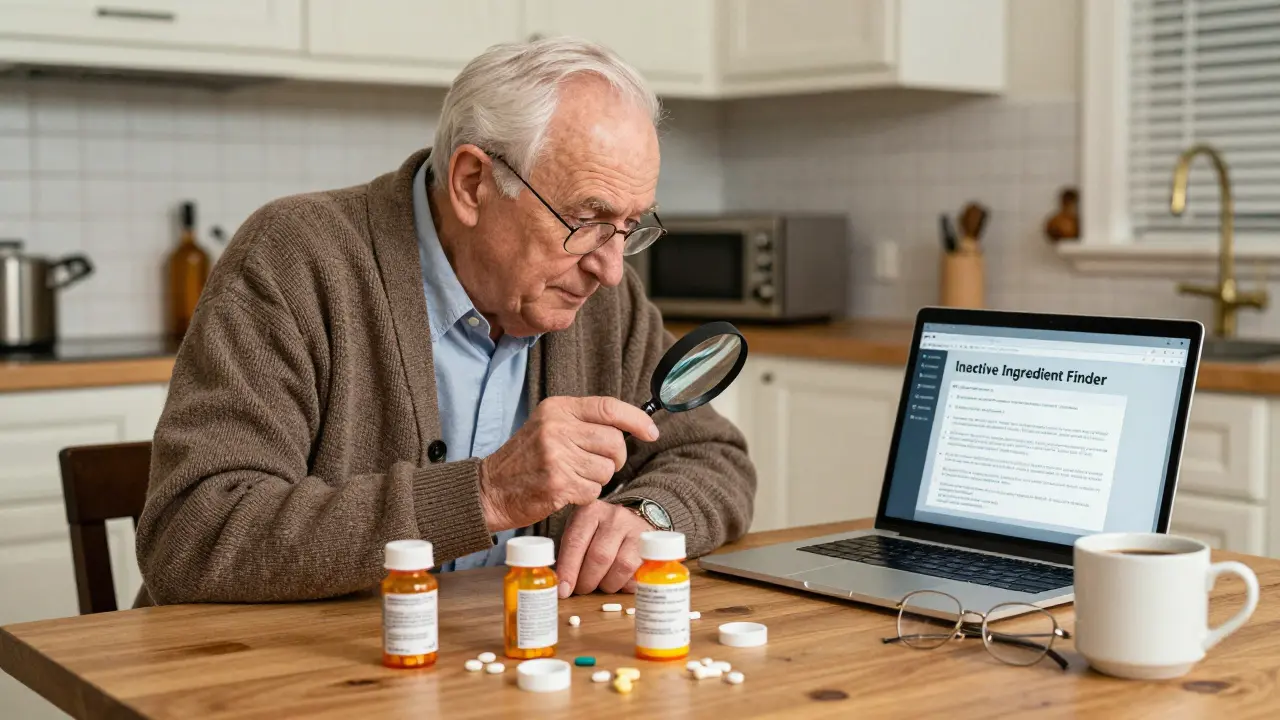
- Use the tools. In January 2023, MIT launched a beta app called Inactive Ingredient Finder. It covers 98% of U.S. medications and lets you search by allergen. Some pharmacies now use electronic systems that flag allergens in prescriptions. Ask if your pharmacy has one.
Why the System Is Still Broken
The U.S. doesn’t require full labeling of excipients. The FDA only mandates disclosure for peanut oil, sulfites, and a few others. Everything else? Optional. That’s why the European Union, which has required full excipient disclosure since 2019, saw a 37% drop in adverse reactions.
In the U.S., pharmaceutical companies are slowly changing. Since the 2019 MIT study, 68% of major drugmakers have improved labeling voluntarily. But it’s not mandatory. And only 12% of generic drugs currently offer allergen-free versions.
The American Medical Association called for mandatory labeling of all excipients by 2026. But as of March 2026, no law has passed. The FDA proposed rules in 2022, but they’re still stuck in review.
What You Can Do Today
Don’t wait for regulations to fix this. You have more power than you think.
- Keep a medication log: Write down every pill you take, the manufacturer, and any symptoms after starting it.
- Bring your list of allergens to every appointment-doctor, pharmacist, even ER visits.
- Ask your pharmacist: "Is this version of the drug free from [lactose, gluten, soy, etc.]?"
- If you’ve had a reaction, report it to the FDA’s MedWatch program. Patient reports drive change.
Medications are supposed to heal. They shouldn’t make you sick because of a filler no one told you about. You deserve to know what’s in every pill you swallow. And you have the right to ask.
Can generic medications cause allergic reactions even if the active ingredient is the same as the brand-name version?
Yes. While the active ingredient in generics must match the brand-name version, the inactive ingredients-like lactose, gluten, dyes, or preservatives-can differ. These fillers are not required to be identical, and they can trigger allergic reactions or intolerances in sensitive individuals. For example, a patient might tolerate the brand-name version of a drug but react to the generic because the generic contains lactose while the brand does not.
How can I find out what inactive ingredients are in my medication?
For over-the-counter drugs, check the Drug Facts label on the packaging. For prescription medications, ask your pharmacist for the full list of inactive ingredients. Many pharmacies have access to manufacturer documentation that includes this information. You can also search the FDA’s National Drug Code Directory or use tools like the MIT-developed "Inactive Ingredient Finder" app, which covers 98% of U.S. medications.
Are there any medications that are guaranteed to be free of common allergens like lactose or gluten?
Some brand-name and generic medications are formulated without common allergens, but they’re not labeled as "allergen-free" by law. For example, certain versions of levothyroxine and metformin are available without lactose or gluten. You’ll need to check the manufacturer’s specifications or ask your pharmacist to identify these options. Only 12% of generic medications currently offer allergen-free formulations, so you’ll need to be proactive in searching for them.
Why don’t drug labels clearly say "contains gluten" or "contains milk"?
The U.S. FDA only requires labeling of a few allergens in medications-primarily peanut oil and sulfites. Other common triggers like lactose, gluten, soy, and gelatin are not required to be disclosed, even though they can cause serious reactions. This is because medications are not regulated under food allergy labeling laws (like the FALCPA), which apply to packaged foods. As a result, ingredients are listed by their chemical names (e.g., "lactose monohydrate"), making it difficult for patients to recognize them as allergens.
What should I do if I suspect a medication is causing an allergic reaction?
Stop taking the medication immediately and contact your doctor or allergist. Keep a record of when you started the drug, what symptoms appeared, and whether they improved after stopping. Report the reaction to the FDA through the MedWatch program. If you’ve recently switched from a brand-name drug to a generic, or from one generic to another, that’s a strong clue the inactive ingredients may be the cause. Bring your medication list and any packaging to your appointment.




Comments
Tom Sanders
8/Mar/2026Ugh, another one of these posts. I just take my pills and don't care what's in them. If I get sick, it's probably because I didn't sleep or ate too much pizza. Why does this even matter?
Judith Manzano
8/Mar/2026This is actually super important. I have celiac and didn't realize my thyroid med had gluten until I started having brutal flare-ups. Switching to a gluten-free generic changed everything. If you're on meds long-term, this info could save your gut.
Jazminn Jones
8/Mar/2026The empirical data presented here is both statistically significant and methodologically robust. However, the author's conflation of correlation with causation in the context of excipient-induced hypersensitivity is a glaring analytical flaw. One must interrogate the confounding variables - namely, polypharmacy, comorbid gastrointestinal dysbiosis, and placebo/nocebo effects - before attributing clinical symptoms to inert excipients.
Stephen Rudd
8/Mar/2026You people are being manipulated. The FDA is in bed with Big Pharma. They don't want you to know that 90% of meds are laced with GMO corn syrup and nanotech particles that track your DNA. Lactose? Gluten? That's the cover. The real poison is in the coating. Ask yourself: why do they make pills taste like bubblegum?
Erica Santos
8/Mar/2026Oh wow, a 2019 study. Groundbreaking. I'm sure the 12% of generics that are allergen-free are just hiding in the shadows waiting for someone to notice. Meanwhile, I'm over here taking my 5 meds a day and wondering why I'm bloated, tired, and broke. Thanks for the info, Captain Obvious.
George Vou
8/Mar/2026I think this is all a scam. The government and pharma companies are using 'lactose' and 'gluten' as code for microchips. You think you're allergic? Nah. You're being targeted. My cousin's dog got a shot and now it won't stop barking at 3am. Coincidence? I think not.
Scott Easterling
8/Mar/2026I've been saying this for YEARS. I switched from one generic to another and my face swelled up. I called the pharmacy. They said, 'It's the same drug.' No, it's not. The filler changed. I've got 17 bottles in my drawer with the same name but different manufacturers. They don't care. They just want to sell.
Mantooth Lehto
8/Mar/2026I had a reaction to my asthma inhaler and no one believed me until I read the label and saw 'sulfites.' I cried. I was so angry. Why isn't this on every bottle? Why do I have to be the one digging through PDFs? I'm done being a lab rat for Big Pharma.
Melba Miller
8/Mar/2026I'm sick of Americans acting like this is new. We've known about this since the 90s. Other countries label everything. We're the ones who think 'natural' means 'unregulated' and 'free market' means 'let people die.' This isn't a medical issue - it's a moral failure.
Katy Shamitz
8/Mar/2026I'm so glad someone finally said this. I'm a nurse and I see patients come in with rashes and stomach pain, and we always assume it's something else. But once we check the med list? 7 out of 10 times it's the filler. My mom's levothyroxine changed brands and she went from fine to dizzy for weeks. Just ask your pharmacist - they know.
Nicholas Gama
8/Mar/2026Excipients are not 'harmless fillers.' They're unregulated chemical additives. The FDA's failure to mandate disclosure is a regulatory abdication. This is not a patient education problem - it's a systemic corruption of pharmaceutical oversight.
Mary Beth Brook
8/Mar/2026The current regulatory framework under Title 21 CFR §201.10 is fundamentally inadequate for allergen risk mitigation. The absence of mandatory excipient labeling constitutes a violation of the principle of informed consent under the Belmont Report. We require pharmacovigilance protocols equivalent to those for active pharmaceutical ingredients.
Neeti Rustagi
8/Mar/2026This is an excellent and much-needed overview. In India, we face similar issues with gelatin capsules and starch fillers derived from wheat or maize. Many patients are unaware. I always encourage my patients to request the manufacturer's product monograph. Knowledge is power - and safety.
Dan Mayer
8/Mar/2026I just looked up my blood pressure med and it says 'lactose monohydrate' - wait, is that like milk? I thought lactose was just in yogurt. I'm gonna call my doc. Maybe I'm allergic to pills now? This is wild.
Janelle Pearl
8/Mar/2026I'm so glad you wrote this. I used to feel so alone. I have a soy allergy and my anxiety med had soy lecithin. I had panic attacks every time I took it. No one told me. I almost quit meds. Please - if you're reading this and you're scared? You're not crazy. Ask for help. Ask for the list. You deserve to be safe.