

You're cleaning out your medicine cabinet and find a bottle of pills that expired six months ago. Do you toss them immediately, or is that date just a suggestion? Most of us are taught that expired drugs are dangerous or useless, but the reality is far more nuanced. While some medications lose their punch quickly, many others stay perfectly fine for years-sometimes even decades-past the date printed on the label.
The core of the issue is that an expiration date isn't a "cliff" where a drug suddenly becomes toxic. Instead, it's a guarantee from the manufacturer. The U.S. Food and Drug Administration (FDA) is the federal agency responsible for protecting public health by ensuring the safety, efficacy, and security of human and veterinary drugs. Since 1979, they've required companies to put dates on meds, but they don't actually force companies to test how long a drug lasts after that date. If a company guarantees a drug for two years, they stop testing it at year two. They aren't looking for the exact moment it fails; they're setting a safe window for liability.
Quick Summary: The Essentials of Drug Expiration
- Most solid pills (tablets/capsules) retain potency long after the expiration date.
- Liquids, injections, and reconstituted meds degrade much faster.
- Storage is everything: cool, dry, and dark environments extend shelf life.
- High-risk meds (like Insulin or EpiPens) should never be used past their date.
- Expiration dates are often more about manufacturer liability than scientific failure.
The Science of Stability: Why Some Meds Last Decades
It sounds crazy, but some drugs are incredibly stable. A major study by the University of California-San Francisco School of Pharmacy looked at prescription drugs that had expired between 28 and 40 years ago. They found that 12 out of 14 medications still had full potency. In plain English: those pills were still doing their job decades after the manufacturer said they might not.
This isn't just a fluke. The Shelf-Life Extension Program (SLEP) is a Department of Defense initiative that tests federal drug stockpiles to extend their usability. Since 1986, they've found that 88% of the drugs they tested could have their dates extended by at least a year, with some lasting over 23 years beyond the original date. This happens because most medications are designed to be stable molecules. As long as they aren't exposed to heat or moisture, they don't just vanish or turn into poison.
Which Medications Are Safe and Which Are Dangerous?
You can't treat all drugs the same. The rule of thumb is: solids are stable; liquids are risky. Tablets and capsules are essentially "frozen" in a dry state, which protects the active ingredients. Liquids, however, are prone to chemical breakdown and bacterial growth once the preservatives start to fail.
There are a few "critical" medications where a drop in potency isn't just a nuisance-it's a life-threatening risk. If you're relying on a drug to stop a heart attack or a severe allergic reaction, you cannot afford a 10% drop in strength.
| Category | Stability Level | Examples | Risk After Expiration |
|---|---|---|---|
| Solid Oral Meds | High | Codeine, Hydrocodone, most tablets | Low (usually just reduced potency) |
| Critical Liquids/Injections | Very Low | Insulin, Nitroglycerin | High (life-threatening failure) |
| Auto-Injectors | Low | EpiPen | High (reduced bioavailability) |
| Reconstituted Meds | Low | Liquid antibiotics | Medium (rapid potency loss) |
The Role of Storage: The Hidden Factor
You can have a drug that's only a month past its date, but if it sat on a sunny windowsill in a humid bathroom, it might be less effective than a ten-year-old pill kept in a cool, dark basement. Heat, light, and moisture are the enemies of chemical stability. They act as catalysts that speed up the breakdown of the active ingredients.
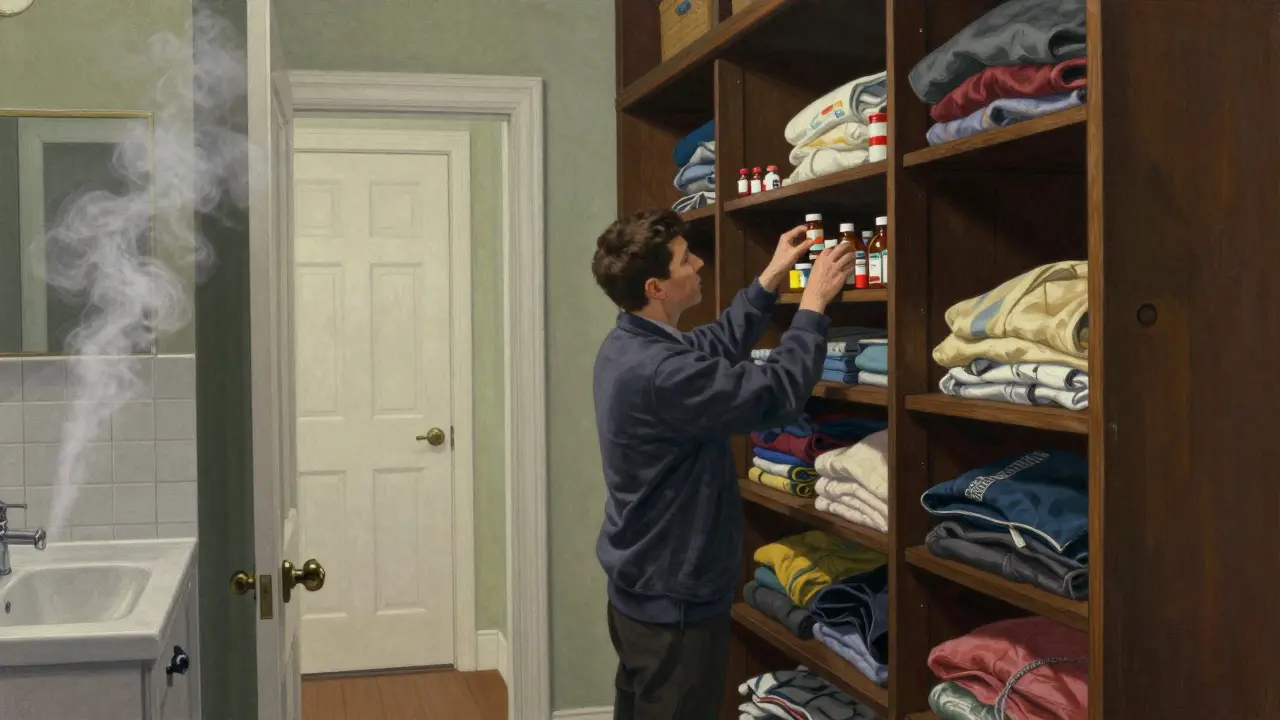
Another big mistake is transferring meds into those plastic pharmacy canisters. While they're convenient, they often aren't as airtight as the original manufacturer's packaging. When you expose a pill to air and moisture every time you open a loose lid, you're accelerating the degradation process. If you want your meds to last, keep them in their original containers and store them in a place that isn't the "bathroom cabinet" (which is ironically one of the worst places due to steam from the shower).
The Economics of the Expiration Date
Why don't companies just give us longer dates if the science says they last? Follow the money. The prescription drug market in the U.S. is a multi-hundred-billion dollar industry. If your medication lasted ten years instead of two, you'd buy it far less often. There is very little financial incentive for a pharmaceutical company to spend millions on long-term stability studies that would ultimately lead to fewer sales.
This creates a massive amount of waste. Millions of tons of perfectly good medication are thrown away every year simply because a date on a bottle passed. While the FDA maintains a cautious stance-warning that expired products can be less effective-the data from programs like SLEP suggests that our current approach to expiration is more about risk aversion and profit than chemistry.
Practical Guidelines for Your Medicine Cabinet
So, what do you actually do when you find an old bottle? First, look at the form. If it's a liquid or an injection, toss it. If it's a pill, check the specific drug. Is it a life-saving emergency med? If so, replace it immediately. If it's something for a minor ailment or a chronic condition where a slight dip in potency isn't a crisis, it may still be useful.
Keep an eye out for physical changes. If a pill is crumbling, discoloring, or smelling strange (like the distinct "vinegar" smell of old aspirin), the chemical structure has changed. At that point, the drug is no longer reliable, regardless of what the date says. When in doubt, a quick call to a pharmacist can clarify if a specific generic version of your drug is known for high stability.
Does medication become toxic after it expires?
In the vast majority of cases, no. Most medications do not become poisonous as they age; they simply lose their potency. The active ingredient breaks down, meaning the drug becomes weaker. There are very rare exceptions, like tetracycline, which has been linked to kidney issues when expired, but for most pills, the risk is that the drug won't work, not that it will harm you.
Can I use an expired EpiPen in an emergency?
In a life-or-death situation, an expired EpiPen is better than no EpiPen. However, research shows that the bioavailability of the epinephrine drops significantly after the expiration date. You should always replace your auto-injectors on time to ensure the dose is strong enough to stop anaphylaxis.
Why are liquid antibiotics considered dangerous after expiration?
Liquid medications, especially those that were mixed from a powder (reconstituted), are unstable. They are prone to chemical degradation and can be contaminated by bacteria. Using a weak antibiotic can also be dangerous because it may not fully kill the infection, potentially contributing to antibiotic resistance.
How can I tell if a pill has actually degraded?
Look for "organoleptic" changes. This is a fancy way of saying use your senses. Look for cracks, changes in color (like a white pill turning yellow), or a strange odor. If the pill is crumbling or smells different than it did when new, the chemical bonds have likely broken down and it should be discarded.
Where is the best place to store medications to make them last?
Avoid the bathroom and the kitchen. Humidity from the shower and heat from the stove/dishwasher accelerate degradation. The ideal spot is a cool, dry, dark cupboard-like one in a bedroom closet-where the temperature remains consistent.
Next Steps for Managing Your Meds
If you're looking to reduce waste and stay safe, start by auditing your meds every six months. Separate your "critical" drugs from your "occasional" ones. For critical meds (Insulin, Nitroglycerin, EpiPens), set a calendar alert for one month before they expire so you have a buffer for refills. For general pills, check the physical condition and storage environment before deciding to keep or toss them. If you have a large amount of medication to discard, look for a local drug take-back program rather than flushing them, as this protects the water supply.



Comments
Agatha Deo
16/Apr/2026Oh, how quaint. You actually believe a blog post that cites 'studies' while ignoring the blatant reality that Big Pharma basically owns the regulatory agencies. Imagine thinking the FDA is 'protecting public health' when their revolving door with industry executives is a well-documented joke. It's hilarious that people still trust labels designed by people who profit from your illness. I'm sure the SLEP data is totally legit and not just another way to justify stockpiling chemicals for some future scenario we aren't told about. Seriously, the naivety here is just breathtaking. But hey, keep trusting the system while they optimize your consumption cycle for maximum revenue growth. It's a beautiful cycle of planned obsolescence applied to your actual health. Absolutely precious.
Anmol Garg
16/Apr/2026It makes you think about how we perceive 'time' and 'value' in our modern lives. We trust a printed date more than our own senses. It's a strange way to live, isn't it?
Nikki Grote
16/Apr/2026From a pharmacokinetics perspective, the degradation of the active pharmaceutical ingredient (API) often follows a predictable first-order kinetic rate. When you're dealing with lyophilized powders or solid-state matrices, the activation energy required for decomposition is much higher, which explains the stability mentioned. However, we have to consider the excipients too; some binders can undergo hydrolysis, which might not change the API but could affect the disintegration time and bioavailability in the GI tract. It's all about the thermodynamic stability of the molecule in its specific polymorphic form.
Jon lee
16/Apr/2026That's a really interesting breakdown of the science behind it. It helps a lot of us understand why some things are okay to keep while others aren't. Thanks for sharing that expertise!
Theresa Griffin MEP
16/Apr/2026Precision in storage is mandatory. Follow these rules.
ira fitriani
16/Apr/2026STOP PUTTING MEDS IN THE BATHROOM! 😱 I can't believe how many people do this! Move them to the closet right now! 🏃♀️💨 Your health is worth the extra walk across the room! 🌟
Michael Lewis
16/Apr/2026Get those calendars marked! No excuses for letting an EpiPen expire. It's a basic safety requirement. Get it done!
Rock Stone
16/Apr/2026Just taking it easy and keeping my stuff in the bedroom dresser. Works for me.