

Every year, Americans fill over 4 billion prescriptions. More than 87% of those are generics. But here’s the thing: not every generic gets covered by your insurance. Some are approved. Others are blocked. Why? It’s not random. It’s not arbitrary. It’s a cold, calculated system built around money, science, and rules you rarely see.
How Formularies Work - And Why Generics Almost Always Win
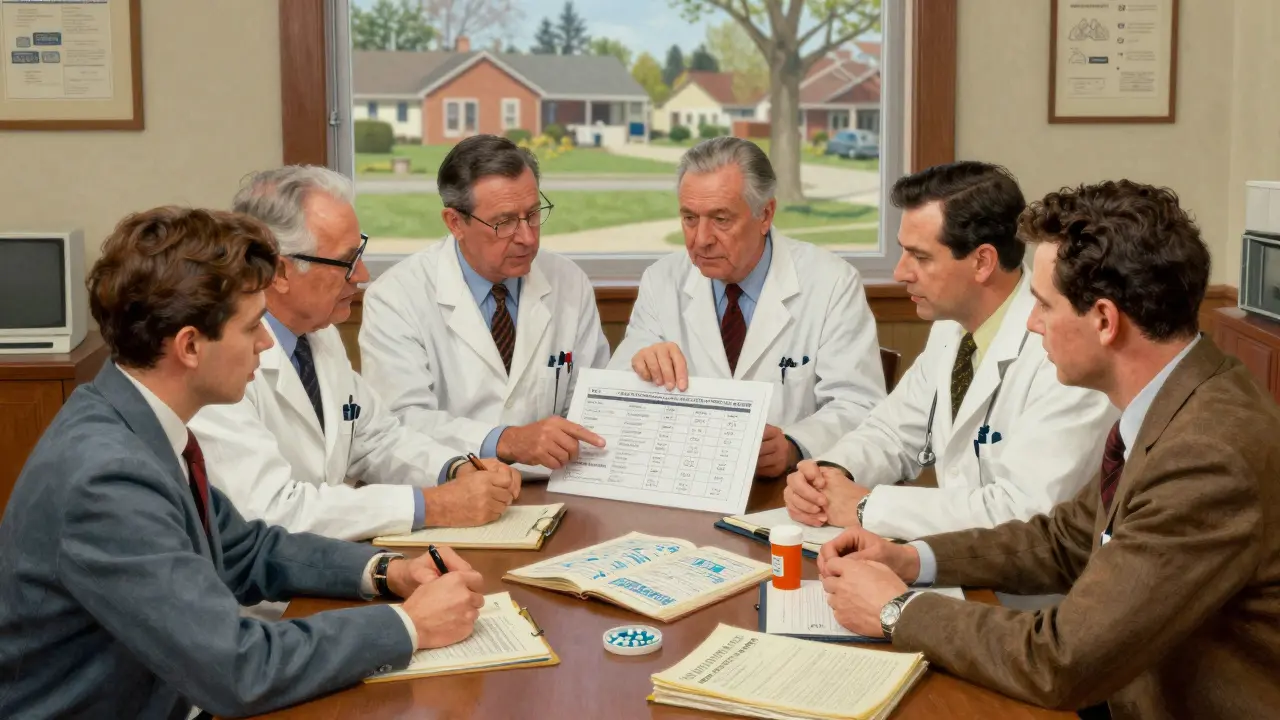
Insurance companies don’t just decide what drugs to cover on a whim. They use something called a formulary - a list of approved medications. And within that list, generics are almost always placed in the lowest tier. Why? Because they save money. Like, huge money. The FDA says generics cost 80-85% less than brand-name drugs. That’s not a guess. It’s a fact backed by billions in real savings. Between 2007 and 2019, Medicare Part D plans saved $1.67 trillion just by using generics and biosimilars. In 2019 alone, that number hit $141 billion in annual savings. So insurers stack the deck in favor of generics. Most plans use a 3- to 5-tier system. Tier 1? That’s where generics live. Copays there? Usually $0 to $15 for a 30-day supply. Compare that to Tier 3 or 4, where brand-name drugs can cost $40 to $100+. It’s not just a preference - it’s a financial strategy built into the system.The P&T Committee: The Hidden Gatekeepers
Who decides which generics make the cut? It’s not a CEO. Not a marketing team. It’s the Pharmacy & Therapeutics (P&T) Committee. These are groups of doctors, pharmacists, and health economists hired by insurers to review drugs. They meet regularly. They review data. They vote. Their decisions aren’t based on brand loyalty. They look at three things:- Clinical effectiveness: Does it work as well as the brand? Studies, trial data, real-world outcomes - they check it all.
- Safety: Has it caused side effects? Are there known risks? A drug with a clean safety record gets priority.
- Cost-effectiveness: If two generics do the same thing, but one is $2 cheaper per pill? The cheaper one wins. Always.
Why Some Generics Still Get Rejected
You’d think if it’s FDA-approved and cheaper, it’s automatically covered. But that’s not true. Here’s why some generics get left out:- Too many similar options: If five generics already treat high blood pressure and all work fine, insurers won’t add a sixth - even if it’s cheaper. Why pay for redundancy?
- New to market: A brand-new generic might sit on the sidelines for months while insurers wait for more real-world data. They don’t want to be the first to cover something that turns out to have hidden issues.
- Manufacturer pricing games: Sometimes, a generic maker charges more than expected. Or they don’t offer volume discounts. Insurers won’t cover it if it doesn’t save money.
What Happens When Your Generic Isn’t Covered?
If your doctor prescribes a generic your plan doesn’t cover, you’re not stuck. You can file an exception request. The process is simple:- Your doctor writes a letter explaining why the specific generic (or brand) is necessary - maybe you had side effects, or it didn’t work before.
- You or your doctor submits it to your insurer.
- They have three business days to respond. If it’s urgent (like a life-threatening condition), they have one day.
- If they don’t reply? Automatic approval.
Therapeutic Substitution: When Your Pharmacy Changes Your Drug
Even if your doctor prescribes a specific brand, your pharmacy might give you a generic instead. That’s called therapeutic substitution. And in 78% of commercial plans, it’s allowed at the point of sale - no doctor approval needed. It sounds helpful. But it’s not always smooth. A 2023 survey found that 31% of patients reported side effects or reduced effectiveness after being switched to a different generic. Why? Because while generics are chemically identical, the fillers, binders, and coatings can vary. For some people - especially those with chronic conditions like epilepsy or thyroid disease - those tiny differences matter. Some states, like Washington, require insurers to let patients opt out of automatic substitution. But most don’t. And most patients don’t even know they can ask.
The Big Picture: Why This System Exists
This isn’t just about saving money. It’s about making healthcare affordable at scale. Without generics, millions of people couldn’t afford their meds. The average Medicare beneficiary spends $1,051 less per year thanks to preferred pharmacy networks and generic coverage. But the system has cracks. Only 37% of insurers publicly share their full P&T committee criteria. That means you’re often guessing why a drug was denied. And with drug shortages on the rise - 78% of current shortages involve generics - insurers are forced to swap drugs mid-treatment, disrupting care. The Inflation Reduction Act of 2022 capped Medicare out-of-pocket drug costs at $2,000 a year starting in 2025. That’s good news for patients. But it also means insurers will push even harder for the cheapest generics - not the best, not the most reliable, but the most affordable.What You Can Do
You don’t have to accept a denial quietly. Here’s what works:- Ask your pharmacist: “Is there a generic on the formulary?” They know the list better than most doctors.
- Request a formulary copy: Most insurers post theirs online. Look up your plan’s drug list before your doctor writes a script.
- Get your doctor to appeal: If a drug isn’t covered, have them write a letter. It’s not hard. Most insurers approve them.
- Check for patient assistance programs: Generic manufacturers often offer discounts or free supplies if you qualify.
Why does my insurance cover one generic but not another for the same condition?
Insurers often cover only one or two generics for a condition to avoid redundancy. If five generics do the same thing, they pick the cheapest or the one with the best volume discount from the manufacturer. It’s not about which one works better - it’s about cost efficiency. Your doctor can request an exception if you’ve had issues with the covered version.
Can my pharmacy switch my brand-name drug to a generic without telling me?
In most cases, yes - if the generic is on your plan’s formulary and your state allows it. Pharmacists are required to inform you if they substitute, but many don’t. Always check the label and ask: “Is this the same as what my doctor prescribed?” If you notice side effects or changes in how you feel, tell your doctor immediately.
Do all insurance plans cover the same generics?
No. Medicare Part D plans, Medicaid, and private insurers all have different formularies. A generic covered by UnitedHealthcare might not be covered by Blue Cross. Even two Medicare plans from the same company can differ. Always check your plan’s drug list before filling a prescription.
Why are some newer generics still not covered even though they’re FDA-approved?
Insurers wait for real-world data. Just because a drug is approved doesn’t mean it’s proven safe for long-term use in diverse populations. P&T committees look at post-market studies, patient reports, and side effect trends. If a new generic has no safety track record, insurers may delay coverage until more evidence is available.
Can I get my insurer to cover a brand-name drug instead of a generic?
Yes - if you can prove the generic doesn’t work for you. Your doctor must submit documentation showing you’ve tried the generic (or similar drugs) and had adverse reactions, ineffectiveness, or dosage issues. Most insurers approve these appeals, especially if you’ve been stable on the brand for years.



Comments
Jay Ara
25/Dec/2025My grandma takes 7 meds and 4 are generics-she’s saved $300/month. Insurance isn’t evil, just math. But sometimes the generic makes her dizzy. No one asks why.
Dan Alatepe
25/Dec/2025Broooooo… this system is a circus 🤡. They pick generics like it’s a dating app-‘swipe left if you’re not the cheapest’. Meanwhile, I’m over here with seizures wondering why my thyroid med got swapped for the one with extra glitter binders.
Angela Spagnolo
25/Dec/2025I… I didn’t know pharmacies could switch my meds without asking… I thought my doctor picked it… I’m so confused now… I just want to feel normal… 😔
Sarah Holmes
25/Dec/2025Let’s be brutally honest: this isn’t healthcare-it’s a corporate cost-cutting algorithm disguised as medicine. You’re not a patient-you’re a line item. And if your body doesn’t conform to the spreadsheet, you’re collateral damage.
SHAKTI BHARDWAJ
25/Dec/2025Typo? Therapeutic substitution? More like therapeutic betrayal. They swap my epilepsy med for a ‘cheaper’ generic and now I’m having mini-seizures at work. And you call that efficiency? I call it medical negligence.
Matthew Ingersoll
25/Dec/2025India’s public health system gives generics to 90% of patients for free. No formularies. No appeals. Just medicine. Maybe we need to stop treating drugs like stock options and start treating them like human rights.
carissa projo
25/Dec/2025There’s something deeply human about this-how we reduce life-saving pills to cost-per-dose, how we ignore the tremor in an elderly hand because the math adds up. Maybe we’re not just broken systems-we’re broken hearts pretending to be balance sheets.
josue robert figueroa salazar
25/Dec/2025Generic = cheaper. Brand = expensive. That’s it. Stop overthinking it. If it doesn’t work, switch. If you can’t afford it, die. That’s the system. Deal.
david jackson
25/Dec/2025Okay, so let’s say you’re on a generic for depression, and it works fine-until one day, you feel like you’re underwater, like your brain’s wrapped in wet paper towels. You go to the pharmacy and they say, ‘Oh, we switched you to a different generic-same active ingredient!’ But the fillers? Totally different. And now you’re crying in the parking lot because you don’t know if it’s your mind or the pill. And the doctor says, ‘It’s probably just stress.’ But it’s not. It’s the binders.
Jody Kennedy
25/Dec/2025You got this! Don’t let the system silence you! Call your pharmacist, ask for the formulary, and if they say no-file that appeal! You’re stronger than their algorithms! 💪❤️
christian ebongue
25/Dec/2025Yeah right, ‘cheaper’ generic. My insurance covers the one that causes nausea, but not the one that doesn’t. Because the nausea one has a deal with the devil-er, the manufacturer. Thanks, capitalism.
jesse chen
25/Dec/2025I’ve been on the same generic for 8 years… then they switched it last month… I didn’t notice until I started having panic attacks at 3am. I didn’t connect the dots until I read this. Thank you for explaining why this happens. I’m going to call my doctor tomorrow.
Joanne Smith
25/Dec/2025They say generics are ‘therapeutically equivalent’-but have you ever tried swallowing a pill that tastes like chalk and plastic? No, I didn’t think so. Because your body remembers more than your doctor’s algorithm. And yes, that matters.
Prasanthi Kontemukkala
25/Dec/2025This is why we need transparency. Not just in formularies, but in how decisions are made. People aren’t numbers. They’re moms, dads, students, veterans. If we can track a package across the globe, why can’t we track why a life-saving pill was denied? Let’s ask for more than cost-we deserve care.