

Getting medication levels right isn’t just about running a blood test. It’s about making sure that test is accurate - and that the result actually changes how a patient is treated. Too many patients end up with wrong doses because labs skipped the basic step of confirming their tests work as they should. This isn’t theoretical. In 2021, a single digoxin test error led to 23 patients getting incorrect doses. Two of them ended up in the ICU. That’s the kind of mistake that happens when labs don’t verify their monitoring tests properly.
What’s the Difference Between Verification and Validation?
If you’re working in a lab, you’ve probably heard these two terms used interchangeably. But they’re not the same. And mixing them up can cost lives. Verification is for tests that already have FDA approval. Think lithium, vancomycin, or tacrolimus. These tests come with manufacturer specs - precision, range, detection limits - and your job is to prove your lab can reproduce those numbers. You don’t need to invent the method. You just need to show it works in your setup. This usually takes 80 hours and costs between $2,500 and $5,000. Validation is for everything else: lab-developed tests (LDTs), custom panels, or drugs with no FDA-cleared test - like clozapine metabolites. Here, you’re building the test from scratch. You have to prove everything: how sensitive it is, what interferes with it, how stable results are over time. It takes twice as long, costs three times more, and has a 1 in 5 chance of failing on the first try. Most labs use verification for routine drugs. Validation? That’s reserved for rare cases. The key difference? Verification checks if the test works. Validation proves it works - for everything.The 9-Step Process No Lab Can Skip
There’s a standard way to do this right. The APHL toolkit is used by 98% of U.S. labs for a reason. Here’s what it looks like in practice:- Plan it out. Write down exactly what you’re testing, which drugs, which instruments, and what success looks like. Don’t wing it. This step takes 8-16 hours.
- Get approval. Your lab director must sign off. No exceptions. This isn’t bureaucracy - it’s accountability.
- Run the tests. For verification, you need at least 20 replicates across five days. For precision. For trueness. For linearity. You’re not just running one sample. You’re testing the system under real conditions.
- Analyze the data. Use statistical tools. Look for outliers. Is your linearity curve flat at 75 mcg/mL for vancomycin? That’s a red flag. One lab found this exact issue using the APHL template - and fixed it before any patient got a wrong dose.
- Re-evaluate if needed. About 30% of verifications need a second round. Don’t rush this. If the numbers are off, go back. The alternative is a patient overdose.
- Write the report. Document everything. What you did. What you found. What you accepted. This isn’t paperwork - it’s your legal defense.
- Create SOPs and training. Who’s running this test next week? Next month? They need clear instructions. Training takes 20-40 hours. Don’t skip it.
- Final approval. Again, your director signs. This time, it’s official.
- Launch the test. Only after all steps are done. No shortcuts.
What You Must Test - The 9 Critical Parameters
You can’t just say, “The test works.” You need hard numbers. The CLSI EP15-A3 guidelines spell out exactly what to check:- Precision: Repeat the test 20+ times over five days. The variation must be less than 1/4 of the total allowable error. For digoxin, that’s under 2.5% CV.
- Trueness: Compare your results to a certified reference material. Bias can’t exceed half the allowable error.
- Limit of Detection: What’s the lowest level you can reliably measure? For tacrolimus, that’s often below 1 ng/mL.
- Limit of Quantitation: The lowest level you can trust for dosing decisions.
- Specificity: Test for interference. Carbamazepine? Check for metabolites. Tacrolimus? Test 12+ metabolites at 100 ng/mL or higher. The FDA now requires 15 metabolites - a change from January 2024.
- Measuring Range: Your test must cover 80-120% of the therapeutic range. For vancomycin, that’s 5-80 mcg/mL.
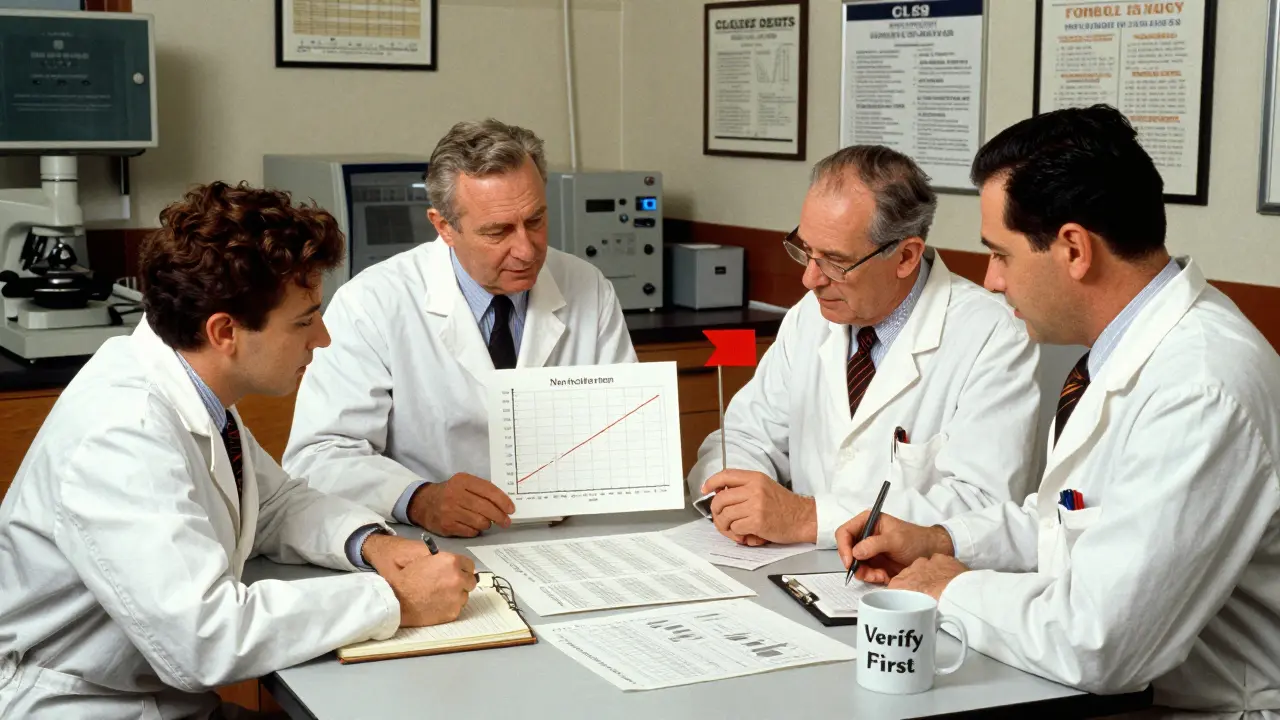
- Linearity: R² must be ≥0.99 across the full range. A curve that flattens? That’s a failure.
- Reportable Range: Your final reportable range must include the therapeutic range plus 20% on each side.
- Measurement Uncertainty: Must be ≤1/3 of total allowable error. For narrow drugs like digoxin, this is critical.
Where Labs Fail - And Why It Matters
The biggest problem? Skipping interference testing. Dr. James Nichols at Vanderbilt says 5-8% of carbamazepine results are wrong because labs didn’t test for metabolites. That’s not rare. That’s common. Another failure point? The lower limit of quantitation. Only 64% of labs check it for narrow therapeutic index drugs. That means 1 in 3 patients with low levels might be missed. They get under-dosed. The drug doesn’t work. Their condition worsens. And then there’s documentation. Lab professionals say it’s the most frustrating part. Manufacturers often give incomplete specs. Abbott scores high. Smaller vendors? Not so much. One lab spent six weeks chasing down a single interference value because the manufacturer’s datasheet was vague. The result? Delayed implementation. One lab delayed their oncology panel by six weeks because they didn’t have staff to run the tests. Another spent 220 hours verifying three drugs - time they didn’t have.What Happens If You Don’t Do This?
Non-compliance isn’t just a paperwork issue. It’s a legal and financial risk. Under CLIA ‘88, labs face fines of $7,500 per violation. Between 2021 and 2023, CMS issued over 200 such fines. That’s not hypothetical. That’s real money. But the real cost? Patient harm. The Institute of Medicine estimates 7,000-9,000 deaths per year in the U.S. from medication errors. A significant portion come from inaccurate drug levels. Labs that follow ISO 15189 have 47% fewer medication errors. That’s not a small gain. That’s life or death.
What’s Changing in 2025 and Beyond
The FDA is cracking down. The new draft guidance requires testing for 15 metabolites for immunosuppressants - up from 8. Labs that haven’t updated their protocols will be non-compliant by late 2025. CLSI is finalizing EP44-Ed2, which will standardize verification for narrow therapeutic index drugs. That’s good news. It means less guesswork. Meanwhile, EHR systems like Epic are starting to auto-flag low or high drug levels. By 2025, 45% of U.S. hospitals will have this built in. That’s a game-changer - but only if the lab data feeding those alerts is accurate. The trend is clear: more drugs, tighter controls, and less room for error. The labs that survive are the ones that treat verification like a clinical procedure - not an administrative task.Who Needs This Most?
Academic medical centers? Nearly all of them have full programs. Community hospitals? Only 38% do. Independent labs? Even fewer. If you’re in a small lab, you might think: “We don’t have the staff.” But the cost of not doing it - in fines, lawsuits, or worse - is far higher. Start small. Pick one drug. Vancomycin. Lithium. Do it right. Document it. Train your team. Then add another. The goal isn’t perfection. It’s consistency. One accurate test at a time.Final Thought: It’s Not About the Test - It’s About the Patient
You’re not just running a blood sample. You’re deciding whether someone gets more of a drug - or less. Whether they go home - or end up in the hospital. The numbers matter. The protocols matter. But none of it means anything unless you remember why you’re doing it. A patient on tacrolimus after a transplant doesn’t care if your lab used the APHL toolkit. They care that their dose keeps their body from rejecting the organ. And that only happens if the test is right. Do the work. Document it. Protect your patients. That’s not just compliance. That’s care.What’s the difference between verification and validation for medication monitoring tests?
Verification is for FDA-cleared tests - you confirm the manufacturer’s claims work in your lab. Validation is for lab-developed tests (LDTs) or modified tests - you build and prove the entire method from scratch. Verification takes less time and cost; validation is more complex, expensive, and has a higher failure rate.
Which medications require the strictest verification?
Narrow therapeutic index drugs like digoxin, vancomycin, lithium, and tacrolimus. For digoxin, total error must be ≤10% across 0.5-4.0 ng/mL. Even small inaccuracies can cause toxicity or treatment failure. These require tighter precision, linearity, and interference testing than broader-range drugs.
What happens if a lab skips verification?
Patients can receive incorrect doses - too high, leading to toxicity, or too low, leading to treatment failure. Labs risk CLIA fines of $7,500 per violation. Between 2021 and 2023, CMS issued over 200 such fines. In extreme cases, like the 2021 digoxin error, patients were hospitalized due to false results.
Why is interference testing so important?
Many drugs have metabolites that cross-react with the test, giving falsely high or low readings. For carbamazepine, metabolites cause 5-8% of inaccurate results. For tacrolimus, 12+ metabolites must be tested. Skipping this step is one of the most common reasons for test failures and patient harm.
How long does verification typically take?
For FDA-cleared tests, verification takes about 80 hours total - including testing, analysis, documentation, and approval. For lab-developed tests (validation), it’s 120+ hours. Delays often come from waiting for clinical samples or unclear manufacturer specs.
Are there tools to make verification easier?
Yes. The APHL Laboratory Test Verification and Validation Toolkit is the industry standard. It includes step-by-step worksheets, templates for SOPs, and data analysis guides. Labs using it report 63% fewer non-conformities and save up to 3 weeks per test. Most successful labs start here.
What’s the role of the lab director in this process?
The lab director must approve the verification plan before testing begins and sign off on the final report. This isn’t a formality - it’s legal responsibility. Under CLIA, the director is accountable for test accuracy and compliance. Without their approval, the test cannot be used on patients.
Can small labs afford to verify all their tests?
It’s challenging, but not impossible. Start with high-risk drugs: vancomycin, digoxin, lithium. Use the APHL toolkit to streamline the process. Partner with a reference lab for validation if needed. The cost of skipping verification - in fines, lawsuits, or patient harm - is far greater than the investment.
How will the VALID Act affect medication monitoring labs?
The VALID Act will bring lab-developed tests (LDTs) under stricter FDA oversight. Labs planning to develop custom tests for monitoring may face longer approval times and higher compliance costs. Many are shifting toward using FDA-cleared tests instead, which are easier and faster to verify.
What’s the future of medication monitoring in labs?
The future is integration. EHRs like Epic are now auto-flagging abnormal drug levels. But this only works if lab data is accurate. Growth in personalized medicine and biologics will increase demand for monitoring. Labs that standardize verification, invest in staff training, and adopt automation will lead. Those that don’t will fall behind - and risk patient safety.



Comments
Carolyn Rose Meszaros
18/Jan/2026Just read this and immediately thought of my cousin who got sent to the ICU over a digoxin mix-up. 😔 Labs need to stop treating this like a checkbox. It's life or death. And yes, I'm crying a little typing this.
Greg Robertson
18/Jan/2026Really appreciate how clear this breakdown is. Verification vs validation always trips people up - you nailed it. Also, the APHL toolkit? Absolute lifesaver. We started using it last year and our error rate dropped like a rock.
Nadia Watson
18/Jan/2026It is imperative that laboratory directors understand that their signature on these documents is not a mere formality; it is a solemn legal and ethical commitment to patient safety. The consequences of negligence are not abstract - they are measured in hospital admissions, organ failure, and, tragically, death. One must not underestimate the gravity of this responsibility.
Shane McGriff
18/Jan/2026Interference testing is the silent killer in so many labs. I’ve seen teams skip it because ‘the manufacturer said it’s fine.’ No. Just no. We ran into this with carbamazepine last quarter - turned out their metabolite was cross-reacting like crazy. Took us three weeks to fix, but we caught it before anyone got hurt. Always test for metabolites. Always.
Jacob Cathro
18/Jan/2026LMAO at all these labs acting like they’re doing brain surgery. It’s a blood test. You plug in the numbers. The machine does the rest. Who cares if the linearity curve flattens? Nobody’s gonna die from a 5% error. Also, why are we spending $5k on this? Just send it to Quest. Problem solved. 😂
Thomas Varner
18/Jan/2026Validation takes twice as long? Yeah, and it’s worth every second. I’ve been doing this for 17 years - I’ve seen labs cut corners, then get audited, then get fined, then lose their license. One lab I worked with skipped the LLOQ check on tacrolimus… three patients had transplant rejection because their levels were ‘normal’ but actually toxic. Don’t be that lab.
Art Gar
18/Jan/2026While the intent of this article is laudable, it presumes a singular moral imperative: that all verification protocols must be uniformly applied. But what of resource disparity? What of systemic inequity in healthcare infrastructure? To mandate these exact procedures on small, underfunded labs is not diligence - it is institutional coercion disguised as safety.
Edith Brederode
18/Jan/2026This is so important! I work in a small community hospital and we just started verifying vancomycin last month. Used the APHL toolkit - it was a game-changer. We’re going to add lithium next. Team’s actually excited now. Who knew paperwork could feel meaningful? 😊
clifford hoang
18/Jan/2026They’re all lying. The FDA doesn’t care about patients - they care about profit. Big Pharma wrote these guidelines. The ‘15 metabolites’ thing? That’s just to force small labs to buy their expensive kits. The real reason digoxin errors happen? The machines are calibrated wrong because the techs are overworked. And the director? They’re too busy signing forms to even look at the data. This whole system is rigged.
Arlene Mathison
18/Jan/2026Stop waiting for perfect conditions. Start with one drug. One. Just pick vancomycin. Do the 80 hours. Document it. Train your team. Then do it again. You don’t need a big budget - you need grit. And your patients? They’ll thank you. I promise.
Emily Leigh
18/Jan/2026So… we’re spending hundreds of hours and thousands of dollars to make sure a machine doesn’t lie? And yet we still let people self-diagnose on WebMD? Priorities, people. Priorities.
Renee Stringer
18/Jan/2026It is unacceptable that any laboratory would consider skipping any step in the verification process. The ethical obligation to patient welfare supersedes all logistical and financial constraints. One must not compromise on standards - not even slightly.
Crystal August
18/Jan/2026Everyone’s acting like this is some noble cause, but let’s be real - most of these labs are just trying to avoid getting fined. If CLIA didn’t exist, 90% of them wouldn’t even bother. This isn’t about care - it’s about fear.
Courtney Carra
18/Jan/2026It’s funny - we spend all this time making sure the test is perfect… but the real problem is that doctors don’t know how to interpret the results. I’ve seen so many clinicians panic over a 0.1 ng/mL difference in digoxin. The test is fine. It’s the human decision-making that’s broken. We need to fix the doctors before we fix the machines.