

Every year, millions of workers lose their hearing-not from aging, not from music, but from the constant hum of machinery, tools, and equipment on the job. This isn’t rare. It’s routine. In the U.S. alone, about 22 million workers are exposed to dangerous noise levels daily. And most of them don’t even realize it’s happening until it’s too late. Hearing loss from noise is permanent. It can’t be cured. But it can be stopped-by a simple, legally required system called a Hearing Conservation Program (HCP).
What Is a Hearing Conservation Program?
A Hearing Conservation Program isn’t just a checklist. It’s a live, ongoing system designed to stop noise-induced hearing loss before it starts. Under OSHA’s 29 CFR 1910.95 regulation, any workplace where employees are exposed to noise at or above an 8-hour average of 85 decibels (dBA) must have one. That’s the sound of a lawnmower, a busy factory floor, or a jackhammer nearby. Not a rock concert. Not a chainsaw at full throttle. Just everyday work noise. The goal isn’t just compliance. It’s survival. Studies show workplaces with strong HCPs see 5-10% higher productivity and 15-20% fewer absences. Why? Because workers aren’t struggling to hear instructions, aren’t missing alarms, and aren’t dealing with the stress of tinnitus or social isolation from hearing loss.The Five Required Components
OSHA doesn’t leave room for guesswork. A valid HCP must include five parts-and all of them must be done right. Missing one means you’re not compliant. And non-compliance can cost you tens of thousands in fines.- Noise Monitoring: You can’t protect what you don’t measure. Employers must use calibrated sound level meters or noise dosimeters to find out who’s exposed to 85 dBA or more. This isn’t a one-time job. Every time you change equipment, move machinery, or add new tools, you have to retest. A 2023 survey found that 47% of companies struggle to keep these records updated.
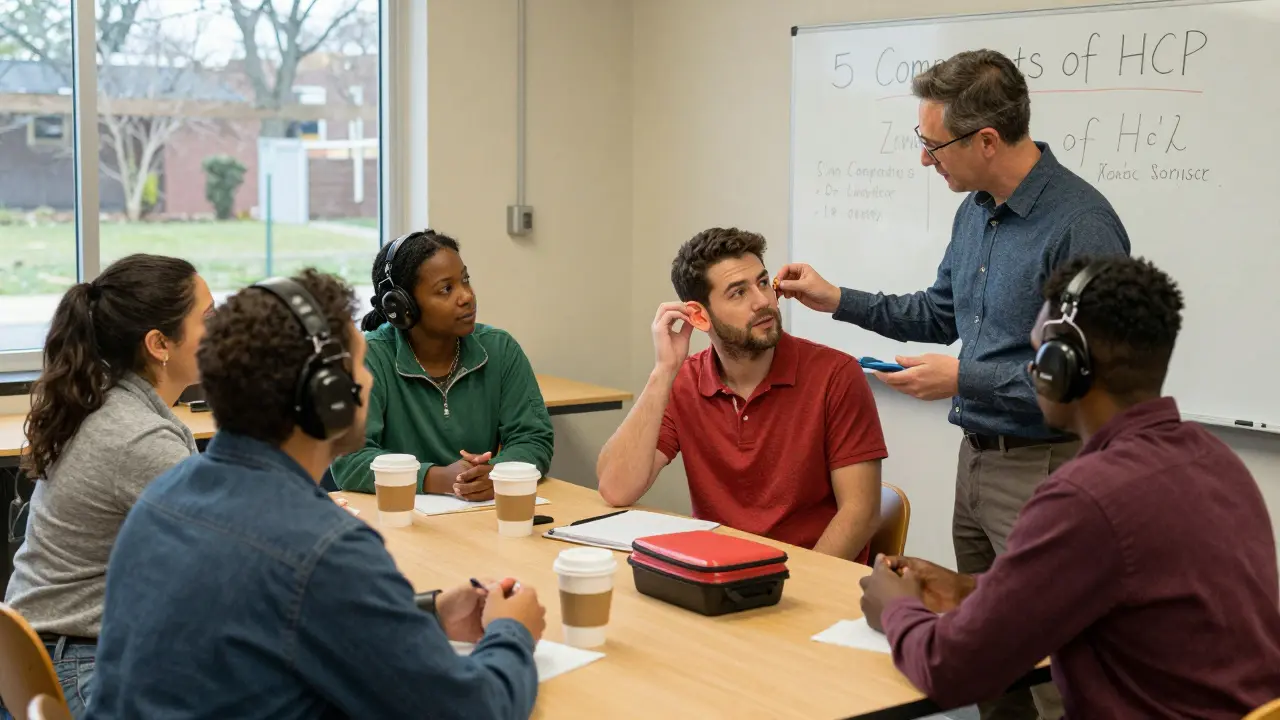
- Audiometric Testing: This is the heartbeat of the program. Every employee exposed to 85 dBA or more must get a baseline hearing test within six months of starting the job. The catch? They must be out of noisy environments for at least 14 hours before the test. Otherwise, the results are useless. After that, they get tested every year. The test must check hearing at 500, 1000, 2000, and 3000 Hz, using audiometers that meet ANSI standards. And the room? It has to be quiet enough to meet OSHA’s Appendix C specs-no background chatter, no HVAC noise.
- Hearing Protection: Earplugs and earmuffs aren’t optional. Employers must provide at least two types of protectors and let workers choose. They also must train employees on how to insert earplugs properly. Most people wear them wrong. Studies show that if you don’t fit-test earplugs, the actual noise reduction can be less than half of what the label says. And protection must bring exposure down to at least 90 dBA over eight hours.
- Training: Every year. No exceptions. Training must cover: how noise damages hearing, how protectors work, why testing matters, and what to do if your hearing changes. A 2021 OSHA report found that 28% of violations came from poor or missing training. Workers who don’t understand why they’re wearing earplugs won’t wear them.
- Recordkeeping: Noise exposure records must be kept for at least two years. Audiometric test results? They stay with the employee for as long as they work there. If they leave, you must give them a copy. These aren’t just paperwork. They’re legal evidence.
What Happens When Hearing Loss Is Detected?
The real test of a good program isn’t whether you do the tests-it’s what you do when the results show trouble. A Standard Threshold Shift (STS) means a worker’s hearing has dropped by 10 dB or more at 2000, 3000, and 4000 Hz compared to their baseline. That’s not a small change. That’s the start of permanent damage. When an STS is found, you have 30 days to act:- Notify the employee in writing within 21 days.
- Re-fit their hearing protection and retrain them.
- If their current protectors aren’t enough, offer ones with higher noise reduction ratings (NRR).
- Refer them to a clinical audiologist if there’s a chance the hearing loss isn’t from noise-maybe an infection, a tumor, or another medical issue.
Why Most Programs Fail
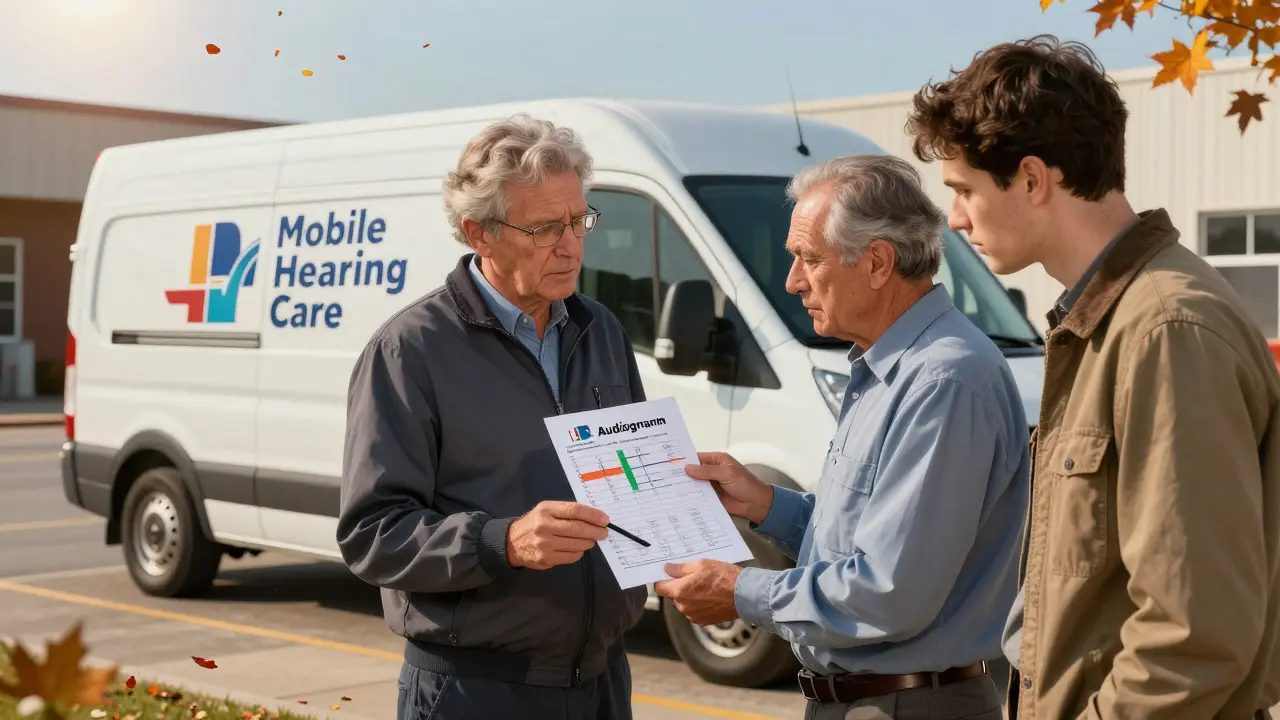
The science is clear. The rules are simple. So why do 62% of OSHA violations involve audiometric testing problems? The biggest issue? Employee participation. A 2023 SHRM survey of 1,200 safety managers found that 68% struggled to get workers to show up for annual hearing tests. Why? They think they’re fine. They don’t feel anything. They don’t realize hearing loss creeps in slowly. By the time they notice, it’s too late. Another problem: fit testing. Many companies hand out earplugs and assume they’re working. But studies show that without proper fit testing, workers get only 20-30% of the protection the product claims. That’s like wearing a helmet that’s two sizes too big. Small businesses have it harder. With fewer than 50 employees, 37% are non-compliant. Why? Cost. A full HCP runs $250-$400 per employee a year. Audiometric testing alone takes up half that. Mobile testing units help-73% of compliant companies use them. They come to the plant, save time, and increase participation.What’s Changing in 2025?
OSHA isn’t standing still. In late 2024, new rules are expected to take effect:- Audiometers must meet the latest ANSI S3.6-2018 standard, not the outdated 1969 version.
- Testing will now include 4000 Hz and 6000 Hz-critical frequencies for early detection of noise damage.
- Protection requirements will tighten. If noise exceeds 100 dBA, protectors must reduce it beyond just 90 dBA. That means higher NRR gear will be mandatory.
The Real Cost of Doing Nothing
The market for hearing conservation services is worth $1.5 billion in the U.S. alone. But the cost of ignoring it? Much higher. Workers with hearing loss are more likely to miss work, make mistakes, or get injured because they didn’t hear a warning. They’re more isolated. More depressed. Employers pay more in workers’ comp claims, disability payments, and lost productivity. OSHA issued 1,842 citations for HCP violations in 2022. Fines? Between $15,625 and $156,259 per violation. That’s not a fine. That’s a wake-up call. And here’s the truth: 8-12% of workers exposed to 85 dBA over a lifetime still lose their hearing-even when they’re wearing protectors. That’s because the current 90 dBA exposure limit hasn’t changed since 1983. NIOSH and the American Academy of Audiology say it should be 85 dBA. But until then, your HCP is your only defense.What You Can Do Today
If you’re an employer:- Test your noise levels. If any area hits 85 dBA or more, you need a program.
- Start with baseline audiograms for everyone exposed. Don’t delay.
- Provide real choices in hearing protection-not just the cheapest option.
- Train every year. Make it engaging. Show real stories.
- Use mobile testing units. They save time and boost participation.
- Keep records. Always.
- Show up for your tests. Even if you think you hear fine.
- Ask how to insert your earplugs correctly. Most people do it wrong.
- Speak up if your protectors are uncomfortable or don’t seem to help.
- Know your rights. You’re not being paranoid-you’re being smart.
Is a Hearing Conservation Program required by law?
Yes. Under OSHA’s 29 CFR 1910.95, any workplace where employees are exposed to noise at or above an 8-hour average of 85 decibels (dBA) must have a formal Hearing Conservation Program. This includes noise monitoring, annual audiometric testing, hearing protection, training, and recordkeeping. Failure to comply can result in fines up to $156,259 per violation.
What happens if an employee has a Standard Threshold Shift (STS)?
If an employee’s hearing drops by 10 dB or more at 2000, 3000, and 4000 Hz compared to their baseline, it’s called a Standard Threshold Shift. The employer must notify the employee in writing within 21 days, retrain them on hearing protection, refit their protectors, and offer higher-rated protection if needed. If there’s a suspicion of a medical issue, the employee must be referred to a clinical audiologist. The baseline can be updated if the shift is confirmed as permanent.
How often must audiometric testing be done?
Employees exposed to 85 dBA or higher must get a baseline audiogram within six months of starting exposure. After that, they must be tested annually. Tests must be conducted in a quiet room meeting OSHA’s Appendix C standards, using calibrated audiometers that meet ANSI S3.6-2018 specifications. Test frequencies must include at least 500, 1000, 2000, and 3000 Hz.
Can employees choose their own hearing protection?
Yes. Employers must provide a variety of hearing protection devices-such as earplugs and earmuffs-and allow employees to choose the type they prefer. The protectors must be properly fitted and the employee must be trained on correct use. Simply handing out the cheapest option isn’t enough.
What’s the difference between the action level and the permissible exposure limit?
The action level is 85 dBA. At this level, employers must start a Hearing Conservation Program. The permissible exposure limit (PEL) is 90 dBA. This is the maximum noise level allowed over eight hours without additional controls. However, even at 85 dBA, long-term exposure can still cause hearing loss in 8-12% of workers. Experts recommend lowering the PEL to 85 dBA, but it hasn’t changed since 1983.
Write a comment
Latest Posts


Comments
Kinnaird Lynsey
17/Dec/2025So let me get this straight - we spend billions on safety vests, hard hats, and glow-in-the-dark reflective tape… but earplugs? Nah, just hand ‘em out like candy and hope for the best. Classic. I’ve seen guys wear earplugs like they’re trying to sneak into a library. Halfway in. One ear. Sometimes upside down. And then they wonder why they can’t hear their boss yelling over the press.
It’s not that people don’t care. It’s that nobody ever showed them how to actually use the damn things. Training shouldn’t be a 10-minute slideshow with a PowerPoint titled ‘Hearing: The Boring Stuff.’ Make it real. Show them what their hearing sounds like after 5 years. Play the audio. Let them hear their own future.
Also - why is the PEL still 90 dBA? That’s like saying ‘it’s fine to drive 85 in a 70 zone as long as you wear your seatbelt.’ The science’s been clear since the 90s. Fix the rule, not just the earplugs.
Andrew Kelly
17/Dec/2025Let’s be honest - this entire HCP framework is just corporate theater. OSHA doesn’t care if you go deaf. They care if you file a complaint. The real goal is to make employers look compliant, not to save hearing. Look at the numbers - 62% of violations are about audiometric testing. Why? Because it’s the easiest thing to fake. Mobile units? Sure. But who’s really conducting those tests? A nurse with a tablet and a $200 audiometer from Amazon? Please.
And don’t get me started on the ‘employee choice’ of protectors. You think the guy on the assembly line is picking based on comfort? No. He’s picking the one that looks least embarrassing. The one that doesn’t make him look like a cyborg. Employers know this. They give him the cheapest foam plugs and call it a day. Compliance checklist? Check. Human health? Not even on the radar.
Isabel Rábago
17/Dec/2025It’s disgusting how we treat hearing like it’s optional. You wouldn’t let someone work without a seatbelt. You wouldn’t let them operate machinery without goggles. But let them slowly, silently, permanently lose one of their most vital senses? Sure. Why not? It’s not visible. It doesn’t bleed. It doesn’t make headlines. But it destroys lives.
I know a guy who worked in a steel mill for 22 years. Wore earplugs ‘most of the time.’ By 43, he couldn’t hear his daughter’s voice on the phone. Couldn’t hear his own alarm clock. Started avoiding family dinners because he couldn’t follow conversations. He’s not ‘old.’ He’s deafened by negligence. And now he’s on disability. And the company? They got their OSHA compliance sticker. That’s all that matters.
Training isn’t enough. You need consequences. You need accountability. You need to make it hurt to ignore this. Not just a fine. A public shaming. A mandatory hearing loss awareness video played at every safety meeting for a year. Let them watch the faces of the people they broke.
Anna Sedervay
17/Dec/2025One must seriously interrogate the epistemological foundations of contemporary occupational audiological compliance frameworks. The very notion that a ‘baseline audiogram’ can be meaningfully established within a six-month window - given the confounding variables of ambient noise exposure, psychosocial stressors, and potential subclinical ototoxicity - is, frankly, a statistical fallacy. Moreover, the reliance on ANSI S3.6-2018, while ostensibly progressive, fails to account for high-frequency thresholds beyond 6000 Hz, which recent peer-reviewed literature (e.g., *Journal of Occupational Audiology*, 2023) demonstrates are the earliest indicators of noise-induced cochlear damage.
Furthermore, the ‘employee choice’ paradigm is a neoliberal illusion. Workers, particularly those in low-wage, high-turnover environments, are not rational agents; they are subjected to coercive conformity. The provision of ‘two types’ of protectors is performative. The reality? One size fits none. And the ‘fit-testing’ protocols? Merely performative compliance rituals masquerading as science.
One must ask: if the permissible exposure limit remains at 90 dBA - a relic of 1983 industrial pragmatism - then how can any HCP be considered ethically defensible? The answer, regrettably, is that it cannot.
Matt Davies
17/Dec/2025Man, this post is a wake-up call wrapped in a spreadsheet. I’ve worked in factories since I was 18 - and I didn’t realize how much I’d lost until I tried to watch a movie with my wife and couldn’t catch half the dialogue. I thought I was just getting old.
But here’s the thing - when they finally got a mobile testing unit to come to our plant, I went. And guess what? My hearing had dropped 15 dB at 4000 Hz. They gave me new custom-molded plugs. Took me 10 minutes to learn how to put them in right. Now I hear the boss’s whistle, the alarm, even my kid laughing in the next room.
It’s not glamorous. It’s not sexy. But it’s the difference between working till 65 - and being isolated and frustrated by 45. Do the test. Wear the plugs. Don’t be a hero. Your ears don’t have a reset button.
Mike Rengifo
17/Dec/2025Been in construction for 15 years. Used to think earplugs were for wusses. Then I got tinnitus. Now I hear a constant ringing like a broken microwave. Can’t sleep. Can’t relax. And I’m only 38.
My crew didn’t even know they were supposed to get yearly tests. We just got handed plugs and told to ‘be careful.’
Now I’m the guy who reminds everyone to show up. Not because I’m bossy - just because I don’t want anyone else to end up like me. It’s not that hard. Just show up. Get tested. Ask how to use the plugs. That’s it.
bhushan telavane
17/Dec/2025Here in India, we don’t even have proper noise monitoring in most factories. Workers wear cotton balls or rags in their ears. Some use plastic bags. No training. No tests. No one cares.
I saw a guy in a textile mill who couldn’t hear his own son call him. He was 41. He thought it was just ‘age.’
This post? It’s a mirror. We need this here too. Not just for compliance. For humanity.
Mahammad Muradov
17/Dec/2025It’s not the program that’s failing. It’s the people. If you’re exposed to 85 dBA and you don’t show up for your audiogram, you’re not a victim - you’re negligent. You’re choosing ignorance. You’re choosing deafness. The tools are there. The regulations are clear. If you refuse to protect yourself, don’t blame the employer. Blame yourself.
And don’t even get me started on the ‘I don’t feel anything’ excuse. That’s how every chronic illness starts. You don’t feel the cancer until it’s stage four. You don’t feel the hearing loss until it’s permanent. You’re not special. You’re just dumb.
Mark Able
17/Dec/2025Wait - so if I wear earplugs, I can just sit next to a 110 dBA grinder all day and it’s fine? No, no, no. That’s not how this works. The protectors are supposed to bring it down to 90 - not give you a free pass to be a human jackhammer.
And why do they even have a ‘permissible exposure limit’ at 90? That’s not a limit - that’s a target. Like saying ‘it’s okay to smoke 20 cigarettes a day as long as you wear a mask.’
Also - why are we still using 1983 standards? Did we stop evolving in 1983? Did science stop? Did people stop having ears? This is ridiculous. Someone needs to sue OSHA. Not for fines - for negligence.
James Stearns
17/Dec/2025It is an incontrovertible fact that the current regulatory framework governing occupational hearing conservation is fundamentally inadequate and reflects a profound institutional failure to prioritize human biological integrity over bureaucratic expediency. The persistence of the 90 dBA permissible exposure limit - a relic of pre-technological industrial ideology - constitutes a moral abdication by regulatory authorities. The introduction of 6000 Hz testing in 2025, while laudable, remains insufficient; the auditory system’s vulnerability extends beyond the conventional audiometric range, and the omission of high-frequency psychoacoustic thresholds is tantamount to scientific malpractice.
Furthermore, the notion of ‘employee choice’ in hearing protection is not merely misguided - it is a catastrophic misapplication of libertarian principles in a context of asymmetrical power dynamics. The worker, under duress of employment, cannot be said to exercise genuine agency. The provision of multiple protectors is performative; the absence of mandatory fit-testing protocols renders the entire apparatus a charade.
One must conclude: the Hearing Conservation Program, as currently constituted, is not a safeguard - it is a legal shield for negligence.
Nina Stacey
17/Dec/2025i just wanted to say thank you for writing this because i work in a warehouse and we got our first mobile testing unit last year and i was so scared to go because i thought i was fine but turns out i had a 12 db shift and now i have custom earplugs and they’re like magic i can actually hear people talk without asking them to repeat everything all the time and i didn’t even realize how much i was missing like the sound of the forklift beeping or my phone ringing or my cat purring and it’s crazy how quiet life gets when you lose your hearing slowly and no one tells you
also i keep forgetting to put my plugs in sometimes and then i feel so guilty because i know how important it is and i just hope everyone else does the test too because it’s not scary it’s just important and i wish more people knew this