

Imagine landing in Tokyo with a prescription for hydrocodone in your bag - only to find out it’s completely illegal there. Or showing up in Dubai with your anxiety medication, only to have it confiscated because the name on the bottle doesn’t exactly match your passport. These aren’t rare stories. They happen every day. And they’re completely avoidable.
If you’re traveling with regular medications - especially for pain, mental health, ADHD, or sleep - you’re not just packing pills. You’re carrying a legal document that must pass through dozens of different systems, each with its own rules. The medications abroad game isn’t about luck. It’s about preparation.
What You Can and Can’t Bring Across Borders
Not all medications are treated the same. What’s over-the-counter in Mexico might be a controlled substance in Australia. What’s legal in the U.S. could land you in jail in Singapore. The key is knowing the rules before you go.
Hydrocodone, for example, is Schedule II in the U.S. - tightly controlled but legal with a prescription. In Japan, it’s banned entirely. Codeine? Available without a prescription in Mexico, but you need special permission in Australia. Even common cold meds like pseudoephedrine are banned in the UAE, Australia, and New Zealand because they can be used to make methamphetamine. In Q1 2025 alone, Sydney Airport seized 387 packages of pseudoephedrine from travelers.
Benzodiazepines like alprazolam (Xanax) and diazepam (Valium) are another major trap. They’re legal in most Western countries with a prescription - but completely illegal in Malaysia, no exceptions. The CDC reports that 43% of all medication-related travel incidents involve these drugs. And yes, that includes people with doctor’s notes.
The World Health Organization says 80% of the world’s population lacks adequate access to pain medications. That doesn’t mean you can just buy them anywhere. It means the system is broken. Your job is to navigate it without getting caught in the cracks.
How Much Can You Carry?
Most countries allow you to bring in a personal supply - usually no more than 90 days’ worth. That’s the standard “three-month rule” recognized by 142 countries. But Japan limits narcotics to 30 days. Singapore caps it at 14. If you’re going to either, bring only what you’ll use in that window - and be ready to prove it.
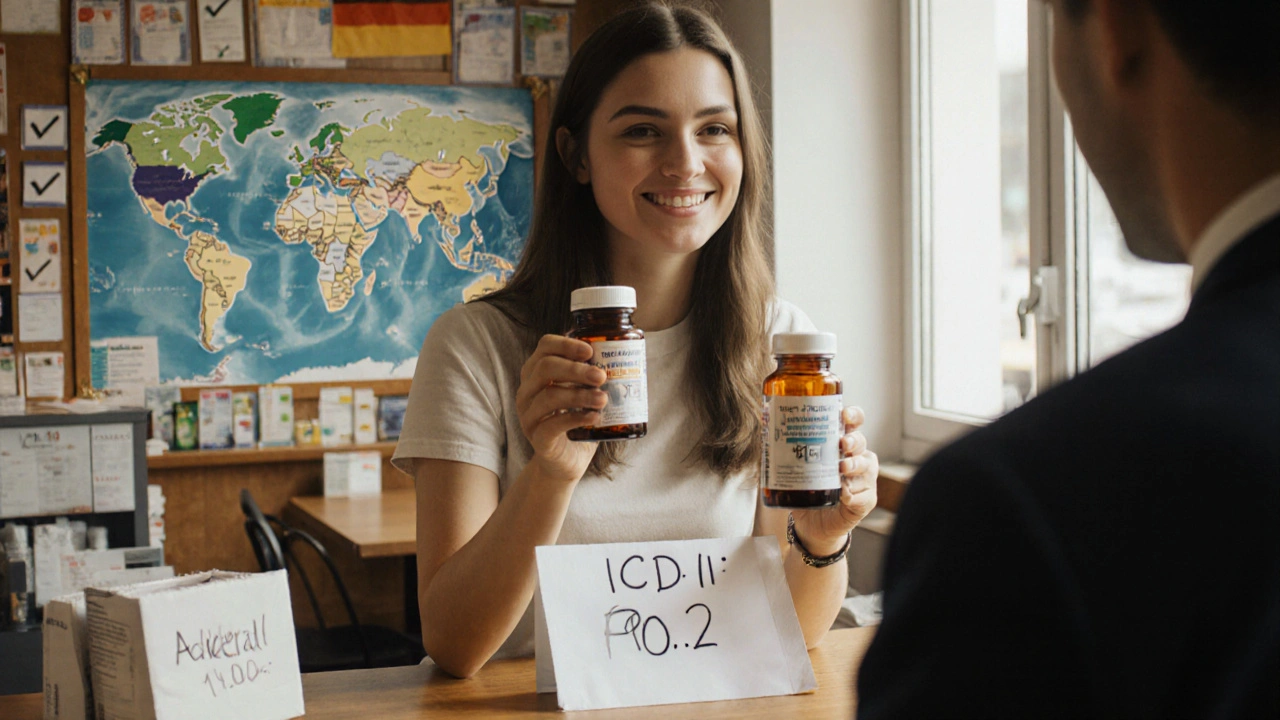
Always keep your meds in their original bottles with the pharmacy label. No ziplock bags. No pill organizers. Even if you’ve been taking the same pills for years, the label must show your name, the drug name, dosage, and prescribing doctor. A 2025 CDC report found that 78% of medication denials at borders were because the name on the bottle didn’t match the passport.
For flights, the TSA allows medically necessary liquids over 3.4 ounces if declared at security. But that doesn’t mean you can skip the label. If you’re flying through the U.S. or connecting there, your meds still need to be clearly labeled. Same goes for EU airports, Australia, and Canada.
Getting a Local Prescription Abroad
What if you run out? Or your meds get lost? Can you just walk into a pharmacy and get a refill?
In the European Union - yes, mostly. Thanks to the EU Falsified Medicines Directive, a prescription from Germany works in France, Italy, or Spain. Pharmacies can fill it directly using your name and the prescription number. In 2024, 98.7% of these cross-border prescriptions were processed without issue.
Outside the EU? It’s a gamble. In Thailand, you can get most medications with a prescription from your home country. In Canada, travelers can legally import a 90-day supply from approved foreign pharmacies under the 2025 Importation Act. But in the UAE, even zolpidem (Ambien) requires pre-approval from the Ministry of Health. You need to apply weeks in advance - and even then, approval isn’t guaranteed.
Here’s the hard truth: In many countries, doctors won’t write a new prescription for a medication you’re already taking unless they’ve examined you in person. And if your condition is psychiatric or chronic pain-related, they might refuse entirely. That’s why 67% of travelers with opioid prescriptions face access issues abroad - not because the drugs are banned, but because local doctors won’t touch them.

Documents You Actually Need
You don’t need a suitcase full of papers. But you do need these five things:
- Original prescription bottles - with your name, drug name, dosage, and pharmacy info.
- A doctor’s letter on letterhead - signed and dated. It must include your full name, the generic drug name (not brand), dosage, reason for use (using ICD-11 codes like F32.0 for depression), and that it’s for personal use.
- A copy of your passport - with the page showing your photo and name.
- Notarized translation - if the destination country doesn’t use English. This is mandatory in 62% of non-English-speaking countries.
- Embassy confirmation - check the destination country’s embassy website. Some require you to submit your documents in advance for approval.
Pro tip: Keep the original documents in your carry-on. Put copies in your checked bag and email them to yourself. If customs seizes your meds, you’ll still have proof.
Where to Find Reliable Info
Don’t rely on Google or Reddit alone. Use official sources:
- WHO Country Regulations Database - updated October 2025. Lists rules for 68 countries. Missing for 124 others - meaning you’re on your own.
- U.S. State Department Travel Advisories - each country page has a “Health” section with medication warnings.
- Embassy websites - search for “medication import” or “controlled substances.” Many have downloadable forms.
- International Association for Medical Assistance to Travellers (IAMAT) - a network of 1,400 clinics worldwide that help travelers find local pharmacies and doctors.
And yes, check your airline’s policy. Some, like Emirates and Qatar Airways, have specific rules about carrying controlled substances - even if the country allows it.
What to Do If Your Meds Get Confiscated
Stay calm. Arguing won’t help. You’re dealing with customs officers who follow strict rules, not personal opinions.
Ask for a written receipt of confiscation. Request to speak with a supervisor. If you have your doctor’s letter and prescription copies, show them. Some countries will let you apply for a temporary import permit on the spot - especially if you’re there for medical treatment.
If you’re stuck without meds, contact your country’s embassy immediately. They can’t give you pills, but they can help you find a local doctor or connect you with IAMAT. In Dubai, over 1,200 travelers faced this in 2024. Most got help within 48 hours.
Real Stories, Real Lessons
A student in Berlin lost her Adderall when her bag was stolen. She went to a local clinic with her U.S. prescription. The doctor refused - no U.S. prescriptions accepted. She ended up using a German alternative (methylphenidate) but had to adjust her dosage. Took two weeks to stabilize.
A couple from Texas traveling in Japan forgot their hydrocodone. They tried to buy it locally. No luck. They called the U.S. Embassy. The embassy referred them to a hospital that could prescribe a different painkiller. They got a 14-day supply and flew home early.
On the flip side: A traveler from the UK used her German e-prescription to refill sertraline in France within two hours. No hassle. No questions. That’s the EU advantage.
Planning Ahead Saves Your Trip
You need at least 8 to 12 weeks to get everything in order if you’re carrying controlled substances. Start by:
- Checking the WHO database or your destination’s embassy website.
- Calling your doctor - ask for the generic name and ICD-11 code.
- Requesting a letter on letterhead - don’t settle for a scribbled note.
- Getting translations notarized if needed.
- Shipping extra supply ahead if allowed (some countries let you pre-ship meds with approval).
And if you’re traveling with a chronic condition - mental health, epilepsy, diabetes - consider using a service like MediFind. They operate in 28 countries and have an 85% success rate getting travelers their meds. It’s not cheap, but it’s cheaper than a canceled trip or a hospital visit abroad.
The bottom line: Medications abroad aren’t a minor detail. They’re a core part of your travel plan. Treat them like your passport. Check them. Double-check them. And never assume it’ll be okay.


Comments
Travis Freeman
28/Nov/2025Just got back from Bali and I didn’t even think about this until I had to explain why I had my SSRIs in a ziplock. Learned the hard way. Now I always carry the doctor’s letter and keep the original bottles. Seriously, this guide saved my trip. Thanks for putting this out there.
Sean Slevin
28/Nov/2025Okay, so… let me get this straight… you’re telling me that in Japan, even if you have a prescription, hydrocodone is just… GONE? Like, poof? No exceptions? No ‘hey buddy, I’m in pain’? I mean… what even IS the point of medicine if borders get to decide if your body gets relief? And don’t even get me started on how the U.S. is fine with opioids, but then you can’t take them abroad? It’s like… we’re all just… pawns in a global pharmacy war… and someone forgot to tell us the rules…
Chris Taylor
28/Nov/2025I’m a nurse and I’ve seen this happen way too many times. People think their meds are ‘just pills’ until they get pulled aside at customs. The label thing? Non-negotiable. I always tell my patients: if it doesn’t have your name on it, it’s not yours anymore. Bring the letter. Bring the bottle. Bring extra copies. Don’t be that person.
Melissa Michaels
28/Nov/2025Excellent summary. I would add that travelers should also verify whether their medication is listed under the International Narcotics Control Board’s Schedule. Many assume that because it’s legal at home, it’s universally accepted. This is not true. Always cross-reference with the WHO database and embassy guidelines. A single typo in the generic name can lead to confiscation. Documentation is not optional.
Nathan Brown
28/Nov/2025It’s wild how the world treats pain like a crime. You need a letter to prove you’re not a drug dealer just to sleep at night? I’ve been to Thailand, Mexico, Germany - and the difference in how they handle meds is like comparing a library to a war zone. And yet, we still act like it’s normal. Maybe the real problem isn’t the laws… it’s that we don’t treat health like a human right. 🤔
Olivia Currie
28/Nov/2025OMG I JUST HAD THIS HAPPEN IN DUBAI!! I had my Xanax in a pill organizer and they took it all. I cried in the airport. I called my embassy and they were like ‘sorry, we can’t help you’… until I showed them the letter. Then they gave me a local script for a weaker benzo. It took 3 days. I was a mess. Please people - don’t be like me. Bring the bottle. Bring the letter. Bring tissues.
Curtis Ryan
28/Nov/2025So… you’re saying I can’t just bring my Adderall to Europe? Like… what? I mean… it’s not like I’m selling it… I just need it to work. And now I gotta get a notarized translation? Who even has time for this? I’m just trying to go on vacation not write a thesis. This is ridiculous. I’m just gonna… hope for the best. 😅
Rajiv Vyas
28/Nov/2025LOL this whole thing is a scam. The government doesn’t care if you’re in pain. They just want to control you. Why do you think they make it so hard? So you’ll rely on their system. And what about the WHO? They’re just puppets for Big Pharma. I’ve seen people get banned for having melatonin. Melatonin. It’s a hormone your body makes. They’re turning the whole world into a prison. You think this is about safety? Nah. It’s about power.
Astro Service
28/Nov/2025Why do Americans think they can just bring their pills anywhere? You think the rest of the world owes you your meds? We have our own rules. If you can’t follow them, stay home. This isn’t a privilege. It’s a privilege. You want your Xanax in Dubai? Go get a local doctor. Stop expecting the world to bend for your American habits.
DENIS GOLD
28/Nov/2025Wow. So now we’re supposed to get a notarized letter just to carry aspirin? Next they’ll want a background check for Tylenol. This is what happens when you let bureaucrats run the world. I’m not filling out 12 forms to get my sleep meds. I’m just gonna leave them at home and wing it. If I pass out on the plane? At least I died free.
Ifeoma Ezeokoli
28/Nov/2025I’m from Nigeria and I’ve seen people bring meds from Europe and get arrested for having ‘too much’. But here’s the thing - we don’t have access to half the drugs they’re talking about. So when someone from the US says ‘I can’t get my meds abroad’… I’m like… sweetie, I’d kill for that problem. This guide is gold. But let’s also talk about how broken the global system is. Not everyone gets to be a ‘traveler with a prescription’.
Sachin Agnihotri
28/Nov/2025This is amazing, thank you so much for writing this… I was just in India last month and had to get a refill for my antidepressants… I went to a pharmacy with my U.S. prescription and they said ‘we don’t recognize foreign scripts’… then I showed them the doctor’s letter and they gave me a local brand… took me two hours… but it worked… I’m so glad I read this before I left… please keep sharing stuff like this… it saves lives…