

It starts with a simple pill for a headache or a routine antibiotic. Within minutes-or sometimes days-your body reacts in ways you never expected. Your throat tightens. A rash spreads rapidly across your chest. You feel dizzy and confused. These are not just "side effects." They are signals that your immune system or organs are under attack from a medication. Severe adverse drug reactions are unexpected, harmful responses to medications that require immediate medical intervention to prevent mortality or permanent disability. The difference between a mild nuisance and a life-threatening crisis often comes down to how quickly you recognize the warning signs and act.
The World Health Organization defines an adverse drug reaction (ADR) as a response that is noxious and unintended, occurring at doses normally used for therapy. But when does it become severe? According to the U.S. Food and Drug Administration (FDA), a serious adverse event is one that results in death, is life-threatening, requires hospitalization, causes disability, or creates permanent damage. Knowing this definition helps you gauge urgency. If you are reading this because you suspect a reaction, do not wait for a perfect diagnosis. Time is the most critical factor in survival.
Recognizing the Silent Killers: Type I Hypersensitivity
The most immediate danger comes from Type I hypersensitivity reactions, which are IgE-mediated allergic responses that can lead to anaphylaxis within minutes of exposure. This is what people commonly call a severe allergic reaction. It happens fast. One moment you are fine; the next, your airway is closing. Symptoms include hives (urticaria), swelling of the lips or tongue (angioedema), wheezing (bronchospasm), and a sudden drop in blood pressure (hypotension).
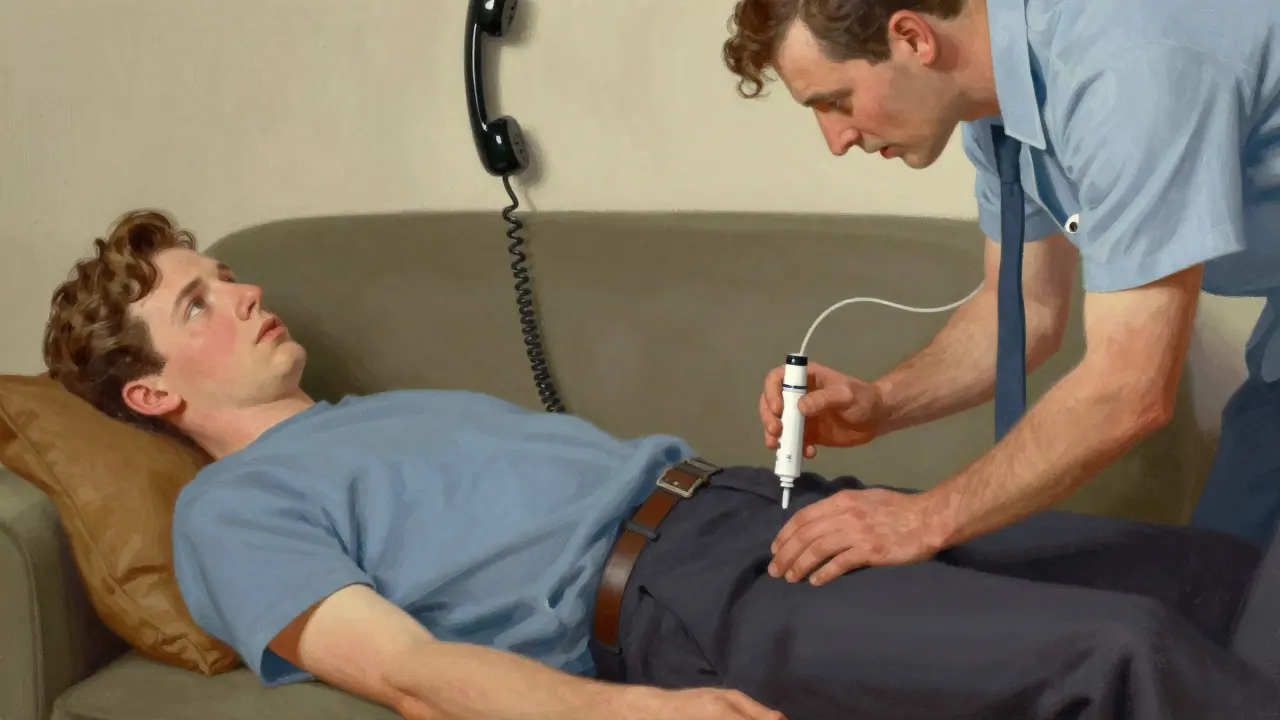
If you experience difficulty breathing, swelling, or dizziness alongside a rash, this could point to anaphylaxis, a life-threatening systemic allergic reaction requiring immediate epinephrine administration. The Resuscitation Council UK guidelines state clearly: initial treatment should not be delayed by a lack of complete history. If you see these signs, act now. For those with known allergies, carrying an epinephrine auto-injector is non-negotiable. The first-line treatment is an intramuscular injection into the mid-outer thigh. Delaying this step increases the risk of fatal outcomes significantly.
Delayed Dangers: Severe Cutaneous Adverse Reactions
Not all severe reactions happen instantly. Some drugs trigger Type IV hypersensitivity reactions, which are T-cell mediated delayed responses that manifest days or weeks after starting a medication. These are particularly insidious because they appear long after you have started taking the drug, making the connection less obvious. The most dangerous forms are known as SCARs (Severe Cutaneous Adverse Reactions), including Stevens-Johnson Syndrome (SJS) and Toxic Epidermal Necrolysis (TEN).
SJS and TEN cause the top layer of skin to detach from the underlying layers. In TEN cases, more than 10% of the body surface area is affected. Early symptoms might look like flu-like fever, sore eyes, and a painful red rash. As it progresses, blisters form, and the skin sloughs off. This condition has a high mortality rate-up to 30-50% for TEN cases according to NCBI StatPearls data. Unlike anaphylaxis, epinephrine will not help here. Instead, immediate discontinuation of the culprit drug and transfer to a specialized burn unit are essential for survival.
High-Risk Medications: What to Watch For
Certain classes of drugs carry higher risks for severe adverse events. The National Action Plan for Adverse Drug Event Prevention identifies three priority targets due to their high incidence and preventability:
- Anticoagulants: Drugs like warfarin or direct oral anticoagulants can cause severe bleeding if dosed incorrectly or interacting with other substances.
- Diabetes agents: Insulin and sulfonylureas can cause profound hypoglycemia, leading to seizures, coma, or brain damage if blood sugar drops too low.
- Opioids: Painkillers like morphine or fentanyl can cause respiratory depression, slowing breathing to a stop, especially when mixed with alcohol or sedatives.
Additionally, some antibiotics (like penicillin and sulfonamides) and anticonvulsants (like carbamazepine) are notorious triggers for SJS/TEN and anaphylaxis. Always disclose your full medical history and current medication list to every healthcare provider you visit. Even over-the-counter drugs can interact dangerously with prescription meds.
| Reaction Type | Onset Time | Key Symptoms | Immediate Action |
|---|---|---|---|
| Anaphylaxis (Type I) | Minutes to 2 hours | Breathing difficulty, swelling, hives, shock | Epinephrine injection, call emergency services |
| SJS/TEN (Type IV) | Days to weeks | Fever, blistering skin, mucous membrane pain | Stop drug, seek specialized burn care |
| DRESS Syndrome | 2-6 weeks | Rash, fever, organ involvement (liver/kidney) | Stop drug, hospital monitoring |
| Hemolytic Anemia (Type II) | 5-10 days | Fatigue, jaundice, dark urine | Medical evaluation, stop offending agent |

Emergency Response: What to Do Right Now
If you suspect a severe reaction, follow these steps immediately. Do not guess. Do not wait to see if it gets better.
- Stop the medication: Discontinue the suspected drug immediately. Do not take another dose.
- Call for help: Dial your local emergency number (999 in the UK, 911 in the US). Clearly state that you suspect a severe drug reaction.
- Use epinephrine if available: If you have an auto-injector and are experiencing breathing issues or swelling, use it now. Inject into the outer thigh.
- Position yourself safely: Lie flat on your back with legs raised if you feel faint. If vomiting or having trouble breathing, sit up slightly to keep airways clear.
- Bring the medication: Take the pill bottle or package to the hospital. This helps doctors identify the exact compound causing the reaction.
The Resuscitation Council UK emphasizes that patients having anaphylaxis should expect prompt treatment with IM adrenaline. Specialist follow-up in an allergy clinic is mandatory afterward to determine the cause and prevent future occurrences.
Prevention and Reporting: Taking Control
Prevention starts with awareness. Before starting any new medication, ask your doctor about potential severe reactions based on your history. If you have had a reaction before, ensure it is documented in your medical records and consider wearing a medical alert bracelet.
Reporting plays a vital role in public health safety. Systems like the FDA’s Adverse Event Reporting System and the European Medicines Agency’s EudraVigilance rely on patient reports to detect patterns. If you survive a severe reaction, report it. Your experience could save someone else’s life by triggering a warning label update or recall.
For at-risk patients, experts recommend carrying an adrenaline injector as an interim measure before specialist assessment. Training in its use is essential-an unused injector in a drawer saves no lives. Know how to use it, where to inject, and when to deploy it.
How quickly do severe drug reactions usually occur?
Timing varies drastically by type. Anaphylaxis (Type I) typically occurs within minutes to two hours of exposure. In contrast, severe cutaneous reactions like Stevens-Johnson Syndrome may not appear until days or even weeks after starting the medication. This delay makes early recognition challenging, so monitor for any unusual symptoms throughout your course of treatment.
Can I treat a severe drug reaction at home?
No. Severe adverse drug reactions are medical emergencies. While using an epinephrine auto-injector is a critical first step for anaphylaxis, it is not a cure. You still need immediate professional medical attention for further stabilization, observation, and additional treatments such as oxygen, fluids, or steroids. Never attempt to manage severe symptoms solely at home.
What are the earliest signs of anaphylaxis?
Early signs include itching, hives, flushing, and swelling of the face or throat. More ominous signs involve respiratory distress (wheezing, shortness of breath) and circulatory issues (dizziness, rapid pulse, feeling faint). If multiple systems are involved-skin plus breathing or circulation-it is likely anaphylaxis, and you should use epinephrine immediately.
Are natural supplements safe from severe reactions?
Not necessarily. Herbal supplements and vitamins can also cause severe adverse reactions, including liver toxicity or allergic responses. They are not regulated as strictly as pharmaceuticals, meaning purity and dosage consistency vary. Always inform your healthcare provider about all supplements you take, as they can interact dangerously with prescription medications.
Why is epinephrine preferred over antihistamines for anaphylaxis?
Epinephrine works faster and addresses the core life-threatening mechanisms of anaphylaxis: airway constriction and blood pressure collapse. Antihistamines only block histamine release, which is just one part of the complex allergic cascade. They do not open constricted airways or support failing circulation. Guidelines universally recommend epinephrine as the primary, first-line treatment.
Write a comment
Latest Posts
Comments
Tanya KLIMCHUK Klimchuk
17/May/2026Listen up, people! This isn't just some fluffy health blog post.
This is literally life or death stuff and if you think your little headache pill is harmless because it's over the counter, you are dead wrong.
I've seen too many idiots ignore the signs until their throat swells shut and then they're scrambling for an EpiPen that doesn't exist in their purse.
Stop being so lazy with your own safety.
If you have a history of allergies, get that injector and learn how to use it right now instead of waiting for the perfect moment that will never come.
The article says epinephrine is first-line treatment and that is non-negotiable science not a suggestion from a nice doctor who wants to be your friend.
You don't need permission to save your own life.
Read the section on Type I hypersensitivity again because clearly you skimmed past the part about airway closure happening in minutes.
Don't let yourself become a statistic because you were too proud to carry a needle.
Get educated or get left behind.
Anthony Red
17/May/2026Hey everyone, thanks for sharing this important info.
I always try to keep things chill but honestly this topic hits close to home for me since my buddy had a reaction to antibiotics last year.
It was crazy how fast it happened too.
One minute we were laughing at a joke and the next he couldn't breathe properly.
We got him to the ER quick but it was scary as hell.
I really appreciate the breakdown of the different types of reactions here because most people only know about instant allergic reactions.
The delayed ones like SJS are super insidious since you might not even connect the dots back to the med you started taking weeks ago.
Just wanted to say stay safe out there folks and maybe throw an EpiPen in your gym bag if you have allergies.
No harm in being prepared.
Javier Arauz
17/May/2026This whole narrative is designed to make you scared of everything the government puts in your water supply and medicine cabinet.
Why do we need emergency help for every little rash?
In my country we toughen up and don't run to the hospital for every bump.
These severe adverse drug reactions are probably exaggerated by big pharma to sell more antihistamines and injectors.
I bet half these cases are just people having weak immune systems because they don't eat real food.
Stop blaming the pills and start blaming your lifestyle.
Also why are we listening to FDA guidelines when they are corrupt?
Real men handle pain without needles.
But sure, keep telling us to panic over a headache pill.
It's all about control.
Kris Wong
17/May/2026🚨 Wake up sheeple! 🚨
Do you really think these 'adverse reactions' are accidental?
Big Pharma knows exactly what they are doing.
The IgE-mediated responses are engineered to create dependency on their rescue drugs like epinephrine.
They want you terrified so you buy the auto-injector which costs hundreds of dollars.
And guess what? The ingredients in those injectors are tracked.
Every time you use one, they know where you are and what you reacted to.
It's a surveillance state built on fear of natural bodily functions.
The SJS cases? Probably a way to thin out the population who take generic meds.
Only the elite get the safe versions.
Check the timestamps on the reports.
Suspicious timing indeed. 👁️
Danny S
17/May/2026(¬_¬) You are all naive to believe the official narratives provided by the WHO and FDA.
These organizations are fronts for globalist agendas aimed at weakening the populace through chemical dependency.
The 'severe cutaneous adverse reactions' mentioned here are likely bioweapons testing grounds disguised as medical errors.
Notice how the onset times vary?
That is precision engineering.
Type I is for immediate compliance checks.
Type IV is for long-term tracking of resistant individuals.
When they tell you to stop the medication, they are actually trying to hide the source of the toxin.
Do not go to the hospital.
They will inject you with more of the same poison under the guise of stabilization.
Stay home.
Detox naturally.
Trust no one in white coats. (¬_¬)
Jeremiah Cassandra
17/May/2026Oh look, another panicked post about pills making us sick. 😂
Let me guess, did you read this after taking a vitamin C supplement and feeling a tingle?
Because that's definitely anaphylaxis and not just your body working.
But sure, let's pretend that every rash is Stevens-Johnson Syndrome.
I'm sure the NHS loves having empty burn units because everyone decided to self-diagnose TEN from a sunburn.
Carrying an EpiPen is fine if you have a documented allergy to peanuts or bee stings, but carrying one because you're afraid of aspirin is just silly.
Also, injecting yourself in the thigh sounds painful and dramatic.
Maybe just drink some water and wait it out like normal humans do. 💉➡️💧
charles robert
17/May/2026The duality of man is reflected in his relationship with the chemical substances he ingests to alleviate suffering, only to create greater suffering in the process. 🌑
We seek relief from the headache, yet the cure becomes the executioner.
Is it not ironic that the very institutions designed to heal us are the architects of our potential demise?
The epinephrine injection is a modern ritual, a desperate plea to the gods of circulation to spare our fragile vessels.
But what does it mean to survive if we are merely preserving a vessel for further decay?
The skin sloughing off in TEN is perhaps the body's ultimate rejection of the artificial world imposed upon it.
We are trapped in a cycle of consumption and reaction, forever dancing on the edge of the abyss.
Who are we really when the swelling subsides?
Perhaps nothing at all. 🕯️
Mollie Louise
17/May/2026Wow, this is such a crucial conversation to be having right now because knowledge truly is power when it comes to our personal health and safety! 🌟
I cannot stress enough how important it is to listen to your body and advocate for yourself because you are the CEO of your own well-being and nobody else can do that job for you.
It makes me so happy to see resources like this that break down complex medical jargon into actionable steps for everyday people who just want to live their best lives without unnecessary fear.
Remember that prevention is better than cure, so please talk to your doctors about your history and ask questions until you feel confident and informed.
Also, wearing a medical alert bracelet is such a smart move for anyone with known allergies because it ensures that help can reach you even if you are unable to speak for yourself in an emergency situation.
Let's support each other in staying informed and proactive! 💪✨
Christina Moran
17/May/2026i think its cool u posted this bc i didnt know abt the delayed reactions lol
like i thought if u werent dying immediately it was fine but apparently u can get sick weeks later??
thats kinda scary tbh.
also does this apply to herbal stuff too?
i take a lot of supplements from gnc and sometimes i feel weird after but i just thought it was placebo.
maybe i should stop taking them or smth?
anyways good info tho thx for sharing!
mardy duffy
17/May/2026Boring. Read it. Didn't learn anything new. Go away.
Desirea Gaona
17/May/2026It is imperative that we disseminate this information widely within our communities to ensure public safety and awareness regarding pharmaceutical risks.
The distinction between mild side effects and severe adverse drug reactions is often blurred in casual discourse, leading to dangerous delays in seeking appropriate medical intervention.
I commend the author for providing clear, evidence-based guidelines on recognizing symptoms such as angioedema and hypotension.
Furthermore, the emphasis on reporting adverse events to regulatory bodies like the FDA is a vital component of pharmacovigilance that protects future patients.
We must encourage our peers to maintain comprehensive medication lists and disclose all supplements to their healthcare providers to mitigate interaction risks.
Education is the cornerstone of prevention in this context.
Yuvraj Singh
17/May/2026Hello friends, thank you for this detailed overview of adverse drug reactions.
In India, we often face challenges with counterfeit medications, so verifying the source of your drugs is also critical alongside knowing the symptoms.
I would add that DRESS syndrome, mentioned in the table, is particularly tricky because it involves organ inflammation which can be silent initially.
Regular monitoring of liver enzymes and kidney function when starting high-risk drugs like carbamazepine is essential practice in our clinical settings.
Please remember that while epinephrine is crucial for anaphylaxis, corticosteroids are often used adjunctively to prevent biphasic reactions, though this should always be determined by a physician.
Stay healthy and informed everyone.
Dana Ellington
17/May/2026OMG this gave me chills!! 😱
I had a reaction to penicillin once and I thought I was gonna die!
My throat felt like it was closing up and I was sweating so much.
Thank god my mom knew to call 911 immediately.
People really need to pay attention to these signs because it happens SO fast.
I cant believe some people think they can treat it at home.
NOPE! 🙅♀️
Get to the hospital ASAP!
Also thanks for mentioning the epinephrine thing, I didnt know you could buy those without a prescription in some places.
Might have to look into getting one just in case.
Scary stuff but good info! ❤️