

Drug Safety Risk Calculator
How Sentinel Detects Hidden Risks
Most drug safety systems rely on voluntary reports (like FAERS), which miss 90-99% of serious events. Enter numbers to see how Sentinel calculates true risk rates using real-world data.
Risk Analysis Results
FAERS System (Voluntary Reporting)
Only 0.00% of true events detected.
Missed 90-99% of cases
Apparent risk rate: 1 in 20,000
FDA Sentinel System (Real-World Data)
Detects 90-99% of events.
No underreporting bias
True risk rate: 1 in 1,000
Every year, millions of people take prescription drugs. Most of them are safe. But for a small number, something goes wrong - a rare side effect, a dangerous interaction, a delayed reaction that no clinical trial ever caught. Before the FDA Sentinel Initiative, finding these hidden risks was like searching for needles in a haystack made of paper forms and delayed reports. Today, it’s different. The FDA uses big data to spot drug safety problems in near real-time - without waiting for patients to report them.
What Is the FDA Sentinel Initiative?
The FDA Sentinel Initiative is a national system built to watch what happens to people after they take FDA-approved drugs, vaccines, and medical devices. It’s not a single database. It doesn’t collect your medical records. Instead, it connects to dozens of healthcare organizations across the U.S. - insurance companies, hospitals, clinics - all keeping their own data. When the FDA needs to check if a drug might be causing harm, it sends a secure question to this network. Each partner runs the same analysis on their own data. Then, they send back the results - no personal health information ever leaves their system.
Launched in 2008 after Congress passed the FDA Amendments Act, Sentinel started small. The first phase, called Mini-Sentinel, tested the idea from 2009 to 2015. By 2016, the full system went live. Today, it’s the largest distributed medical safety network in the world. It covers over 200 million people - more than half the U.S. population. And it’s not just looking at billing codes anymore. It’s now using electronic health records with doctor’s notes, lab results, and even symptoms written in free text.
How It Beats Old-Style Reporting Systems
Before Sentinel, the main way the FDA learned about bad drug reactions was through the FAERS system - the FDA Adverse Event Reporting System. Doctors, pharmacists, or patients could voluntarily report side effects. Sounds simple, right? But here’s the problem: only 1% to 10% of serious side effects ever get reported. Many people don’t connect their symptoms to a drug. Others don’t know where to report. And even when they do, the reports are often incomplete - missing dates, doses, or medical history.
Sentinel fixes that. Instead of waiting for reports, it actively looks. It knows exactly how many people took a drug (the denominator), not just how many had problems. It can compare users of Drug A to users of Drug B. It can track whether people on a new diabetes medication have more heart attacks over six months. It can even spot patterns in elderly patients or pregnant women - groups often left out of clinical trials.
One example: In 2018, Sentinel flagged a possible link between a popular antipsychotic and sudden cardiac events in older adults. Traditional reports had missed it. Sentinel’s analysis, based on claims and EHR data from over 10 million patients, confirmed the risk. The FDA updated the drug’s label within months. That’s the power of real-world data.
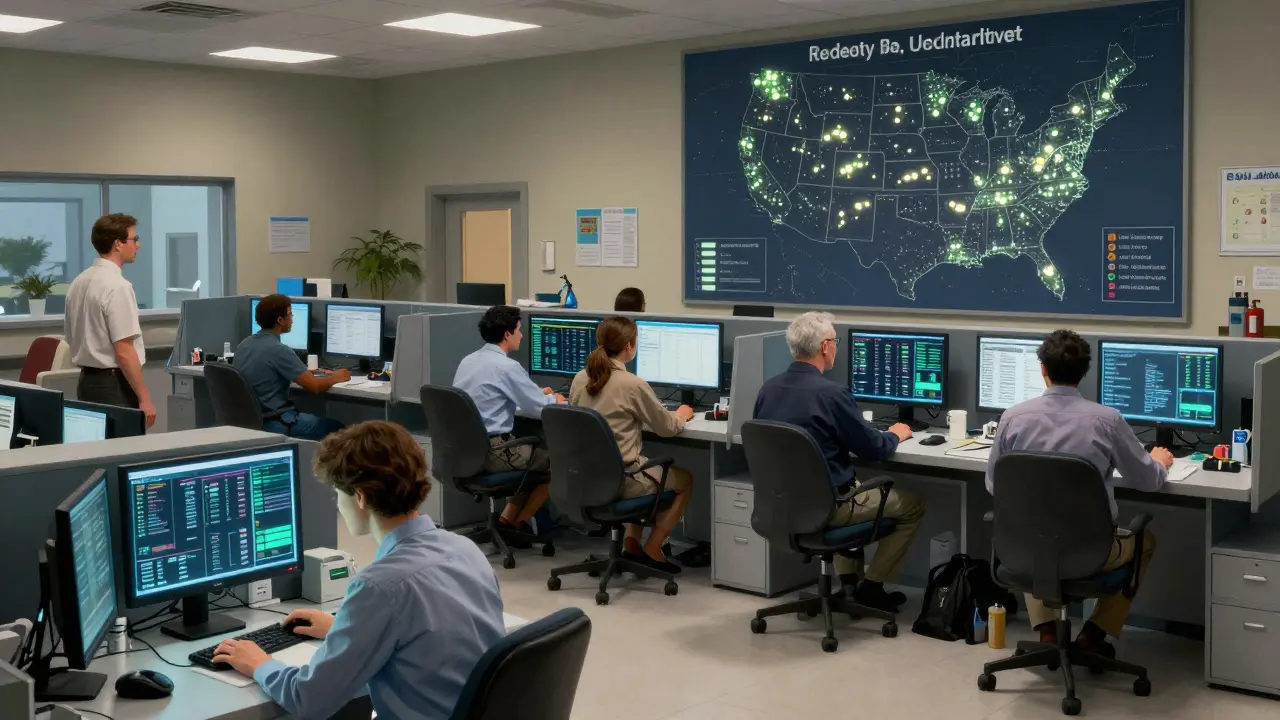
How the System Works Behind the Scenes
Sentinel doesn’t move your data. That’s the key. Your records stay where they are - at your insurer, your hospital, your clinic. The FDA sends a query: “Show me all patients over 65 who took Drug X in the last year and had a stroke.” Each data partner runs that exact same code on their own system. They use standardized tools built by the FDA to make sure results are comparable. Then, they send back numbers - not names, not addresses, not Social Security numbers. Just counts and statistics.
Data partners update their information quarterly. Some have full EHRs. Others have only insurance claims. The system accounts for that. It doesn’t assume all data is perfect. It flags gaps and uses statistical methods to adjust for missing pieces. The FDA’s Innovation Center is constantly improving how it reads unstructured data - like doctor’s notes that say “patient felt dizzy after new pill” - turning those phrases into usable signals.
It’s not magic. It’s engineering. And it’s expensive. The system has received over $300 million in funding since its start. But the cost of missing a dangerous drug? That’s far higher.
Big Data, Big Challenges
Even with all its power, Sentinel has limits. Not all hospitals use the same electronic systems. Some code high blood pressure as “HTN,” others as “hypertension.” Some notes are clear. Others are messy. The system can’t read every handwritten chart or interpret every vague symptom. That’s why the Innovation Center is working on artificial intelligence - using natural language processing to extract meaning from clinical notes.
Another issue: rare side effects. If a drug causes a problem in one out of 100,000 people, Sentinel might still miss it - even with 200 million records. That’s why it doesn’t replace clinical trials. It complements them. Trials find common side effects. Sentinel finds the ones that only show up after years of use, or in people with multiple chronic conditions.
And then there’s the human factor. Running a Sentinel query takes expertise. You need epidemiologists, statisticians, pharmacists, and data scientists. It’s not something a general practitioner can do on their own. The FDA trains researchers through its Operations Center, but the learning curve is steep. That’s why most analyses are done by FDA staff or academic partners, not individual doctors.

Why This Matters for You
If you take a prescription drug, Sentinel is watching. It’s not spying on you. It’s protecting you. When a new drug hits the market, we assume it’s safe. But safety isn’t proven in a 6-month trial. It’s proven over years, in millions of real lives. Sentinel makes that possible.
It’s also changing how drugs are approved. The 21st Century Cures Act gave the FDA authority to use real-world evidence - like Sentinel data - to support new drug labels or even approvals. In 2023, the FDA used Sentinel findings to approve a new indication for a heart medication based on long-term outcomes from EHRs, not just a trial.
And it’s not just the U.S. Other countries are watching. The UK’s CPRD and the EU’s EudraVigilance are learning from Sentinel’s model. The goal? A global network where drug safety data flows securely across borders - without sacrificing privacy.
What’s Next for Sentinel?
The system is evolving fast. In 2019, the FDA split Sentinel into three centers: Operations, Innovation, and Community Building. The Innovation Center now focuses on AI, machine learning, and better ways to use EHR data. One project is trying to predict which patients are most likely to have bad reactions before they even happen - using patterns in their medical history.
Another goal: faster responses. Right now, a safety analysis takes weeks to months. The aim is to cut that down to days. Imagine a new vaccine rollout. Sentinel could monitor for rare blood clots in real time - and alert regulators within 72 hours.
The biggest shift? From reactive to predictive. Sentinel isn’t just answering questions anymore. It’s starting to ask them. What if we could predict a drug’s risk before it’s widely used? What if we could match patients to the safest medication based on their genetics, lifestyle, and past health? Sentinel is building the foundation for that future.
It’s not perfect. It’s not complete. But it’s the best tool we have to keep drugs safe after they leave the lab. And it’s only getting smarter.
How is the FDA Sentinel Initiative different from FAERS?
FAERS relies on voluntary reports from doctors, patients, or drug companies. It’s passive, often incomplete, and doesn’t know how many people took the drug. Sentinel is active - it pulls data from millions of real patient records and knows exactly how many people were exposed. That lets it calculate true risk rates, not just counts of reports.
Does Sentinel collect personal health information?
No. Sentinel never collects or stores personal data. Each partner keeps their own records. The FDA sends a query, and partners run the analysis locally. Only aggregated, de-identified results are shared. No names, addresses, or medical record numbers are ever transferred.
Can patients opt out of Sentinel?
Individuals cannot opt out directly because Sentinel doesn’t collect personal data. But data partners - like insurance companies or hospitals - may have their own privacy policies. If you’re concerned, contact your provider. Sentinel itself doesn’t track or identify individuals.
What kind of data does Sentinel use?
Sentinel uses two main types: insurance claims data (which shows prescriptions, diagnoses, and hospital visits) and electronic health records (EHRs), which include lab results, doctor’s notes, and clinical observations. The system is increasingly focused on EHRs because they provide richer, more detailed information.
Has Sentinel actually changed drug safety outcomes?
Yes. Since 2016, Sentinel has completed hundreds of safety analyses that directly influenced FDA decisions. Examples include updating warnings for certain diabetes drugs, restricting use of specific antipsychotics in elderly patients, and identifying risks with new vaccines. It’s now a core part of how the FDA ensures drug safety after approval.


Comments
Doreen Pachificus
4/Jan/2026Sentinel’s quiet genius is how it turns chaos into clarity - no personal data moved, no one’s privacy violated, just numbers dancing in the dark to reveal hidden patterns. It’s like watching a ghost write a safety manual.
Jason Stafford
4/Jan/2026They say it doesn’t collect personal data. But who’s writing the queries? Who’s deciding what’s a ‘risk’? This isn’t safety - it’s surveillance with a FDA stamp. They’re building a behavioral profile of every American on prescription. Don’t be fooled.
Stephen Craig
4/Jan/2026Real-world data beats clinical trials for late-onset effects. Simple as that.
Cassie Tynan
4/Jan/2026So we’re trusting algorithms to interpret doctor’s scribbles like ‘felt weird after pill’? Next they’ll automate empathy. 🤖
Justin Lowans
4/Jan/2026This system is one of the most elegant applications of distributed computing in public health. By keeping data localized and queries standardized, Sentinel respects privacy while scaling insight. It’s not just smart - it’s ethically engineered.
The fact that it’s now integrating unstructured clinical notes with NLP? That’s the future of pharmacovigilance. Most countries are still stuck in FAERS’ paper-trail mindset.
And yes, it’s expensive - but so is burying another thalidomide under a pile of ‘unreported’ cases.
Michael Rudge
4/Jan/2026Oh please. You think this isn’t just another corporate-government data grab dressed up as ‘public safety’? Every ‘de-identified’ dataset eventually gets re-identified. And who’s auditing the auditors? The same folks who approved the drugs in the first place.
Don’t you see? This isn’t about protecting you - it’s about protecting the pharmaceutical industry from liability. Sentinel lets them say ‘we didn’t know’ - until they do, then they quietly update the label and move on.
And don’t get me started on the AI ‘predicting’ reactions. That’s not medicine. That’s prophecy with a grant number.
Uzoamaka Nwankpa
4/Jan/2026It’s beautiful how they say they don’t track individuals… but then they know exactly which elderly patients are dying on antipsychotics. It’s like they’re watching through walls.
I don’t trust systems that speak in statistics but never name the faces behind them.
Connor Hale
4/Jan/2026The real win isn’t the tech - it’s the shift from reactive to proactive. We used to wait for bodies. Now we watch for patterns. That’s evolution.
Yes, it’s imperfect. Yes, it needs more AI. But it’s the first system that treats drug safety like a living ecosystem - not a checklist.
Charlotte N
4/Jan/2026so like… if i take metformin and get dizzy and my doc writes ‘patient felt off’… does that count? because my chart is a mess and i’m not sure if they even typed it right
also why does sentinel care about HTN vs hypertension??
and who fixes the code when the hospital’s system crashes and all the data disappears for a week??
Rory Corrigan
4/Jan/2026We’re using AI to read doctor’s notes like they’re poetry… but we still can’t fix the fact that half of them don’t know how to spell ‘hypertension’.
It’s like teaching a dolphin to read Shakespeare - impressive, but the dolphin’s just guessing.
Still… if it saves one life? Worth the weirdness. 🤔
bob bob
4/Jan/2026I’ve been on 7 different meds in the last 5 years. I never reported a single side effect. But I guess Sentinel caught a few anyway. Kinda reassuring, honestly.
Thanks for doing the quiet work so we don’t have to.
jigisha Patel
4/Jan/2026The statistical power of Sentinel is undeniable - but its methodological rigor must be scrutinized. Heterogeneity in EHR coding across institutions introduces significant bias, particularly in comorbid populations. The use of propensity score matching to adjust for confounders is only as strong as the covariates encoded - many of which are inconsistently documented.
Furthermore, the reliance on claims data for denominator estimation underrepresents uninsured and underinsured populations, creating a systematic sampling bias toward higher-income demographics. This undermines generalizability, particularly for drugs targeting low-SES groups.
While the transition from Mini-Sentinel to the full network represents a technical triumph, the validation of algorithmic outputs against gold-standard clinical adjudication remains insufficiently documented in public literature. Without transparent benchmarking, we risk institutionalizing false positives as regulatory truth.
The AI-driven extraction of symptoms from free-text notes, while innovative, lacks external reproducibility. No peer-reviewed study has yet validated the sensitivity and specificity of these NLP models against clinician-annotated datasets. This is not science - it’s algorithmic speculation dressed in regulatory clothing.
And yet… despite these flaws, the system outperforms FAERS by orders of magnitude. The real tragedy is not that Sentinel is imperfect - it’s that we accept its imperfections because we have no better alternative.
We must demand open-source query frameworks, public audit trails, and independent validation panels. Otherwise, we’re not advancing safety - we’re automating complacency.
Ethan Purser
4/Jan/2026You know what’s scary? Sentinel doesn’t just detect harm - it predicts it. What if it starts telling doctors who’s ‘high risk’ before they even take the pill? Who decides what ‘risk’ means? A computer? A bureaucrat? A pharmaceutical lobbyist?
This isn’t safety. It’s control. And once they have your data, they’ll start telling you what drugs you’re allowed to take. Next thing you know, your doctor’s just reading a script from a machine.
They say it’s for you. But who’s watching the watchers?
And don’t tell me ‘it’s de-identified.’ I’ve seen what happens when ‘anonymous’ data gets sold. It always finds a way back to you.
They’re not protecting us. They’re preparing us. For what? I don’t know. But I don’t trust it.