

How antitrust laws shape the price of your generic medicines
When you pick up a prescription for metformin, lisinopril, or atorvastatin, chances are you’re getting a generic drug. These pills cost a fraction of their branded versions-sometimes less than $5 a month. But behind that low price is a decades-long legal battle over who gets to sell them, when, and under what rules. Antitrust laws weren’t designed to lower drug prices directly. Yet in the generic pharmaceutical market, they’re the main reason those prices dropped by 80% to 90% in the last 40 years.
It wasn’t always this way. Before 1984, generic drugs were rare. Branded companies held patents for years, and even after those patents expired, they used legal tricks to block competitors. The Hatch-Waxman Act changed that. Signed into law by President Reagan in 1984, it created a clear path for generic manufacturers to enter the market without repeating expensive clinical trials. In return, it gave the first generic company to challenge a patent 180 days of exclusive sales. That was supposed to spark competition. And for a while, it did.
The 180-day exclusivity loophole
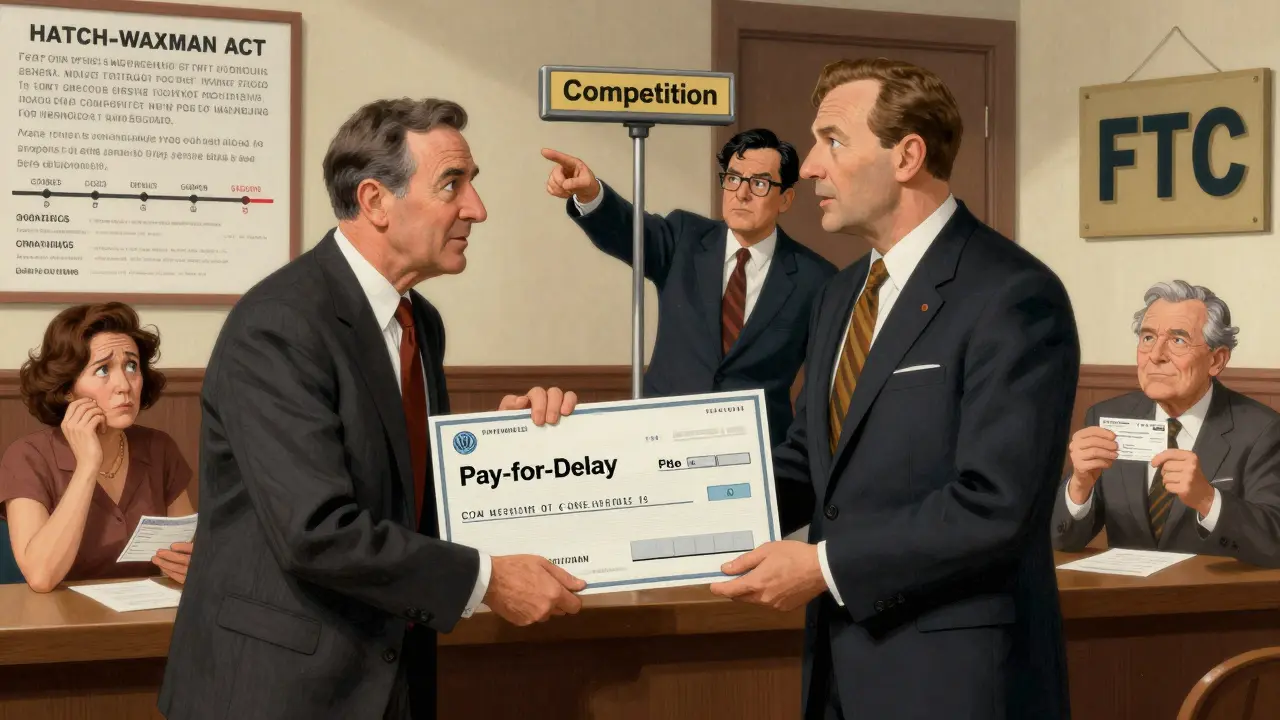
The 180-day exclusivity period was meant to be a reward for the brave generic company willing to risk a lawsuit by challenging a patent. But over time, it became a tool for delay. Sometimes, branded companies would pay the first generic manufacturer not to enter the market at all. These deals, called “pay-for-delay,” turned the system on its head. Instead of competition lowering prices, money changed hands to keep them high.
The Federal Trade Commission (FTC) started tracking these deals in the early 2000s. By 2023, they had investigated 18 pay-for-delay cases, with settlements totaling over $1.2 billion. One of the biggest was against Gilead Sciences in 2023, where the company paid $246.8 million to settle claims it blocked generic versions of its HIV drug Truvada. The Supreme Court ruled in 2013 (FTC v. Actavis) that these payments weren’t automatically legal just because they came from a patent settlement. If the payment was large and unexplained, it could be an antitrust violation.
But pay-for-delay isn’t the only trick. Some branded companies file dozens of patents on minor changes-like a new coating or pill shape-just to keep their drugs listed in the FDA’s Orange Book. Each patent on that list blocks generic entry. In 2003, the FTC sued Bristol-Myers Squibb for listing patents that didn’t actually cover the drug, just to delay generics. Courts have since cracked down, but the practice still happens.
Product hopping and sham petitions
Another tactic is called “product hopping.” A company slightly changes its branded drug-switching from a tablet to a capsule, adding a flavor, or changing the release mechanism-right before the patent expires. Then it tells doctors and patients the old version is unsafe or outdated. Even though the old version is still available, pharmacies and insurers are pushed to switch to the new one. Since the new version is still under patent, generics can’t copy it yet.
The AstraZeneca case with Prilosec and Nexium is the classic example. Prilosec’s patent was about to expire. AstraZeneca launched Nexium, a slightly modified version, and marketed it as “the next generation.” Sales of Nexium soared, and generics of Prilosec struggled to gain traction. Courts didn’t find this illegal, but the FTC called it a “classic anticompetitive maneuver.” In 2022, the FTC held a workshop specifically on product hopping, signaling they’re still watching.
Then there are sham citizen petitions. Anybody can file a petition with the FDA asking them to delay approval of a generic drug. Legitimate petitions raise safety concerns. Sham petitions? They’re just legal distractions. In 2023, the FTC sued Teva Pharmaceuticals for filing dozens of these petitions to block generic versions of its multiple sclerosis drug Copaxone. The petitions claimed the generics weren’t bioequivalent, even though independent studies proved they were. The case is still pending, but it shows how deeply entrenched these tactics have become.
What’s happening in Europe and China
The U.S. isn’t alone in fighting generic drug delays. The European Commission has opened 27 antitrust cases between 2018 and 2022, and 60% of them were about blocking generic entry. One common tactic? Withdrawing marketing authorization in certain countries just to prevent generics from entering. Another is misleading patent offices to extend protection. In 2023, Commissioner Margrethe Vestager said delays in generic entry cost European consumers €11.9 billion every year.
China moved fast in 2025, releasing its first-ever Antitrust Guidelines for the Pharmaceutical Sector. It identified five “hardcore restrictions” that are automatically illegal: price fixing, output limits, market division, joint boycotts, and blocking new technology. By Q1 2025, six cases had been penalized-five of them for price fixing through WhatsApp groups, encrypted apps, and even algorithm-driven pricing. Chinese regulators are now using AI to monitor online price trends in real time, a move that could set a global standard.

Why this matters to real people
These aren’t just legal technicalities. They affect whether someone takes their medication. In 2022, the Kaiser Family Foundation found that 29% of U.S. adults skipped doses or didn’t fill prescriptions because of cost. That’s not because drugs are expensive overall-it’s because the right generics aren’t available yet. When a generic enters, prices drop fast. One study found that the first generic cuts prices by at least 20% in a year. With five generics on the market, prices fall nearly 85%.
Between 2005 and 2014, generic drugs saved U.S. consumers $1.68 trillion. In 2012 alone, that number was $217 billion. That’s more than the annual GDP of most countries. But every time a pay-for-delay deal stalls a generic, that savings disappears. And it’s not just money. Delayed access to generics means more hospital visits, worse health outcomes, and more strain on public health systems.
The future of generic competition
Antitrust enforcement is evolving. Regulators are getting smarter. The FTC is now looking at how companies use digital platforms to coordinate pricing. China’s AI-driven monitoring is pushing others to follow. The EU is tightening rules on patent listings and marketing practices. But the biggest hurdle isn’t the law-it’s the money.
Branded drug companies still make billions from each drug. A single blockbuster can earn $5 billion a year. Even after patent expiry, that revenue stream lasts for years. So they spend millions on lawyers, lobbyists, and patent filings to stretch it out. The system is stacked. The Hatch-Waxman Act was meant to balance innovation and access. Today, that balance is tipping.
What’s next? More lawsuits. More scrutiny. And more pressure on Congress to fix the loopholes. Until then, the fight for affordable medicine isn’t just about science or supply chains. It’s about who gets to play by the rules-and who gets to rewrite them.
Write a comment
Latest Posts



Comments
Nicole Rutherford
18/Dec/2025I used to work in pharma compliance. Pay-for-delay? It’s not a loophole-it’s a cartel. Companies literally pay each other to keep prices high. And we all pay the price. No wonder my insulin costs $400 a vial.
Mark Able
18/Dec/2025Wait, so you’re telling me the system’s rigged? I thought generics were supposed to be the people’s win. Now I’m wondering if my $3 metformin is just a placebo for my trust in capitalism.
Chris Clark
18/Dec/2025Dude, the Hatch-Waxman Act was genius-until Big Pharma figured out how to game it. They file patents on the color of the pill. Seriously. I read a study where one company had 17 patents on one drug, and 15 were for packaging. That’s not innovation, that’s legal jiu-jitsu.
Dorine Anthony
18/Dec/2025I just filled my lisinopril prescription for $2.50. I’m grateful. But reading this makes me wonder how many people aren’t even getting that chance. It’s not just about money-it’s about access.
William Storrs
18/Dec/2025You know what’s wild? China’s using AI to track price collusion on WhatsApp. Meanwhile, we’re still debating whether a patent on a pill coating counts as real innovation. We’re decades behind. Let’s not wait for a crisis to fix this.
Alisa Silvia Bila
18/Dec/2025Product hopping is so obvious it’s embarrassing.
Marsha Jentzsch
18/Dec/2025I knew it!!! I KNEW IT!!! The FDA is in on it!!! They’re letting these pharma giants push fake petitions because they’re paid off!!! I saw a guy on YouTube say the Orange Book is just a secret blacklist!!! And don’t get me started on the microchips in the pills!!!
Henry Marcus
18/Dec/2025The real game? The FDA, FTC, and Big Pharma are all part of the same shadow network. They don’t want generics because they need you dependent on overpriced meds so they can sell you supplements, detox teas, and ‘immune boosters’ next. It’s not about profit-it’s about control. They’re turning healthcare into a cult. And you’re all just信徒.
Carolyn Benson
18/Dec/2025The tragedy isn’t the loopholes-it’s that we’ve normalized this. We accept $5 pills as a miracle, not a symptom of a broken system. We cheer when a generic enters, but we don’t ask why it took 12 years. We don’t demand accountability. We just sigh and pay. This isn’t capitalism. It’s feudalism with a pharmacy counter.