

When a patient with rheumatoid arthritis or cancer needs a biologic drug that costs $80,000 a year, the question isn’t just about effectiveness-it’s about whether they can even afford it. That’s where biosimilars come in. These aren’t generics. They’re not exact copies. But they’re close enough-so close that the FDA now says you don’t always need a new clinical trial to prove they work.
What Makes a Biosimilar Different From a Generic?
Generics are simple. They’re small-molecule drugs, like aspirin or metformin, made from chemical formulas you can replicate exactly. If you know the recipe, you can make the same pill in a factory anywhere in the world. Biosimilars? They’re different. They’re made from living cells-yeast, bacteria, or mammalian cells-that produce complex proteins like antibodies. Think of it like cloning a tree. Even if you take a cutting from the same parent tree and grow it in the same soil, the new tree won’t be identical. Tiny differences in how the cells grow, how the proteins fold, or how sugars attach can change how the drug behaves in the body. That’s why the FDA doesn’t approve biosimilars the same way it approves generics. For a generic, you just prove chemical identity. For a biosimilar, you prove biosimilarity-a scientific standard that says the drug is so similar in structure, function, and safety that any differences don’t affect how well it works or how safe it is.The FDA’s New Approach: Less Testing, Faster Access
Until October 2025, the FDA required biosimilar makers to run full-scale clinical trials comparing their drug to the original biologic-often taking two to three years and costing over $200 million. That kept most small companies out of the game. Only 28 companies had ever submitted a biosimilar application in the U.S., even though there were 157 potential candidates. Then came the draft guidance: Scientific Considerations in Demonstrating Biosimilarity to a Reference Product: Updated Recommendations for Assessing the Need for Comparative Efficacy Studies. This wasn’t a minor tweak. It was a rewrite of the rulebook. Now, if three conditions are met, you don’t need a comparative efficacy study at all:- The reference product and biosimilar are made from the same type of cell line and are highly purified.
- The link between the drug’s structure and its clinical effect is well understood-for example, how a monoclonal antibody blocks a specific immune signal.
- You’ve already shown pharmacokinetic (PK) similarity: the drug enters the bloodstream, stays there, and leaves the body at the same rate as the original.
Interchangeability: The Big Controversy
There’s another layer: interchangeability. This is the status that lets pharmacists swap a biosimilar for the brand-name drug without asking the doctor. In Europe, most biosimilars are automatically interchangeable. In the U.S., it’s been a legal minefield. Before October 2025, the FDA required switching studies-where patients alternate between the reference drug and biosimilar multiple times-to prove no extra risk. That added another year and $50 million to development. The FDA’s new stance? Commissioner Marty Makary said at the GRx+Biosims conference: “Every biosimilar should have the designation of interchangeable.” He called interchangeability a “legislative term, not a scientific term.” That’s a bold move. It’s also controversial. Critics like Dr. Robert Popovian from PhRMA warn it could confuse doctors. If a patient has a reaction, will they know if it’s the drug or the switch? Some states still require prescriber approval for substitution, even when the FDA says it’s interchangeable. Still, the FDA approved two denosumab biosimilars as interchangeable in October 2025-the first time multiple interchangeables were approved for the same reference product. That’s a signal: the system is changing.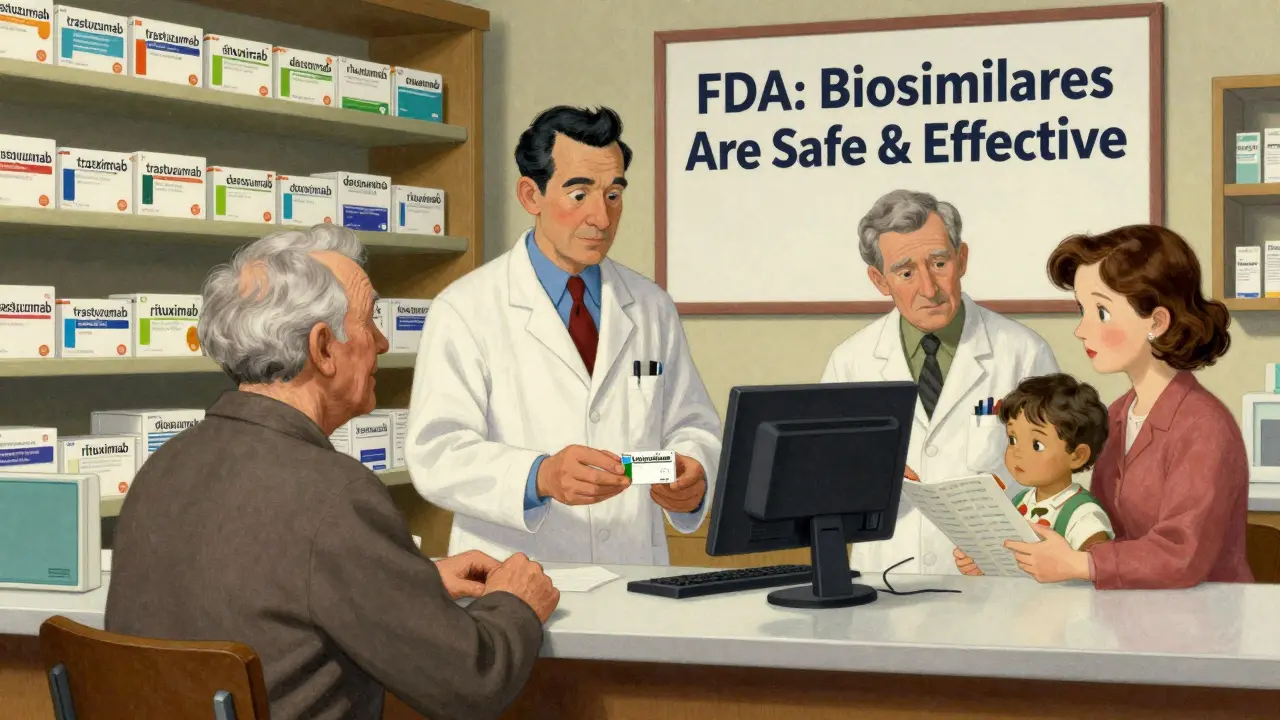
Who’s Winning? Who’s Still Struggling?
The big players are moving fast. Sandoz has 17 biosimilars approved. Pfizer and Amgen each have 10 or more. Viatris and Biocon are catching up. But small companies? They’re still fighting an uphill battle. Why? Because the analytical tools needed-high-resolution mass specs, automated bioassay platforms-cost millions. Only 12 of the 76 approved biosimilars came from companies with fewer than 100 employees. That’s not because they lack talent. It’s because the infrastructure is too expensive. The FDA’s Biosimilars User Fee Amendments (BsUFA III), which run through 2027, are trying to help. They fund faster reviews and offer free pre-submission meetings. The Biosimilars Council has held 87 consultations with small developers since 2023. Still, it’s not enough. Many startups still walk away after their first meeting with the FDA, realizing they can’t afford the next step.Where Are Biosimilars Working Best?
Not all therapeutic areas are equal. Oncology biosimilars have taken off. Why? Because hospitals are under pressure to cut costs-and cancer drugs are the most expensive. Mayo Clinic saved $18 million a year after switching to biosimilars for chemotherapy drugs like trastuzumab and rituximab. Autoimmune diseases? Slower. Patients with rheumatoid arthritis or Crohn’s disease often worry about switching. A September 2025 Arthritis Foundation survey found 78% of patients were satisfied with biosimilars, but 41% were initially scared. Most of those fears faded after talking to their doctor. On Reddit, patients shared real experiences: 63% said their biosimilar worked just as well. 22% noticed more injection site reactions. One user wrote: “My joint pain didn’t come back. But my arm hurt for two days after every shot. My doctor said it’s normal.” The biggest barrier? Awareness. Only 32% of U.S. patients know what a biosimilar is. Most think it’s a “cheap version” and assume it’s less effective. Doctors, too, are cautious. A 2025 survey of 1,200 physicians found 58% said they’d prescribe a biosimilar only if the patient asked for it.
What’s Next? The Road to 0 Billion in Savings
The U.S. biosimilar market was worth $18.7 billion in 2024. By 2029, it’s projected to hit $62.3 billion. That’s a 27% annual growth rate. The FDA’s new guidance could push that even higher. McKinsey predicts biosimilars could capture 40-50% of the market for major biologics by 2030-up from just 23% today. That could save the healthcare system $150 billion a year. But hurdles remain. Patent lawsuits delay 68% of biosimilars from entering the market. Some companies use “patent thickets”-layering dozens of minor patents-to block competition. The FTC is watching, but action has been slow. The biggest question? Will Congress update the law to match the FDA’s science? Right now, interchangeability is a legal status, not a scientific one. If the FDA says all biosimilars are interchangeable, but the law says they need separate approval, confusion grows. That’s a problem for pharmacists, insurers, and patients. The FDA’s draft guidance is open for public comment until January 27, 2026. Final rules will come by June 2026. One thing’s clear: the era of slow, expensive biosimilar approvals is ending. The question is whether the rest of the system-doctors, insurers, lawmakers-will catch up.Real Impact: One Patient’s Story
Maria, 58, has been on adalimumab for psoriatic arthritis since 2018. Her monthly cost: $4,200. Her insurance covered it, but only after two denials and a six-month appeal. In March 2025, her pharmacy switched her to a biosimilar. The cost? $980. No paperwork. No appeals. She didn’t feel any difference. Her joint pain stayed gone. Her skin cleared up. She didn’t even know the name changed until her bill came. “I’m not a scientist,” she said. “But I know what works. And this works.” That’s the goal. Not to confuse. Not to overcomplicate. Just to make life-saving drugs affordable.Are biosimilars the same as generics?
No. Generics are exact chemical copies of small-molecule drugs, like ibuprofen. Biosimilars are highly similar versions of complex biologic drugs made from living cells. They can’t be identical because biological processes vary slightly each time. The FDA requires extensive testing to prove biosimilars are as safe and effective as the original, but they’re not exact copies.
Why do biosimilars cost less than biologics?
Biosimilars cost less because they don’t require repeating the full clinical trials that the original biologic went through. The reference product already proved safety and effectiveness. Biosimilar makers only need to show their version is highly similar using advanced analytical tools and targeted studies. This cuts development time and costs by 50% or more.
Can pharmacists substitute biosimilars without a doctor’s approval?
Only if the biosimilar has an “interchangeable” designation from the FDA. Even then, state laws vary. Some states allow automatic substitution; others require the prescriber to specifically authorize it. As of late 2025, the FDA considers all biosimilars interchangeable in principle, but legal and regulatory confusion still exists at the state level.
How many biosimilars has the FDA approved as of 2025?
As of late 2025, the FDA has approved 76 biosimilars for use in the U.S. These treat conditions including cancer, rheumatoid arthritis, diabetes, Crohn’s disease, and osteoporosis. The pace of approvals is accelerating due to the October 2025 guidance changes.
Do biosimilars have the same side effects as the original biologic?
They should. The FDA requires biosimilars to have no clinically meaningful differences in safety or side effects. Most patients report similar experiences. However, minor differences in injection site reactions or rare immune responses can occur. These are monitored closely in post-market studies. Overall, patient satisfaction rates are high-78% in one 2025 survey.
Why hasn’t the U.S. biosimilar market grown faster than Europe’s?
Europe approved its first biosimilar in 2006 and has over 100 on the market today. The U.S. lagged because its regulatory process was more complex, especially with mandatory efficacy trials and strict interchangeability rules. Market penetration is only 23% in the U.S. versus 67% in Europe. The 2025 FDA guidance aims to close that gap by reducing barriers and aligning more closely with the EMA’s approach.
What therapeutic areas are seeing the most biosimilar use?
Oncology leads, with biosimilars capturing 31% of the market for drugs like trastuzumab and rituximab. Autoimmune diseases like rheumatoid arthritis and Crohn’s disease have lower adoption at 18%, partly due to patient and physician hesitation. Diabetes and osteoporosis biosimilars are growing quickly too, especially as more affordable options become available.
How can patients find out if a biosimilar is right for them?
Talk to your doctor or pharmacist. Ask if a biosimilar is available for your condition and whether it’s FDA-approved as interchangeable. Check your insurance plan’s formulary-many now cover biosimilars at lower copays. Patient advocacy groups like the Arthritis Foundation and the Biosimilars Council offer free resources to help you understand your options.

Comments
Stewart Smith
30/Dec/2025So basically, we’re trading one set of corporate gatekeepers for another? Cool. I’ll believe it when my insulin costs less than my Netflix subscription.
Aaron Bales
30/Dec/2025The science is solid. The data is clear. If your doctor hesitates, ask them why. Biosimilars save lives and money. No magic, just molecules.
linda permata sari
30/Dec/2025I live in Jakarta and we got biosimilars before the US even finished debating whether they’re real drugs 😅 My cousin with RA pays $20/month now. America, we’re waiting.
Sara Stinnett
30/Dec/2025Oh, so now the FDA is just signing off on ‘close enough’ because Big Pharma is tired of waiting? Let me guess-the same people who insisted generics were ‘unsafe’ are now calling biosimilars ‘revolutionary.’ Classic. The only thing changing is the price tag on the lie.
Lawver Stanton
30/Dec/2025I’ve been reading this whole thing and honestly? I’m exhausted. First, they say biosimilars aren’t generics, then they say they’re just as good, then they say you don’t need trials, then they say pharmacists can swap them, then they say states can block it, then they say the FDA wants them all interchangeable, but Congress won’t fix the law, and now I’m sitting here wondering if my arthritis is worse than the regulatory chaos. I just want my drug to work and not cost me my house. Is that too much to ask? Why does everything have to be a five-act Shakespearean tragedy with a PowerPoint presentation?
Darren Pearson
30/Dec/2025The regulatory evolution of biosimilars represents a paradigmatic shift in pharmacoeconomic policy, aligning with the EMA’s evidence-based framework while mitigating redundant clinical expenditure. The integration of high-resolution analytical platforms-mass spectrometry, chromatographic fingerprinting, and bioassay deconvolution-demonstrates a maturation of biologics governance beyond the crude analogues of the early 2000s. This is not merely cost-cutting; it is scientific rationalization.
Retha Dungga
30/Dec/2025so like... if a tree falls in the forest and no one knows its protein structure did it really make a biosimilar?? 🌲🧪 #scienceisweird #letthepatientswin
Emma Hooper
30/Dec/2025I love how people act like biosimilars are some newfangled scam. My mom’s been on one for two years. Her joint pain? Gone. Her bank account? Still alive. Meanwhile, the guy who sells ‘miracle’ supplements on Instagram makes more money than the entire biosimilar industry. Priorities, people.
Joy Nickles
30/Dec/2025ok but like... i just read this whole thing and i’m confused?? so if it’s not a generic but it’s just as good and the FDA says it’s interchangeable but states won’t let pharmacists switch it and doctors are scared and patients are scared and the only people who are happy are the ones who made the original drug and now they’re just charging less because they have to?? i mean... why is this so complicated?? why can’t we just say it’s the same??
Jenny Salmingo
30/Dec/2025My sister switched to a biosimilar for her lupus meds. She was nervous. We talked about it. She tried it. No problems. Her co-pay dropped from $500 to $80. She didn’t need a PhD to understand that. She just needed to know it was safe. And it was. Simple.