

You might think that because your doctor prescribes a generic drug, you’ll pay the same low price no matter which Medicare plan you choose. That’s not how it works. In fact, the difference between paying $5 and $40 for the exact same medication often comes down to one thing: where that drug sits on your plan’s list.
That list is called a formulary. It is a specific list of prescription drugs covered by a particular health insurance plan. For Medicare Part D beneficiaries, understanding this list is the single most effective way to control healthcare costs. With the Inflation Reduction Act changes fully in effect for 2026, the rules have shifted again. The old “donut hole” is gone, replaced by a hard cap on what you spend. But if you don’t know how generic coverage fits into this new structure, you could still be overpaying significantly.
What Is a Medicare Part D Formulary?
Think of a formulary as a menu. Not every restaurant serves every dish, and not every Medicare plan covers every pill. Under federal law, specifically regulations from the Centers for Medicare & Medicaid Services (CMS), every Part D plan must cover at least two chemically distinct drugs in each therapeutic class. This means if you need an antidepressant, your plan can’t just pick one brand; they must offer options. However, they get to decide which generics are "preferred" and which are not.
The goal of these lists is to steer patients toward cost-effective treatments. According to 2023 CMS data, generic drugs make up 92% of all prescriptions filled under Part D. Because they are so common, plans use their formularies to reward you with lower prices when you choose them. But "generic" isn't a single category-it's split into tiers based on negotiation deals between the insurer and the pharmacy benefit manager.
Understanding the Tier System for Generics
This is where most people get confused. They see "generic" and assume it’s cheap. In reality, your formulary will likely place generics into two main buckets:
- Tier 1 (Preferred Generics): These are the cheapest options. You usually pay a small fixed copayment, often between $0 and $15 for a 30-day supply. Plans negotiate heavily with manufacturers to keep these prices down.
- Tier 2 (Non-Preferred Generics): These are still generic versions of drugs, but your plan hasn’t negotiated a special discount for them. You might pay a higher fixed fee (up to $40) or a percentage coinsurance (25-35%).
Why would two identical pills be in different tiers? It often comes down to volume. If Plan A expects millions of its members to take Drug X, they put it in Tier 1 to save money. Plan B might expect fewer users, so they leave it in Tier 2. This lack of standardization is a major pain point. The Medicare Rights Center found that 62% of beneficiaries face formulary differences for at least one generic medication when comparing plans in their area.
| Feature | Generic Drugs | Brand-Name Drugs |
|---|---|---|
| Typical Tier Placement | Tier 1 or Tier 2 | Tier 3, 4, or 5 |
| Initial Coverage Cost Share | 25% coinsurance or low copay | 25% coinsurance |
| Average Copay (30-day) | $1 - $15 (Tier 1) | $40 - $100+ |
| Catastrophic Phase Cost | $0 (after OOP cap) | $0 (after OOP cap) |
| Share of Total Spending | 18% | 82% |
The 2026 Out-of-Pocket Cap Changes Everything
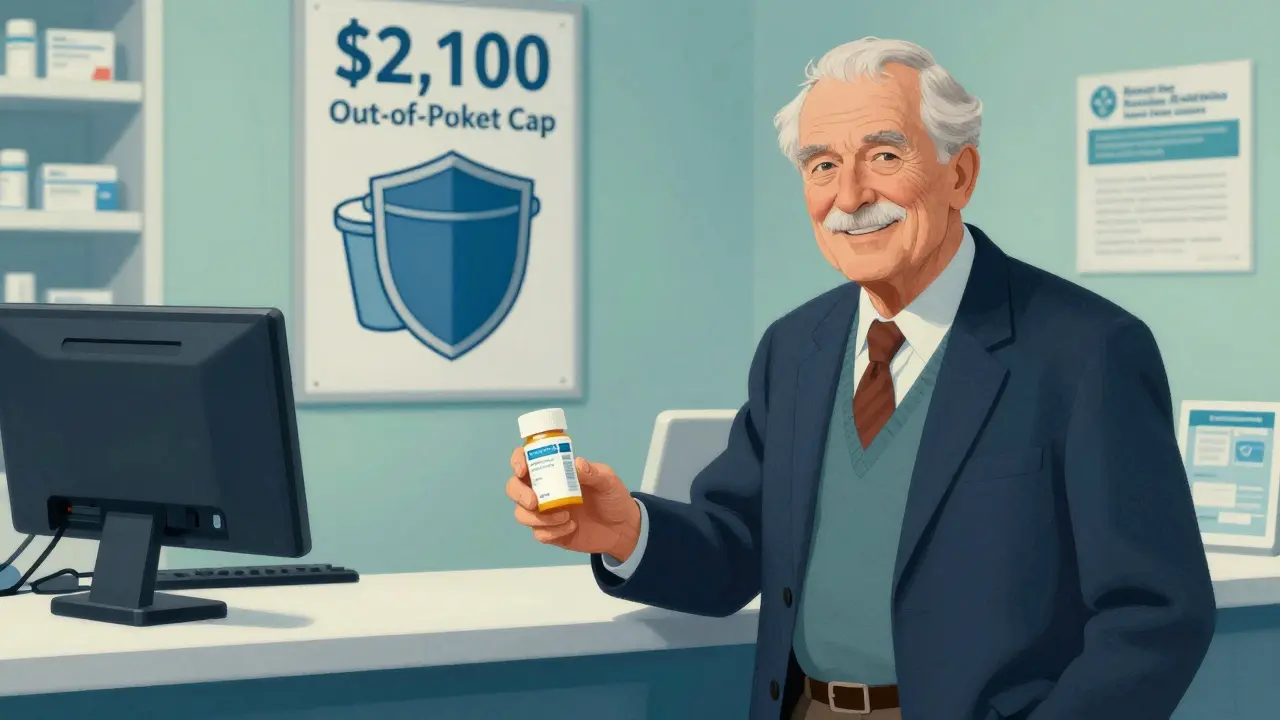
If you’re reading this in 2026, you’re benefiting from a massive shift in policy. The Inflation Reduction Act introduced a hard cap on annual out-of-pocket spending. For 2026, that cap is $2,100. Once you spend $2,100 on covered drugs (including deductibles, copays, and coinsurance), your plan pays 100% of the rest for the year.
How does this affect generics? It makes them even more valuable. Here is why:
- Faster Track to the Cap: Only the amount you actually pay counts toward the $2,100 limit for generics. If you pay $10 for a generic, $10 goes toward the cap. If you pay $50 for a brand, $50 goes toward the cap. While brands hit the cap faster per dose, generics keep your monthly bills predictable and low until you reach that threshold.
- No More Donut Hole Surprises: Previously, there was a gap in coverage where you paid full price. Now, after meeting the deductible (which was $615 in 2025 and may adjust slightly in 2026), you generally pay 25% coinsurance for generics until you hit the $2,100 limit. Then, it’s free.
- Predictability: Dr. Richard Frank, a former HHS official, noted that tiered structures reduce overall program spending by billions. For you, this means that sticking to Tier 1 generics keeps you far away from worrying about hitting that $2,100 ceiling early in the year.

Common Pitfalls with Generic Substitution
You’ve probably experienced this at the pharmacy counter: you hand over a prescription for "Lisinopril," and the pharmacist hands you back a pill bottle that says "Lisinopril" but looks different. Or worse, they tell you the plan doesn’t cover the specific manufacturer you asked for.
This is called therapeutic interchange or substitution. Federal law allows pharmacists to substitute a therapeutically equivalent generic unless the doctor writes "Dispense as Written." However, problems arise when your plan’s formulary only covers one specific generic manufacturer.
In 2024, analysis showed that 23% of formulary-related complaints involved these substitution issues. Imagine you’ve been taking Generic Brand A for years. Your plan updates its formulary and drops Brand A, keeping only Brand B. If your local pharmacy only stocks Brand A, you might face a delay or have to pay out of pocket while waiting for a refill. Always check your plan’s Formulary Finder tool online before enrolling. Enter your exact medication names to see if they are listed as "covered" or if there are restrictions like prior authorization.
How to Optimize Your Generic Savings in 2026
Don’t just accept the first plan offered. Use these strategies to ensure you’re getting the best deal on your generics:
1. Use the Medicare Plan Finder Tool
Kaiser Family Foundation research indicates that 61% of beneficiaries who use the official Medicare Plan Finder tool save an average of $427 annually. Why? Because they compare actual drug costs, not just monthly premiums. A plan with a $0 premium might charge $30 for your generic blood pressure med, while a plan with a $15 premium charges $5. Do the math.
2. Watch for Annual Notices of Change (ANOC)
Every fall, during Open Enrollment, your plan sends an ANOC. This document lists any changes to your formulary. CMS data shows that 37% of plans modify at least one generic drug’s tier placement each year. Your Tier 1 drug might move to Tier 2, costing you more next year. Read this letter carefully.
3. Consider Plans with $0 Deductibles
In 2025, 52% of stand-alone Prescription Drug Plans (PDPs) offered a $0 deductible. If you take multiple generics, skipping the deductible phase means you start saving immediately. Without a $0 deductible, you’d have to pay the full cost of your drugs until you hit the deductible amount (e.g., $500+), which adds up fast.
4. Ask About Authorized Generics
Sometimes, a brand-name manufacturer sells an "authorized generic"-the exact same pill, just without the brand logo. These accounted for 12% of generic prescriptions in 2024. They can sometimes be cheaper than other generics, but they might also be placed in a higher tier. Check if your plan treats authorized generics as preferred or non-preferred.
What If My Generic Isn’t Covered?
It happens. Maybe you moved, or maybe the plan changed its mind. If a necessary generic is missing from your formulary, you have rights. You can request a coverage determination or appeal. According to 2023 CMS data, 83% of such requests result in coverage approval. To do this:
- Contact your plan’s member services number.
- Ask your doctor to write a letter of medical necessity explaining why this specific generic is required (e.g., allergies to other formulations).
- Submit the request formally within the timeframe specified by your plan.
Don’t just stop taking your medication. The system is designed to protect you, but you have to advocate for yourself.
Looking Ahead: Standardization Efforts
The landscape is shifting. The Medicare Payment Advisory Commission (MedPAC) has recommended that CMS standardize generic tier placement across all plans to reduce confusion. Additionally, starting in 2026, plans are required to include a "generic price comparison tool" in their member portals. This should help you identify the lowest-cost alternatives instantly.
By 2030, the Congressional Budget Office projects that 94% of Part D prescriptions will be generic. As patents expire, more expensive brands will become affordable generics. Understanding how your formulary handles these transitions now will prepare you for those future savings.
Does Medicare Part D cover all generic drugs?
No, not automatically. While plans must cover at least two drugs in each therapeutic class, they do not have to cover every single generic available. They can exclude certain generics if they meet specific regulatory criteria, though they must cover all generics in six protected classes (like antidepressants and immunosuppressants). Always check your specific plan's formulary.
What is the difference between Tier 1 and Tier 2 generics?
The main difference is cost. Tier 1 generics are "preferred" by your insurance plan, meaning they have negotiated lower prices, resulting in smaller copays (often $0-$15). Tier 2 generics are "non-preferred," meaning the plan hasn't secured a special discount, so you may pay a higher copay or a percentage of the drug's cost.
How much can I spend on generics in 2026 before hitting the cap?
In 2026, the annual out-of-pocket cap for Medicare Part D is $2,100. This includes your deductible, copays, and coinsurance for both generic and brand-name drugs. Once you spend $2,100, you enter catastrophic coverage, where you pay $0 for covered medications for the rest of the year.
Can my pharmacist change my generic drug without asking me?
Yes, in most cases. Federal law allows pharmacists to substitute a therapeutically equivalent generic unless your doctor specifies "Dispense as Written." However, if your insurance plan only covers one specific generic manufacturer, the pharmacist may only be able to dispense that one, even if another generic is physically available.
When should I review my Medicare Part D formulary?
You should review your formulary during Annual Enrollment Period (October 15 - December 7) each year. Additionally, review it whenever you receive an Annual Notice of Change (ANOC) from your plan, as tier placements and coverage status for generics can change annually.
Write a comment
Latest Posts




Explore 10 Alternatives to Terbinafine in 2025
19/Mar/2025
Comments
Aswin Narayan J
29/May/2026listen up you idiots. the formulary is a menu and if you dont read it you starve. simple as that. stop crying about prices when you refuse to do the basic homework required to survive this system. i see people complaining every day because they picked a plan with a low premium and now they are paying $40 for their blood pressure meds. stupid.
Lenny Cruz
29/May/2026the notion that one should simply 'check the formulary' is a trivialization of a deeply flawed bureaucratic apparatus designed to obscure value rather than reveal it. furthermore, the tier system is not merely a pricing mechanism but a subtle instrument of behavioral conditioning, steering the masses toward pharmaceuticals that have been negotiated into submission by benefit managers who care little for therapeutic nuance. it is pretentious to suggest that a layperson can navigate this labyrinth without significant financial loss or cognitive fatigue. the real issue is the lack of standardization which forces patients to play a game of russian roulette with their health outcomes each enrollment period. one might argue that the $2100 cap is a band-aid on a gaping wound, offering a false sense of security while the underlying structure remains predatory. we are told to be grateful for the 'hard cap' yet ignore the fact that reaching it requires spending thousands out of pocket first. it is an elitist trap disguised as consumer protection.
Rachel Harrypersad
29/May/2026its all a construct really. the tiers are just social engineering in pill form. why do we accept that our worth is measured by how much we bleed financially for survival? the donut hole is gone but the void remains inside us. we chase the cap like a mirage in the desert of healthcare bureaucracy. meaningless.
Cathy N
29/May/2026i just want to say that checking the annual notice of change is super important. my mom missed hers last year and her generic statin went from tier 1 to tier 2. she was so confused at the pharmacy counter. please just read the letter they send in the fall. its not hard. thanks for sharing this info
Aishwarya Thankachan
29/May/2026OMG yes!! 🙌🏽 The ANOC is literally the bible for us seniors 😭 I swear half the population ignores it and then wonders why their copay jumped from $5 to $40 overnight! 💸 You HAVE to use the Plan Finder tool on Medicare.gov! It’s not rocket science 🚀 If your doc prescribes Lisinopril, make sure the specific manufacturer isn’t dropped next year! My aunt had to fight tooth and nail because her preferred generic was swapped and the new one gave her headaches 🤕 So annoying!! Always ask for 'Dispense as Written' if you’re sensitive to fillers! 💊✨ Don’t let them walk all over you! #MedicareTips #GenericDrugs #SaveMoney 💰
Jerry Mathews
29/May/2026hey everyone, just wanted to add that looking for plans with $0 deductibles is a huge win if you take multiple generics. i switched last year and saved like $400 right off the bat because i didnt have to pay full price until i hit a deductible threshold. its small steps but it adds up. hope this helps someone out there!
Jennifer Legore
29/May/2026What an absolutely brilliant breakdown of the 2026 changes! :) I am so impressed by the clarity regarding the Tier 1 vs Tier 2 distinctions. It is truly encouraging to see resources that empower beneficiaries to take control of their healthcare costs. We must remain vigilant during Open Enrollment! Let us support one another in navigating these complex formularies. Together, we can ensure no one is left behind due to confusion over drug tiers! :D Keep up the excellent work in educating the community!
Dave Villeneue
29/May/2026Your analysis is superficial. The core failure lies in the Pharmacy Benefit Manager's monopoly on negotiation leverage. You cite CMS data but ignore the systemic incentive structures that prioritize volume over clinical equivalence. Stop apologizing for the system.
Adelaide Motata
29/May/2026u ppl r so clueless. its obvious that if u dont check the formulary ur gonna get screwed. why do i even bother explaining this to people who cant be bothered to read a pdf. typical. also the spelling in this post is fine but ur comments r trash. get a life.
Francis Saul
29/May/2026man i totally agree with the part about authorized generics. sometimes they are cheaper but then they end up in a higher tier which is wild. i had to call my doctor to write a letter of medical necessity once because my plan dropped the brand i was used to. took forever but got it sorted. just dont give up guys. keep fighting for what works for u
Alyssa Zucker
29/May/2026i feel like so many people are scared to ask questions about their meds. it feels personal somehow. but reading this makes me feel a bit better. maybe i will look at my plan finder again this fall. it is overwhelming but necessary i guess.