

Imagine your esophagus as a smooth, protective tube. Now, imagine that the lining of this tube-which is supposed to be tough and squamous-starts changing into a different type of cell, similar to what you'd find in your intestines. This is Barrett's Esophagus is a precancerous condition where the distal esophagus is replaced by metaplastic columnar epithelium. . While it isn't cancer, it is the only known precursor to a dangerous cancer called esophageal adenocarcinoma. If you've been told you have this condition, the big question usually isn't just "what is it?" but "will it turn into cancer and how do I stop it?"
The reality is that most people with this condition won't develop cancer. However, for those who do, the stakes are high. Early detection via regular surveillance can push survival rates up to 80-90%, while late-stage diagnosis drops that number to a staggering 20%. The goal of modern medicine here is simple: find the "bad" cells early and remove them before they can grow into a tumor.
Who Is Most at Risk?
It doesn't happen to everyone who suffers from heartburn. In fact, only about 10-15% of people with chronic gastroesophageal reflux disease (GERD) actually develop this change in the lining. But certain factors tilt the scales. If you're over 50, male, or white/Caucasian, your statistical risk climbs. Obesity-specifically abdominal obesity-and a long history of GERD symptoms (occurring weekly for five years or more) are major red flags.
Interestingly, some things don't play the role you'd expect. While many assume alcohol is a primary driver, evidence suggests it doesn't actually increase the risk of developing the condition. Even more surprising? An infection of Helicobacter pylori (H. pylori) might actually lower the risk because it damages the cells that produce the stomach acid that causes the damage in the first place.
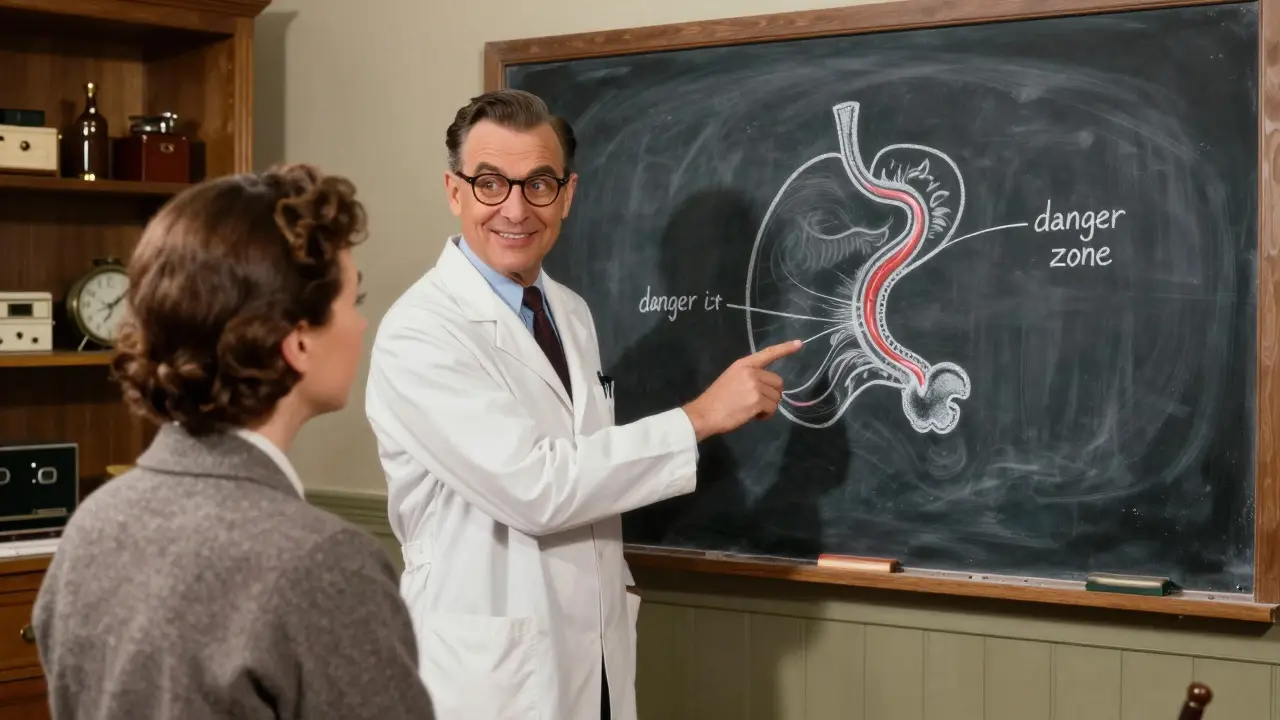
The Danger Zone: What is Dysplasia?
Not all cases of Barrett's are created equal. Doctors categorize the condition based on Dysplasia is the presence of abnormal cells within the lining of the esophagus that may eventually become cancerous. . This is where the risk of cancer really starts to accelerate.
- Non-dysplastic: The cells have changed, but they aren't "precancerous" yet. The risk of progressing to cancer is low, about 0.2% to 0.5% per year.
- Low-grade dysplasia (LGD): This is the first warning sign. The cells look abnormal under a microscope. The risk of progression jumps to 6-19% per year.
- High-grade dysplasia (HGD): This is the critical stage. The cells are very abnormal. The risk of turning into adenocarcinoma climbs to 23-40% per year.
Physical factors also matter. If the affected segment of your esophagus is longer than 3cm, or especially longer than 10cm, the risk of progression is significantly higher. Persistent acid exposure-even while taking medication-can also act like fuel on a fire, increasing the risk by over seven times.
Ablation: Removing the Threat
When dysplasia is found, doctors don't just watch and wait. They use radiofrequency ablation or other endoscopic therapies to "burn away" the abnormal lining, allowing healthy tissue to grow back. This is often called Endoscopic Eradication Therapy.
The gold standard today is Radiofrequency Ablation (RFA) is a procedure that uses high-frequency alternating current to thermally destroy abnormal esophageal tissue. . Using tools like the HALO360 catheter, doctors can treat the esophagus in a circular fashion. It's highly effective, with some trials showing nearly 88% eradication of dysplasia within a year.
Then there is Cryoablation is a technique that uses extreme cold, typically nitrous oxide, to freeze and destroy abnormal cells. . While slightly less effective at totally clearing the area than RFA, it is often safer for people who have already developed strictures (narrowing of the esophagus).
| Method | Primary Tool | Efficacy (Dysplasia Eradication) | Stricture Risk | Best For... |
|---|---|---|---|---|
| RFA | HALO Catheters | ~88% | Moderate (6.2%) | First-line, standard care |
| Cryoablation | Barrx CryoBalloon | ~82% | Low (2.8%) | Patients with prior strictures |
| PDT | Photofrin / Laser | ~77% | High (17%) | Specific visible lesions |
| EMR | Endoscopic Snare | ~93% (small lesions) | Low to Moderate | Large, visible polyps/lesions |
The Trade-offs: Efficacy vs. Side Effects
No procedure is without a catch. The biggest worry with ablation is the development of a stricture. This is essentially internal scarring that narrows the esophagus, making it hard to swallow. About 32% of RFA patients end up needing a "dilation" procedure-where the doctor uses a balloon to stretch the esophagus back open. Some patients describe the chest pain during these dilations as being worse than the original reflux symptoms.
Cost is another factor. RFA is generally more expensive per session (averaging around $12,450) compared to cryoablation. However, because RFA usually requires fewer repeat treatments, it ends up being roughly equal in cost over five years. The most important thing is the outcome: reducing the risk of cancer by up to 90% compared to just doing check-ups.

What to Expect During Treatment
If you're scheduled for ablation, it isn't a one-and-done deal. Most people require an average of 2.3 sessions to get complete eradication. To make this work, doctors use high-definition endoscopy and Narrow-Band Imaging (NBI) is an imaging technology that enhances the visualization of blood vessels and abnormal tissue. , which helps them see the abnormal areas much more clearly than standard white light.
Post-procedure care is also critical. The latest standards suggest that combining ablation with high-dose proton pump inhibitors (PPIs), such as esomeprazole, significantly cuts the risk of the abnormal cells coming back. In one trial, this combination dropped the recurrence rate from nearly 25% down to about 8%.
The Future of Barrett's Management
We are moving toward a world where we don't have to treat everyone. Currently, there is a bit of a controversy: about 25-30% of patients might be getting ablation they don't actually need because different pathologists disagree on whether a sample is "low-grade" or not. To fix this, researchers are looking into TFF3 methylation testing is a molecular biomarker test used to determine the actual risk of progression to cancer. . This could potentially eliminate unnecessary procedures for thousands of people.
Artificial intelligence is also entering the room. New AI-assisted tools are showing a 94% accuracy rate in detecting dysplasia, which is far better than the 78% average seen in community clinics. Between smarter detection and more precise ablation tools, the goal is a 45% reduction in esophageal cancer deaths by 2035.
Does everyone with Barrett's Esophagus need ablation?
No. Most people with non-dysplastic Barrett's only need regular surveillance (endoscopies) to monitor for changes. Ablation is typically reserved for those with confirmed low-grade or high-grade dysplasia to prevent the progression to cancer.
What is the difference between RFA and Cryoablation?
RFA uses heat to destroy abnormal cells and is generally more effective at complete eradication. Cryoablation uses extreme cold to freeze the cells; while slightly less effective overall, it has a lower risk of causing strictures (scarring).
How do I know if I have a stricture after ablation?
The most common sign is difficulty swallowing (dysphagia), where food feels like it is "stuck" in your chest. If you notice this after a procedure, you should contact your gastroenterologist immediately for a potential dilation.
Can diet and medication cure Barrett's Esophagus?
Medications like PPIs cannot "cure" or reverse the cellular change already present, but they are essential for controlling the acid that causes the condition to progress. Diet and lifestyle changes help manage symptoms but cannot remove the metaplastic cells.
What is the success rate of these procedures?
Success rates for eradicating dysplasia are high, with RFA achieving around 88% and Cryoablation around 82% in major trials. However, success is measured by the removal of abnormal cells, not necessarily the total reversal of the Barrett's condition.
Write a comment
Latest Posts




Comments
Betty Kawira
26/Apr/2026Just a heads up for anyone reading this, if you're on PPIs and still feel that burn, definitely bring up the NBI endoscopy with your doc. It's way more precise than the old school white light ones and can catch those tiny areas of dysplasia that otherwise get missed. Also, don't let the 'stricture' part scare you too much-dilations are quick and most people bounce back fast.
Darrin Oneto
26/Apr/2026man that HALO thing sounds like some wild sci-fi gear lol. hope it dont leave too many scars in there.
Abhishek Charan
26/Apr/2026The statistics presented are simply too optimistic!!! 🙄 One must wonder why the variance in pathology is ignored... it is a massive flaw in the current medical system!!! 🚩🚩🚩
Amber McCallum
26/Apr/2026Your body is just telling you that you're out of balance. All these machines and burns are just avoiding the real problem of how we live our lives. We need to even out our spirits first.
Michael Yoste
26/Apr/2026I totally get how scary this is, but trust me, the medical route is the only way. I've seen so many people try the "natural" path only to end up in the ER when it's too late. Just follow the doctors, honey.
Timothy Brown
26/Apr/2026Honestly, the whole 'waiting' game for non-dysplastic cases is just anxiety fuel. Just get the ablation and be done with it.
prince king
26/Apr/2026It's honestly amazing how far medical tech has come! 🌟 Imagine being able to just freeze or burn away the bad cells before they even become a problem. It gives me so much hope for the future of healthcare for everyone! 😊✨
Jarrett Jensen
26/Apr/2026The prose of this piece is remarkably pedestrian, and the lack of nuanced discussion regarding the molecular pathways of metaplasia is quite disappointing. One would expect a more rigorous academic approach when discussing such a critical pathology, rather than this simplified summary which caters to the lowest common denominator. It is truly an exercise in mediocrity.
Angela Cook
26/Apr/2026USA has the best medical tech in the world! PERIOD. Why are people even questioning the RFA gold standard when we literally invented the most efficient ways to treat this? Get it done in a US hospital or you're just gambling with your life!
lalit adesara
26/Apr/2026Science is a tool. Only a fool ignores the soul. Too much tech, too little wisdom.
Sharon Mathew
26/Apr/2026Oh please! As if an 88% success rate is something to brag about! That means 12% of people are just left with a mess in their throat! Absolutely terrifying!
Nigel Gosling
26/Apr/2026What a tragic comedy we live in! We spend thousands of dollars to burn our own insides just to avoid a slightly higher chance of a tumor! It's the height of absurdity, really, this desperate scramble to outrun the inevitable decay of the human form! My god, the sheer irony of it all is just breathtaking!
Aubrey Johnson
26/Apr/2026The distinction between LGD and HGD is the only part of this that actually matters. Everything else is just noise for people who can't handle the facts.
Jonathan Hall
26/Apr/2026While I understand the urgency to implement these high-tech solutions across the board, we must be incredibly mindful of how different cultures approach end-of-life care and chronic illness, because if we just push these expensive American-style interventions without considering the holistic and social impact on the patient's family structure, we are essentially engaging in a form of medical imperialism that ignores the patient's mental wellbeing in favor of a clinical statistic, and frankly, it's an aggressive way to handle healthcare.