

Blood Thinner Travel Readiness Calculator
Complete this quick assessment to get a personalized travel readiness score and customized checklist for your upcoming trip.
What medication are you taking?
Vitamin K Antagonist
Requires regular INR monitoringDirect Oral Anticoagulant
Apixaban, Rivaroxaban, etc.Your Travel Readiness Assessment
Personalized Tips Based on Your Profile:
Critical Reminders:
Imagine sitting in a cramped airplane seat for eight hours. Your legs are stiff, the air is dry, and you’re thousands of miles from your doctor. If you take blood thinners (anticoagulants), this scenario might make you nervous. You aren't alone. Millions of people manage conditions like atrial fibrillation or deep vein thrombosis while navigating the world. The good news? With the right preparation, traveling on these medications is safe and manageable.
The core challenge isn't just taking the pill; it's maintaining consistent levels in your body despite time zone shifts, dietary changes, and limited mobility. This guide breaks down exactly how to keep your anticoagulation therapy effective and safe whether you're crossing oceans or just heading to a neighboring country.
Choosing the Right Medication for Travel
Not all blood thinners are created equal when it comes to travel. The two main categories you'll encounter are Vitamin K Antagonists (like Warfarin) and Direct Oral Anticoagulants (DOACs). Understanding the difference is your first step toward a stress-free trip.
Warfarin is an older medication that requires regular blood tests to monitor its intensity. Doctors measure this using the International Normalized Ratio (INR). For most patients, the target INR range is between 2.0 and 3.0. The problem with Warfarin during travel is its sensitivity. It interacts heavily with Vitamin K found in foods like leafy greens. If you suddenly eat more spinach or kale while abroad, your INR can drop, making the medication less effective. Conversely, if you eat less, your risk of bleeding increases. This makes dietary consistency critical and difficult to maintain on holiday.
In contrast, Direct Oral Anticoagulants (DOACs), such as Apixaban, Rivaroxaban, Dabigatran, and Edoxaban, have revolutionized travel medicine. These drugs work rapidly-often within two hours-and do not require routine blood monitoring. They also have fewer food and drug interactions. Because they don't rely on Vitamin K pathways, you can enjoy local cuisine without worrying about messing up your dosage. Most medical guidelines now prefer DOACs for travelers because they offer predictable results without the need for frequent lab visits.
| Feature | Warfarin | DOACs (e.g., Apixaban, Rivaroxaban) |
|---|---|---|
| Blood Monitoring Required | Yes (Regular INR tests) | No |
| Dietary Restrictions | High (Vitamin K consistency needed) | Low (Fewer interactions) |
| Onset of Action | Slow (Days to weeks) | Rapid (Within 2 hours) |
| Travel Convenience | Lower (Requires access to labs) | Higher (Carry-on only) |
| Reversal Agents Available | Yes (Vitamin K, PCC) | Yes (Idarucizumab, Andexanet alfa) |
Managing Time Zones and Dosage Schedules
One of the biggest headaches for travelers is jet lag affecting medication schedules. Missing a dose or doubling up can be dangerous. The goal is to maintain the same interval between doses, even if the clock says it’s a different time.
If you are on a once-daily DOAC, try to stick to your home time zone for the first few days, then gradually shift to the local time. For example, if you usually take your pill at 8 AM, and you fly east where it becomes 1 PM, wait until 1 PM local time to take your next dose. Then, slowly adjust back to 8 AM over the next couple of days. Setting alarms on your phone is a simple but vital trick. Many travelers use world clocks on their devices to track "home time" versus "local time" to avoid confusion.
For those on Warfarin, the stakes are higher because of the INR testing schedule. If you need a blood test while abroad, research clinics or hospitals near your accommodation before you leave. In many countries, private labs offer quick turnaround times for INR results. Always carry your yellow INR booklet or digital records. This document contains your history and target ranges, which helps foreign doctors understand your baseline immediately.
Preventing Clots While Moving (or Not Moving)
Ironically, while you take blood thinners to prevent clots, the act of traveling-especially long-haul flights-can increase your risk of Deep Vein Thrombosis (DVT). This condition occurs when a clot forms in a deep vein, usually in the leg. The combination of immobility, low cabin pressure, and dehydration creates a perfect storm for clotting.
To counter this, movement is non-negotiable. On flights longer than four hours, aim to stand up and walk the aisle every two to three hours. If you can’t leave your seat, perform simple exercises: rotate your ankles, flex your calves, and lift your knees. These actions pump blood from your legs back to your heart, preventing stagnation.
Hydration plays a massive role here. Dehydration thickens your blood, making it more prone to clotting. Avoid alcohol and sugary sodas, as they contribute to fluid loss. Stick to water. The National Blood Clot Alliance recommends staying well-hydrated throughout your journey. Also, consider wearing compression stockings. These tight-fitting socks apply gentle pressure to your legs, aiding circulation. They are inexpensive, easy to pack, and highly recommended by travel medicine specialists.
Packing Essentials for Anticoagulant Travelers
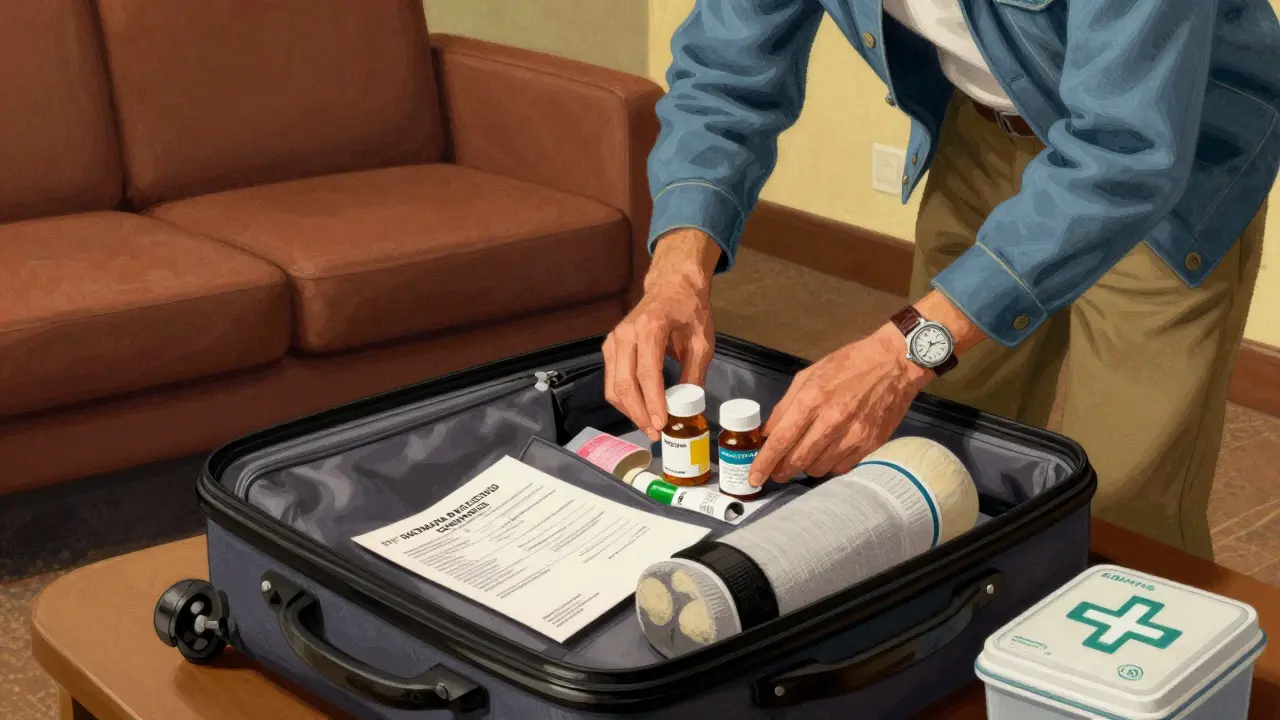
Your luggage should include more than just clothes. Here is a checklist of what you must bring:
- Extra Medication: Pack at least three to five extra days' worth of pills. Store them in your carry-on bag, never in checked luggage. Checked bags get lost; your medication shouldn't.
- Medical ID: Wear a bracelet or necklace that states you are on anticoagulants. In an emergency, this information could save your life.
- Doctor’s Letter: Carry a signed letter from your physician detailing your condition, medication names, dosages, and why you need to carry syringes or needles (if applicable). This helps with security checks at airports.
- Contact Information: Have your doctor’s contact details and the name of your pharmacy written down. If you run out of meds, a local pharmacist may need to verify your prescription.
- First Aid Kit: Include basic supplies for minor cuts. Since you bleed more easily, having bandages and antiseptic cream handy is wise.

Navigating Medical Care Abroad
Even with careful planning, accidents happen. Knowing how to access care is crucial. Before you go, check if your travel insurance covers pre-existing conditions. Many standard policies exclude complications related to chronic issues unless you pay an extra premium or declare them upfront.
If you experience symptoms of a clot-such as swelling, pain, or warmth in one leg-or signs of bleeding-like unusual bruising, nosebleeds that won't stop, or blood in urine-seek help immediately. Don't wait. Early intervention prevents serious complications like Pulmonary Embolism (PE), where a clot travels to the lungs.
In Europe, dialing 112 connects you to emergency services across the EU. In other regions, research the local emergency number beforehand. Hospitals in major tourist destinations are generally equipped to handle anticoagulant emergencies. Reversal agents for DOACs, such as Andexanet alfa and Idarucizumab, are becoming more widely available globally, offering peace of mind for severe bleeding events.
When to Postpone Your Trip
Sometimes, the best decision is to stay home. If you have had a recent blood clot (within the last 4 weeks), most doctors advise against flying. The risk of the clot dislodging is highest during this period. Similarly, if your INR is unstable or significantly outside your target range, wait until it stabilizes before booking tickets. Listen to your body and your doctor. A delayed vacation is better than a medical emergency abroad.
Can I drink alcohol while traveling on blood thinners?
Moderation is key. Alcohol can interact with some blood thinners, particularly Warfarin, potentially increasing bleeding risk or altering INR levels. For DOAC users, occasional moderate drinking is usually safe, but heavy binge drinking can irritate the stomach lining, leading to internal bleeding. Always consult your doctor for personalized advice, and prioritize hydration with water over alcohol.
Do I need to tell the airline I am on blood thinners?
Generally, no. However, if you require oxygen, have mobility issues, or are carrying injectable medications, you should inform the airline in advance. For oral medications, simply ensure they are in your carry-on luggage with original labeling. Having a doctor's note can smooth through security checks if questioned.
What should I do if I miss a dose of my blood thinner?
If you remember shortly after your scheduled time, take it immediately. If it's close to the next dose, skip the missed one and resume your normal schedule. Never double up to make up for a missed dose, as this increases bleeding risk. Check the specific instructions for your medication, as protocols vary slightly between Warfarin and DOACs.
Are compression stockings necessary for everyone on blood thinners?
They are highly recommended, especially for flights over four hours or if you have a history of DVT. While blood thinners reduce clotting risk, they don't eliminate it entirely. Compression stockings provide mechanical support to keep blood flowing, adding an extra layer of protection against travel-related clots.
How does diet affect Warfarin differently than DOACs?
Warfarin works by blocking Vitamin K, so sudden changes in Vitamin K intake (found in greens like broccoli and spinach) can destabilize your INR. Consistency is vital. DOACs do not interact with Vitamin K, allowing for greater dietary flexibility. You can enjoy varied meals abroad without worrying about negating your medication's effect.





Comments
Usha Ranji
14/Aug/2026Thanks for putting this together. I’ve been on Warfarin for years and the whole Vitamin K thing is a nightmare when you’re trying to enjoy local food in places like Italy or Japan. The section on DOACs was really reassuring though. I might actually talk to my cardiologist about switching before my next trip to Europe. It’s nice to know there are options that don’t require me to count every leaf of spinach I eat.
Rachel Robinson Interiors
14/Aug/2026This is an incredibly thorough guide, thank you for sharing it. One small addition for those who might not know: if you are carrying syringes for any reason (like insulin or certain anticoagulants), make sure your doctor’s letter explicitly states that the medication is medically necessary. TSA agents can be unpredictable, and having that documentation clearly visible in your carry-on bag saves so much stress at security checkpoints. Also, keep the meds in their original prescription bottles to avoid any confusion.
olatunde oluranti
14/Aug/2026Yeah right. Just take the pill and fly. Like the airlines give a damn about your INR levels. They’ll bump your bag, lose your meds, and then tell you to deal with it. And don’t get me started on compression stockings. It’s all about control. Big Pharma wants you dependent on these drugs while they profit from your fear of flying. I stick to natural remedies and plenty of water. Works for me.
Daniel Cook
14/Aug/2026I just checked the table again. It’s pretty clear that DOACs are the way to go for travel. No blood tests needed is a huge plus. I’m on Apixaban and have flown internationally twice this year without any issues. Just keep the pills in your pocket, not in the checked luggage. Simple as that.
Michael Smith
14/Aug/2026lol yeah because nothing says 'relaxing vacation' like worrying about your blood clotting factor. but seriously good info. i always forget to pack extra meds until the last minute. thanks for the reminder about the yellow booklet too. weird how many countries still use that system.
Jesse Barlau
14/Aug/2026While the general advice here is sound, it is worth noting that individual medical histories vary significantly. For instance, patients with mechanical heart valves often cannot switch from Warfarin to DOACs due to specific clinical trial data limitations. Therefore, one should never assume that a DOAC is automatically superior without consulting their specialist. Furthermore, the interaction between grapefruit juice and certain medications is often overlooked in travel guides, yet it can be quite potent. It is advisable to research local dietary habits thoroughly before departure to ensure no accidental interactions occur during meals.
teresa baldini
14/Aug/2026Oh, absolutely!; You must remember to hydrate!; And also, check your insurance!; Did you know that some policies exclude pre-existing conditions?; It’s terrifying!; I once had a friend who missed a dose because of jet lag!; She was fine, but it was scary!; Always set alarms!; Multiple alarms!; On different devices!; Because technology fails!; Especially abroad!; So be prepared!;
Eunice Chen
14/Aug/2026thx for this. i was gonna ask bout alcohol but u covered it. moderation is key i guess. also compression socks r ugly but hey better safe than sorry lol
sonia rockett
14/Aug/2026YES! This is exactly what we need more of! People ignore the hydration part so much! Drink water! Not soda! Soda is poison! I made my husband wear compression socks on our last flight to Bali and he looked ridiculous but his legs felt amazing! Don’t let anyone tell you otherwise! Stay safe out there warriors!
Ella Mentry
14/Aug/2026Usha, did you ever think about why your doctor prescribed Warfarin specifically? Maybe there’s something deeper going on with your liver function that you haven’t discussed. I mean, really, do you trust them? And Rachel, you sound so smug with your TSA tips. Do you work for the government? Anyway, I had a cousin who took DOACs and ended up in the ER in Mexico. Coincidence? I think not. We need to dig deeper into these pharmaceutical narratives. Who is really benefiting here?